
Diastereotopic protons in a predicted spectrum
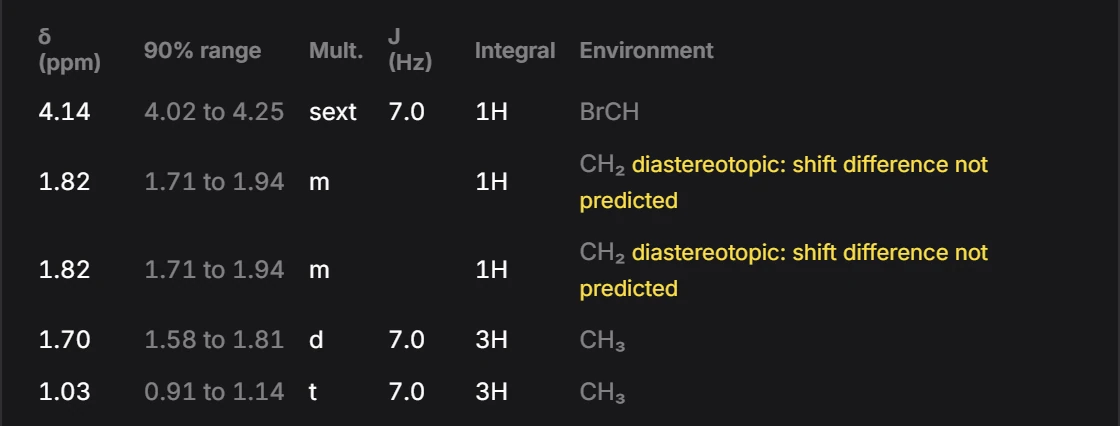
When the two protons of a CH2 are diastereotopic, for example next to a stereocenter, the 1H table lists them as two 1H rows marked "diastereotopic: shift difference not predicted". Both get the same predicted shift.
Two protons on the same CH2 are diastereotopic when replacing each in turn would give diastereomers, typically because the molecule has a stereocenter. In a real spectrum they can have different shifts and couple to each other.
How the prediction shows them
Predict the 1H NMR of a structure with such a CH2, for example 2-bromobutane. See How to predict a 1H NMR spectrum.
The table lists the two protons as two rows of 1H each, and the Environment column marks both diastereotopic: shift difference not predicted.
Prediction
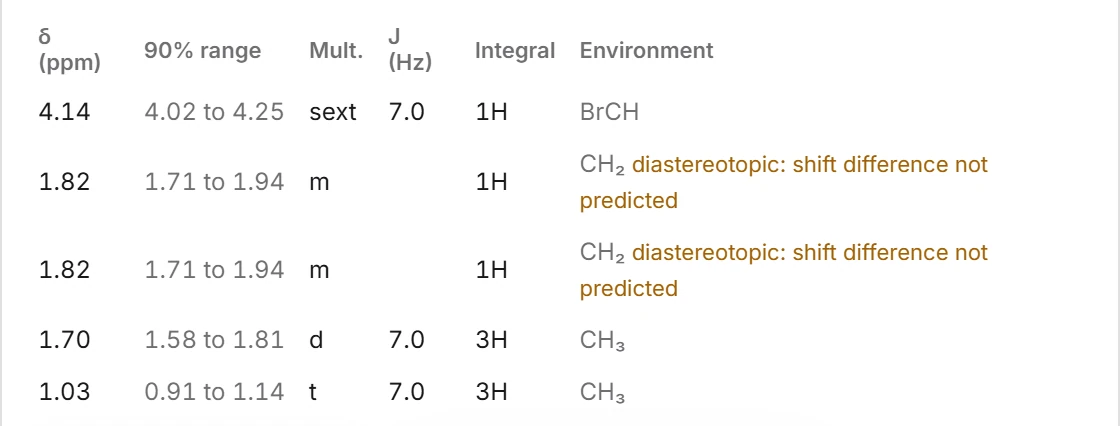
Both rows carry the same predicted shift and the same 90% range. The model predicts one shift for the pair; the split between them is not predicted, so do not read a difference into the two rows. In a measured spectrum they may appear as two separate multiplets.
Multiplicities and J values are Athanor's first-order estimate, not part of the prediction. See How accurate are the NMR predictions.
Is this helpful?
Last updated Nov 12, 2026
- Still stuck? Read the FAQ or contact support.
- Something wrong on this page? Tell us.
- For AI tools: llms.txt