
Ornithine
Athanor · official
C5H12N2O2 · 132.16 g/mol
IUPAC name: (2S)-2,5-diaminopentanoic acid
Also called L-ornithine, urea cycle
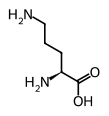
Names and identifiers
- IUPAC name
- (2S)-2,5-diaminopentanoic acid
- Synonyms
- L-ornithine, urea cycle, (S)-2,5-Diaminopentanoic acid
+ 35 more
(S)-Ornithine, (S)-2,5-diaminovaleric acid, (2S)-2,5-diaminopentanoic acid, (S)-alpha,delta-Diaminovaleric acid, Ornitina, (+)-S-Ornithine, Ornithinum, (S)-2,5-Diaminopentanoate, L-(-)-Ornithine, NSC-758894, E524N2IXA3, CHEBI:15729, DTXSID00883219, CHEBI:18257, DTXSID00860383, RefChem:856923, 2,5 Diaminopentanoic Acid, A05BA06, DTXCID40197342, DTXCID201022768, (2S)-2,5-diaminopentanoate;hydron, 200-731-7, 2,5-Diaminopentanoate, 2,5-Diaminovaleric acid, Ornithine [INN], Ornithinum [Latin], Ornitina [Spanish], L-Norvaline, 5-amino-, Ornithine (VAN), Pentanoic acid, 2,5-diamino-, (S)-, ORNITHINE, L-, MFCD00242584, BRN 1722298, Ornithine, (L)-Isomer, Ornithine (INN)
- Molecular formula
- C5H12N2O2
- Empirical formula
- C5H12N2O2
- Molecular weight
- 132.16 g/mol
- Exact mass
- 132.08988
- CAS number
- 70-26-8
- PubChem CID
- 6262
- Canonical SMILES
- C(CC(C(=O)O)N)CN
- Isomeric SMILES
- C(C[C@@H](C(=O)O)N)CN
- InChI
- InChI=1S/C5H12N2O2/c6-3-1-2-4(7)5(8)9/h4H,1-3,6-7H2,(H,8,9)/t4-/m0/s1
- InChIKey
- AHLPHDHHMVZTML-BYPYZUCNSA-N
- Molfile
Names, InChI and the identifiers from PubChem, retrieved 2026-10-14.
Calculated
- Heavy atoms
- 9
- Rings
- 0
- Aromatic rings
- 0
- Fraction sp³ carbons (Fsp3)
- 0.8
- H-bond donors
- 3
- H-bond acceptors
- 3 computed here · PubChem 4
- Rotatable bonds
- 4
- TPSA (Ų)
- 89.3
- Formal charge
- 0
- XLogP3
- -4.4 PubChem
- Complexity
- 95 PubChem
- Stereocenters
- 1 definedCIP: C5: S
- Double-bond geometry
- None specified
- Point group
- C1 of one 3D conformer with its hydrogens, by Athanor’s engine (as in the app)
Elemental analysis
- C45.44%
- H9.15%
- N21.20%
- O24.21%
Isotope pattern
Each peak is a nominal mass with its abundance-weighted exact mass, as a percentage of the tallest, from IUPAC natural isotope abundances.
Computed from the structure with RDKit 2026.09 when this page was built, beside PubChem's own computed values from its record; where the two differ, both are shown.
Predicted
- log P
- -0.86 Crippen (Wildman and Crippen 1999)
- log S (water solubility)
- 0.15 ESOL (Delaney 2004), log mol/L
- Synthetic accessibility
- 2.56 SA score, 1 easy to 10 hard (Ertl and Schuffenhauer 2009)
Drug-likeness: Lipinski’s rule of five
- Molecular weight ≤ 500: 132.16
- log P ≤ 5 (Crippen): -0.86
- H-bond donors ≤ 5: 3
- H-bond acceptors ≤ 10: 3
Passes all four rules.
¹³C NMR shifts, predicted
Predictions, not measurements; each names its method. A measured log P, where a source reports one, is under Physical properties.
Safety
This chemical does not meet GHS hazard criteria for 100% (6 of 6) of all reports.[1]
Safety data sheets on the supplier’s page: Angene Chemical, AppChem, Alfa Chemistry.
Always read the supplier’s safety data sheet before working with it.
Spectra
- 1H NMRHuman Metabolome Database (HMDB) (Varian · 500 MHz · Water) · Human Metabolome Database (HMDB) (Bruker · D2O) · SpectraBase
- 13C NMRHuman Metabolome Database (HMDB) (Bruker · 125 MHz · Water) · Human Metabolome Database (HMDB) (400 MHz · H2O) · SpectraBase
- 1H-1H NMRHuman Metabolome Database (HMDB)
- 1H-13C NMRHuman Metabolome Database (HMDB) (Bruker · 600 MHz · Water)
- GC-MSHuman Metabolome Database (HMDB) (GC-MS) · Human Metabolome Database (HMDB) (GC-MS) · Human Metabolome Database (HMDB) (GC-MS) · Human Metabolome Database (HMDB) (GC-MS) · Human Metabolome Database (HMDB) (EI-B · positive) · Human Metabolome Database (HMDB) (GC-EI-TOF · positive)
- MS-MSHuman Metabolome Database (HMDB) (Positive) · Human Metabolome Database (HMDB) (Positive) · Human Metabolome Database (HMDB) (Positive) · Human Metabolome Database (HMDB) (Positive) · Human Metabolome Database (HMDB) (Positive) · Human Metabolome Database (HMDB) (Positive)
- LC-MSMassBank Europe (Agilent 6530 QTOF · LC-ESI-QTOF · POSITIVE) · MassBank Europe (Agilent 6530 QTOF · LC-ESI-QTOF · POSITIVE) · MassBank Europe (Agilent 6530 QTOF · LC-ESI-QTOF · POSITIVE) · MassBank Europe (API3000, Applied Biosystems · LC-ESI-QQ · NEGATIVE) · MassBank Europe (API3000, Applied Biosystems · LC-ESI-QQ · NEGATIVE) · MassBank Europe (API3000, Applied Biosystems · LC-ESI-QQ · NEGATIVE)
- Other MSMassBank Europe (GCMS-2010 Plus, Shimadzu · EI-B · POSITIVE) · MassBank Europe (X500R QTOF (AB Sciex LLC, USA) · ESI-QTOF · POSITIVE) · MassBank Europe (X500R QTOF (AB Sciex LLC, USA) · ESI-QTOF · POSITIVE) · MassBank Europe (X500R QTOF (AB Sciex LLC, USA) · ESI-QTOF · POSITIVE) · MassBank Europe (X500R QTOF (AB Sciex LLC, USA) · ESI-QTOF · POSITIVE) · MassBank Europe (X500R QTOF (AB Sciex LLC, USA) · ESI-QTOF · POSITIVE)
Experimental spectra held by these sources; each link opens the source's own record.
Literature
Reading PubChem, OpenAlex and GSRS…
Bioactivity
Reading ChEMBL…
References
- [1]European Chemicals Agency (ECHA) · ECHA legal notice: reuse with acknowledgement · via PubChem · retrieved 2026-10-14
- [2]Human Metabolome Database (HMDB) · Linked only · via PubChem · retrieved 2026-10-14
- [3]SpectraBase · Linked only · via PubChem · retrieved 2026-10-14
- [4]MassBank Europe · Linked only · via PubChem · retrieved 2026-10-14
- [5]MassBank of North America (MoNA) · CC BY 4.0 · via PubChem · retrieved 2026-10-14
- ·Calculated values: computed by Athanor with RDKit 2026.09 from the structure.
- ·Literature on PubChem
Data last updated 2026-10-14.