
Aspartic acid
Athanor · official
C4H7NO4 · 133.1 g/mol
IUPAC name: (2S)-2-aminobutanedioic acid
Also called aspartate, L-aspartic acid
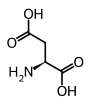
Names and identifiers
- IUPAC name
- (2S)-2-aminobutanedioic acid
- Synonyms
- aspartate, L-aspartic acid, (2S)-2-aminobutanedioic acid
+ 36 more
Asparagic acid, L-Aminosuccinic acid, (S)-2-Aminosuccinic acid, Asparaginic acid, L-Asparaginic acid, L-Asparagic acid, (S)-Aspartic acid, Aspartic acid, L-, (S)-Aminobutanedioic acid, L-Asparaginsaeure, Acidum asparticum, L-(+)-Aspartic acid, Asparaginsaeure, Acido aspartico, 2-aminosuccinic acid, Acide aspartique, Aminosuccinic acid, Butanedioic acid, amino-, (S)-, (L)-ASPARTIC ACID, Deamidated asparagine, (S)-2-aminobutanedioic acid, 30KYC7MIAI, FEMA NO. 3656, CHEBI:17053, DTXSID7022621, NSC3973, (3S)-3-azaniumyl-4-hydroxy-4-oxobutanoate, CHEBI:22660, l aspartic acid, Aspartate, Sodium, aspartate magnesium, Aspartate, Calcium, Aspartate, Ammonium, Aspartate, Disodium, Aspartate, Magnesium, Aspartate, Potassium
- Molecular formula
- C4H7NO4
- Empirical formula
- C4H7NO4
- Molecular weight
- 133.1 g/mol
- Exact mass
- 133.03751
- CAS number
- 56-84-8
- PubChem CID
- 5960
- Canonical SMILES
- C(C(C(=O)O)N)C(=O)O
- Isomeric SMILES
- C([C@@H](C(=O)O)N)C(=O)O
- InChI
- InChI=1S/C4H7NO4/c5-2(4(8)9)1-3(6)7/h2H,1,5H2,(H,6,7)(H,8,9)/t2-/m0/s1
- InChIKey
- CKLJMWTZIZZHCS-REOHCLBHSA-N
- Molfile
Names, InChI and the identifiers from PubChem, retrieved 2026-10-14.
Physical properties
- Appearance
- White, crystalline solid[3]
3 values
From Hazardous Substances Data Bank (HSDB), the most authoritative source here.
Value As written Source – Dry Powder [1] EPA Chemical Data Reporting (CDR) – COLOURLESS CRYSTALS. [2] ILO-WHO International Chemical Safety Cards (ICSCs) –shown White, crystalline solid [3] Hazardous Substances Data Bank (HSDB)cites Ashford, R.D. Ashford's Dictionary of Industrial Chemicals. London, England: Wavelength Publications Ltd., 1994., p. 97 - Melting point
- 270 °C[2]
- Density
- 1.7 g/cm³[2]
- Solubility in water
- Solubility in water, g/100ml: 0.45[2]
2 values
From ILO-WHO International Chemical Safety Cards (ICSCs), the most authoritative source here.
Value As written Source – In water, 5,360 mg/L at 25 °C [3] Hazardous Substances Data Bank (HSDB)cites Yalkowsky, S.H., He, Yan., Handbook of Aqueous Solubility Data: An Extensive Compilation of Aqueous Solubility Data for Organic Compounds Extracted from the AQUASOL dATAbASE. CRC Press LLC, Boca Raton, FL. 2003., p. 105 –shown Solubility in water, g/100ml: 0.45 [2] ILO-WHO International Chemical Safety Cards (ICSCs) - log P
- -3.89[2]
2 values
2 of 2 sources agree on it (most common value).
Value As written Source – log Kow = -3.89 [3] Hazardous Substances Data Bank (HSDB)cites Chmelik J et al; Coll Czech Chem Commun 56: 2030-2041 (1991) –shown -3.89 [2] ILO-WHO International Chemical Safety Cards (ICSCs) - pKa
- pK1 = 1.92 (COOH)[3]
3 values
Only one source reports it.
Value As written Source –shown pK1 = 1.92 (COOH) [3] Hazardous Substances Data Bank (HSDB)cites Sergeant EP, Dempsey B; Ionisation constants of organic acids in aqueous solution, IUPAC Chemical Data Series No. 2, New York, NY: Pergamon Press, p. 95 (1979) – pK2 =3.87 (COOH) [3] Hazardous Substances Data Bank (HSDB)cites Sergeant EP, Dempsey B; Ionisation constants of organic acids in aqueous solution, IUPAC Chemical Data Series No. 2, New York, NY: Pergamon Press, p. 95 (1979) – pK3 = 9.87 (amine) [3] Hazardous Substances Data Bank (HSDB)cites Sergeant EP, Dempsey B; Ionisation constants of organic acids in aqueous solution, IUPAC Chemical Data Series No. 2, New York, NY: Pergamon Press, p. 95 (1979)
Each value as its source reports it, with the source's number after it (listed under References). Where several sources report a property, the row shows the value most of them agree on, the rule the app uses; open the values to see every one.
Calculated
- Heavy atoms
- 9
- Rings
- 0
- Aromatic rings
- 0
- Fraction sp³ carbons (Fsp3)
- 0.5
- H-bond donors
- 3
- H-bond acceptors
- 3 computed here · PubChem 5
- Rotatable bonds
- 3
- TPSA (Ų)
- 100.6 computed here · PubChem 101
- Formal charge
- 0
- XLogP3
- -2.8 PubChem
- Complexity
- 133 PubChem
- Stereocenters
- 1 definedCIP: C2: S
- Double-bond geometry
- None specified
- Point group
- C1 of one 3D conformer with its hydrogens, by Athanor’s engine (as in the app)
Elemental analysis
- C36.10%
- H5.30%
- N10.52%
- O48.08%
Isotope pattern
Each peak is a nominal mass with its abundance-weighted exact mass, as a percentage of the tallest, from IUPAC natural isotope abundances.
Computed from the structure with RDKit 2026.09 when this page was built, beside PubChem's own computed values from its record; where the two differ, both are shown.
Predicted
- log P
- -1.13 Crippen (Wildman and Crippen 1999)
- log S (water solubility)
- 0.24 ESOL (Delaney 2004), log mol/L
- Synthetic accessibility
- 2.41 SA score, 1 easy to 10 hard (Ertl and Schuffenhauer 2009)
Drug-likeness: Lipinski’s rule of five
- Molecular weight ≤ 500: 133.1
- log P ≤ 5 (Crippen): -1.13
- H-bond donors ≤ 5: 3
- H-bond acceptors ≤ 10: 3
Passes all four rules.
¹³C NMR shifts, predicted
Predictions, not measurements; each names its method. A measured log P, where a source reports one, is under Physical properties.
Safety
This chemical does not meet GHS hazard criteria for 94.4% (340 of 360) of all reports.[4]
First aid
- Fresh air, rest. Refer for medical attention.[2]
- Remove contaminated clothes. Rinse and then wash skin with water and soap.[2]
- First rinse with plenty of water for several minutes (remove contact lenses if easily possible), then refer for medical attention.[2]
- Rinse mouth. Do NOT induce vomiting. Give one or two glasses of water to drink.[2]
Storage
- Separated from strong oxidants.[2]
Safety data sheets on the supplier’s page: LGC Standards, AppChem, Life Chemicals.
Always read the supplier’s safety data sheet before working with it.
Spectra
- 1H NMRHuman Metabolome Database (HMDB) (Varian · 600 MHz · Water) · Human Metabolome Database (HMDB) (Bruker · D2O) · SpectraBase
- 13C NMRHazardous Substances Data Bank (HSDB) · Human Metabolome Database (HMDB) (Bruker · 125 MHz · Water) · Human Metabolome Database (HMDB) (400 MHz · H2O) · SpectraBase
- 1H-1H NMRHuman Metabolome Database (HMDB)
- 1H-13C NMRHuman Metabolome Database (HMDB) (Bruker · 400 MHz · Water)
- GC-MSHuman Metabolome Database (HMDB) (GC-MS) · Human Metabolome Database (HMDB) (GC-MS) · Human Metabolome Database (HMDB) (GC-MS) · Human Metabolome Database (HMDB) (EI-B · positive) · Human Metabolome Database (HMDB) (GC-EI-TOF · positive) · Human Metabolome Database (HMDB) (GC-EI-TOF · positive)
- MS-MSHuman Metabolome Database (HMDB) (Negative) · Human Metabolome Database (HMDB) (Positive) · Human Metabolome Database (HMDB) (Positive) · Human Metabolome Database (HMDB) (Positive) · Human Metabolome Database (HMDB) (Positive) · Human Metabolome Database (HMDB) (Positive)
- LC-MSMassBank Europe (maXis plus UHR-ToF-MS, Bruker Daltonics · LC-ESI-QTOF · POSITIVE) · MassBank Europe (maXis plus UHR-ToF-MS, Bruker Daltonics · LC-ESI-QTOF · POSITIVE) · MassBank Europe (maXis plus UHR-ToF-MS, Bruker Daltonics · LC-ESI-QTOF · NEGATIVE) · MassBank Europe (API3000, Applied Biosystems · LC-ESI-QQ · NEGATIVE) · MassBank Europe (API3000, Applied Biosystems · LC-ESI-QQ · NEGATIVE) · MassBank Europe (API3000, Applied Biosystems · LC-ESI-QQ · NEGATIVE)
- Other MSHazardous Substances Data Bank (HSDB) · MassBank Europe (GCMS-2010 Plus, Shimadzu · EI-B · POSITIVE) · MassBank Europe (CE-system connected to 6210 Time-of-Flight MS, Agilent · CE-ESI-TOF · POSITIVE) · MassBank of North America (MoNA) (CE-system connected to 6210 Time-of-Flight MS, Agilent · CE-ESI-TOF · ESI) · MassBank of North America (MoNA) (Agilent 6550 iFunnel · Q-TOF · ESI) · MassBank of North America (MoNA) (TQD, Waters · Flow-injection QqQ/MS · ESI)
- UVHazardous Substances Data Bank (HSDB)
- IRHazardous Substances Data Bank (HSDB)
- FTIRSpectraBase (KBr WAFER)
- ATR-IRSpectraBase (Bio-Rad FTS · ATR-Neat (DuraSamplIR II))
- RamanSpectraBase (Bruker MultiRAM Stand Alone FT-Raman Spectrometer · FT-Raman)
Experimental spectra held by these sources; each link opens the source's own record.
Literature
Reading PubChem, OpenAlex and GSRS…
Bioactivity
Reading ChEMBL…
References
- [1]EPA Chemical Data Reporting (CDR) · Public domain (US EPA) · via PubChem · retrieved 2026-10-14
- [2]ILO-WHO International Chemical Safety Cards (ICSCs) · CC BY 4.0 · via PubChem · retrieved 2026-10-14
- [3]Hazardous Substances Data Bank (HSDB) · Public domain (US NLM) · via PubChem · retrieved 2026-10-14
- [4]European Chemicals Agency (ECHA) · ECHA legal notice: reuse with acknowledgement · via PubChem · retrieved 2026-10-14
- [5]Human Metabolome Database (HMDB) · Linked only · via PubChem · retrieved 2026-10-14
- [6]SpectraBase · Linked only · via PubChem · retrieved 2026-10-14
- [7]MassBank Europe · Linked only · via PubChem · retrieved 2026-10-14
- [8]MassBank of North America (MoNA) · CC BY 4.0 · via PubChem · retrieved 2026-10-14
- [9]NIST Mass Spectrometry Data Center · Linked only · via PubChem · retrieved 2026-10-14
- ·Calculated values: computed by Athanor with RDKit 2026.09 from the structure.
- ·Literature on PubChem
Data last updated 2026-10-14.