
Methionine
Athanor · official
C5H11NO2S · 149.21 g/mol
IUPAC name: (2S)-2-amino-4-methylsulfanylbutanoic acid
Also called L-methionine
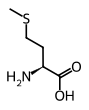
Names and identifiers
- IUPAC name
- (2S)-2-amino-4-methylsulfanylbutanoic acid
- Synonyms
- L-methionine, h-Met-oh, (S)-2-Amino-4-(methylthio)butanoic acid
+ 35 more
Cymethion, L-(-)-Methionine, S-Methionine, L-Methioninum, Neo-methidin, Methilanin, (S)-methionine, (L)-Methionine, metionina, Acimethin, L-Methionin, (2S)-2-amino-4-(methylsulfanyl)butanoic acid, Methioninum, L-alpha-Amino-gamma-methylmercaptobutyric acid, L-Homocysteine, S-methyl-, L-Met, (2S)-2-Amino-4-methylsulfanylbutanoic acid, L(-)-Amino-gamma-methylthiobutyric acid, L-alpha-Amino-gamma-methylthiobutyric acid, L-gamma-Methylthio-alpha-aminobutyric acid, METHIONINE, L-, (S)-2-amino-4-(methylthio)butyric acid, Butanoic acid, 2-amino-4-(methylthio)-, (S)-, AE28F7PNPL, Toxin WAR (Bacillus thuringiensis strain PS205C), L-a-Amino-g-methylthiobutyric acid, gamma-Methylthio-alpha-aminobutyric acid, NSC-22946, DTXSID5040548, CHEBI:16643, 2-Amino-4-(methylthio)butyric acid, (2S)-2-amino-4-(methylsulfanyl)butanoate, L-Isomer Methionine, alpha-Amino-gamma-methylmercaptobutyric acid, Methionine, L
- Molecular formula
- C5H11NO2S
- Empirical formula
- C5H11NO2S
- Molecular weight
- 149.21 g/mol
- Exact mass
- 149.05105
- CAS number
- 63-68-3
- PubChem CID
- 6137
- Canonical SMILES
- CSCCC(C(=O)O)N
- Isomeric SMILES
- CSCC[C@@H](C(=O)O)N
- InChI
- InChI=1S/C5H11NO2S/c1-9-3-2-4(6)5(7)8/h4H,2-3,6H2,1H3,(H,7,8)/t4-/m0/s1
- InChIKey
- FFEARJCKVFRZRR-BYPYZUCNSA-N
- Molfile
Names, InChI and the identifiers from PubChem, retrieved 2026-10-14.
Physical properties
- Appearance
- Colorless or white, lustrous plates or as white, crystalline powder[2]
2 values
From Hazardous Substances Data Bank (HSDB), the most authoritative source here.
Value As written Source – Minute hexagonal plates from dilute alcohol. (NTP, 1992) [1] CAMEO Chemicalscites National Toxicology Program, Institute of Environmental Health Sciences, National Institutes of Health (NTP). 1992. National Toxicology Program Chemical Repository Database. Research Triangle Park, North Carolina. –shown Colorless or white, lustrous plates or as white, crystalline powder [2] Hazardous Substances Data Bank (HSDB)cites FCC; Food Chemicals Codex. Committee on Food Chemicals Codex, Food and Nutrition Board, Institute of Medicine. 5th. Washington, DC: National Academy Press p. 286 (2003) - Odor
- Faint[2]
- Melting point
- 280 to 282 °C (536 to 540 °F) decomposes 283.0-284.0 °C (541.4-543.2 °F, NTP 1992)[1]
- Boiling point
- Reported, but no value passed the checks.
The value and why
- sublimes at 367 °F (NTP, 1992) (could not be read; source [1])
- Density
- 1.178 at 20 °C (68 °F) (NTP, 1992) - Denser than water[1]
- Solubility in water
- In water, 56.6 g/L at 25 °C[2]
2 values
From Hazardous Substances Data Bank (HSDB), the most authoritative source here.
Value As written Source – Soluble (NTP, 1992) [1] CAMEO Chemicalscites National Toxicology Program, Institute of Environmental Health Sciences, National Institutes of Health (NTP). 1992. National Toxicology Program Chemical Repository Database. Research Triangle Park, North Carolina. –shown In water, 56.6 g/L at 25 °C [2] Hazardous Substances Data Bank (HSDB)cites Yalkowsky, S.H., He, Yan., Handbook of Aqueous Solubility Data: An Extensive Compilation of Aqueous Solubility Data for Organic Compounds Extracted from the AQUASOL dATAbASE. CRC Press LLC, Boca Raton, FL. 2003., p. 175 - log P
- log Kow = -1.87[2]
- pKa
- pKa = 2.28[2]
2 values
Only one source reports it.
Value As written Source –shown pKa = 2.28 [2] Hazardous Substances Data Bank (HSDB)cites Drauz K et al; Ullmann's Encyclopedia of Industrial Chemistry. 7th ed. (2008). NY, NY: John Wiley & Sons; Amino Acids. Online Posting Date: Apr 15, 2007. – pK2 = 9.21 [2] Hazardous Substances Data Bank (HSDB)cites Drauz K et al; Ullmann's Encyclopedia of Industrial Chemistry. 7th ed. (2008). NY, NY: John Wiley & Sons; Amino Acids. Online Posting Date: Apr 15, 2007.
Each value as its source reports it, with the source's number after it (listed under References). Where several sources report a property, the row shows the value most of them agree on, the rule the app uses; open the values to see every one.
Calculated
- Heavy atoms
- 9
- Rings
- 0
- Aromatic rings
- 0
- Fraction sp³ carbons (Fsp3)
- 0.8
- H-bond donors
- 2
- H-bond acceptors
- 3 computed here · PubChem 4
- Rotatable bonds
- 4
- TPSA (Ų)
- 63.3 computed here · PubChem 88.6
- Formal charge
- 0
- XLogP3
- -1.9 PubChem
- Complexity
- 97 PubChem
- Stereocenters
- 1 definedCIP: C5: S
- Double-bond geometry
- None specified
- Point group
- C1 of one 3D conformer with its hydrogens, by Athanor’s engine (as in the app)
Elemental analysis
- C40.25%
- H7.43%
- N9.39%
- O21.44%
- S21.49%
Isotope pattern
Each peak is a nominal mass with its abundance-weighted exact mass, as a percentage of the tallest, from IUPAC natural isotope abundances.
Computed from the structure with RDKit 2026.09 when this page was built, beside PubChem's own computed values from its record; where the two differ, both are shown.
Predicted
- log P
- 0.15 Crippen (Wildman and Crippen 1999)
- log S (water solubility)
- -0.6 ESOL (Delaney 2004), log mol/L
- Synthetic accessibility
- 2.64 SA score, 1 easy to 10 hard (Ertl and Schuffenhauer 2009)
Drug-likeness: Lipinski’s rule of five
- Molecular weight ≤ 500: 149.22
- log P ≤ 5 (Crippen): 0.15
- H-bond donors ≤ 5: 2
- H-bond acceptors ≤ 10: 3
Passes all four rules.
¹³C NMR shifts, predicted
Predictions, not measurements; each names its method. A measured log P, where a source reports one, is under Physical properties.
Safety
This chemical does not meet GHS hazard criteria for 97.6% (206 of 211) of all reports.[3]
First aid
- Eyes: First check the victim for contact lenses and remove if present. Flush victim's eyes with water or normal saline solution for 20 to 30 minutes while simultaneously calling a hospital or poison control center. Do not put any ointments, oils, or medication in the victim's eyes without specific instructions from a physician. Immediately transport the victim after flushing eyes to a hospital even if no symptoms (such as redness or irritation) develop. Skin: Immediately flood affected skin with water while removing and isolating all contaminated clothing.[1]
Safety data sheets on the supplier’s page: Alfa Chemistry, Mcule, Chemodex Ltd..
Always read the supplier’s safety data sheet before working with it.
Spectra
- NMRNMRShiftDB
- 1H NMRHuman Metabolome Database (HMDB) (Varian · 500 MHz · Water) · Human Metabolome Database (HMDB) (Bruker · D2O) · SpectraBase
- 13C NMRHazardous Substances Data Bank (HSDB) · Human Metabolome Database (HMDB) (Bruker · 125 MHz · Water) · Human Metabolome Database (HMDB) (400 MHz · H2O) · SpectraBase
- 1H-1H NMRHuman Metabolome Database (HMDB)
- 1H-13C NMRHuman Metabolome Database (HMDB) (Bruker · 600 MHz · Water)
- GC-MSHuman Metabolome Database (HMDB) (GC-MS) · Human Metabolome Database (HMDB) (GC-MS) · Human Metabolome Database (HMDB) (EI-B · positive) · Human Metabolome Database (HMDB) (GC-EI-TOF · positive) · Human Metabolome Database (HMDB) (GC-EI-TOF · positive) · Human Metabolome Database (HMDB) (GC-EI-QQ · positive)
- MS-MSHuman Metabolome Database (HMDB) (Positive) · Human Metabolome Database (HMDB) (Negative) · Human Metabolome Database (HMDB) (Negative) · Human Metabolome Database (HMDB) (Negative) · Human Metabolome Database (HMDB) (Negative) · Human Metabolome Database (HMDB) (Negative)
- LC-MSMassBank Europe (Agilent 6530 QTOF · LC-ESI-QTOF · POSITIVE) · MassBank Europe (Agilent 6530 QTOF · LC-ESI-QTOF · POSITIVE) · MassBank Europe (Agilent 6530 QTOF · LC-ESI-QTOF · POSITIVE) · MassBank Europe (maXis plus UHR-ToF-MS, Bruker Daltonics · LC-ESI-QTOF · POSITIVE) · MassBank Europe (maXis plus UHR-ToF-MS, Bruker Daltonics · LC-ESI-QTOF · POSITIVE) · MassBank Europe (maXis plus UHR-ToF-MS, Bruker Daltonics · LC-ESI-QTOF · POSITIVE)
- Other MSHazardous Substances Data Bank (HSDB) · MassBank Europe (GCMS-2010 Plus, Shimadzu · EI-B · POSITIVE) · MassBank Europe (CE-system connected to 6210 Time-of-Flight MS, Agilent · CE-ESI-TOF · POSITIVE) · MassBank of North America (MoNA) (TQD, Waters · Flow-injection QqQ/MS · ESI) · MassBank of North America (MoNA) (TQD, Waters · Flow-injection QqQ/MS · ESI) · MassBank of North America (MoNA) (TQD, Waters · Flow-injection QqQ/MS · ESI)
- UVHazardous Substances Data Bank (HSDB)
- IRHazardous Substances Data Bank (HSDB)
- FTIRSpectraBase (KBr WAFER)
- ATR-IRSpectraBase (Bio-Rad FTS · ATR-Neat (DuraSamplIR II))
- RamanSpectraBase (FT-Raman)
Experimental spectra held by these sources; each link opens the source's own record.
Literature
Reading PubChem, OpenAlex and GSRS…
Bioactivity
Reading ChEMBL…
References
- [1]CAMEO Chemicals · Public domain (NOAA) · via PubChem · retrieved 2026-10-14
- [2]Hazardous Substances Data Bank (HSDB) · Public domain (US NLM) · via PubChem · retrieved 2026-10-14
- [3]European Chemicals Agency (ECHA) · ECHA legal notice: reuse with acknowledgement · via PubChem · retrieved 2026-10-14
- [4]NMRShiftDB · Linked only · via PubChem · retrieved 2026-10-14
- [5]Human Metabolome Database (HMDB) · Linked only · via PubChem · retrieved 2026-10-14
- [6]SpectraBase · Linked only · via PubChem · retrieved 2026-10-14
- [7]MassBank Europe · Linked only · via PubChem · retrieved 2026-10-14
- [8]MassBank of North America (MoNA) · CC BY 4.0 · via PubChem · retrieved 2026-10-14
- [9]NIST Mass Spectrometry Data Center · Linked only · via PubChem · retrieved 2026-10-14
- ·Calculated values: computed by Athanor with RDKit 2026.09 from the structure.
- ·Literature on PubChem
Data last updated 2026-10-14.