
D-Methionine
Athanor · official
C5H11NO2S · 149.21 g/mol
IUPAC name: (2R)-2-amino-4-methylsulfanylbutanoic acid
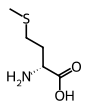
Names and identifiers
- IUPAC name
- (2R)-2-amino-4-methylsulfanylbutanoic acid
- Synonyms
- (R)-Methionine, D-Methionin, D-Metionien
+ 35 more
(R)-2-amino-4-(methylthio)butanoic acid, METHIONINE, D-, Methionine D-, Methionine d-form, D-Metionien [Australian], (2R)-2-amino-4-(methylsulfanyl)butanoic acid, (2R)-2-amino-4-methylsulfanylbutanoic acid, D-2-Amino-4-(methylthio)butyric acid, METHIONINE D-FORM [MI], CHEBI:16867, EINECS 206-483-6, NSC 45689, 868496F25R, DTXSID90883369, NSC-45689, D-Metionien (Australian), RefChem:584336, DTXCID201022906, 206-483-6, H-D-Met-OH, MRx-1024, MFCD00002622, D-2-Amino-4-(methylthio)butanoic acid, R-Methionine, CHEMBL1234268, MED, D-Methionine, puriss., >=99.0% (NT), (R)-2-Amino-4-(methylmercapto)butyric acid, M02939, (R)-Methionine; MRX 1024; NSC 45689; S-Methyl-D-homocysteine, s4494, UNII-868496F25R, D-Met, D-Met-OH, (2R)-2-amino-
- Molecular formula
- C5H11NO2S
- Empirical formula
- C5H11NO2S
- Molecular weight
- 149.21 g/mol
- Exact mass
- 149.05105
- CAS number
- 348-67-4
- PubChem CID
- 84815
- Canonical SMILES
- CSCCC(C(=O)O)N
- Isomeric SMILES
- CSCC[C@H](C(=O)O)N
- InChI
- InChI=1S/C5H11NO2S/c1-9-3-2-4(6)5(7)8/h4H,2-3,6H2,1H3,(H,7,8)/t4-/m1/s1
- InChIKey
- FFEARJCKVFRZRR-SCSAIBSYSA-N
- Molfile
Names, InChI and the identifiers from PubChem, retrieved 2026-10-14.
Calculated
- Heavy atoms
- 9
- Rings
- 0
- Aromatic rings
- 0
- Fraction sp³ carbons (Fsp3)
- 0.8
- H-bond donors
- 2
- H-bond acceptors
- 3 computed here · PubChem 4
- Rotatable bonds
- 4
- TPSA (Ų)
- 63.3 computed here · PubChem 88.6
- Formal charge
- 0
- XLogP3
- -1.9 PubChem
- Complexity
- 97 PubChem
- Stereocenters
- 1 definedCIP: C5: R
- Double-bond geometry
- None specified
- Point group
- C1 of one 3D conformer with its hydrogens, by Athanor’s engine (as in the app)
Elemental analysis
- C40.25%
- H7.43%
- N9.39%
- O21.44%
- S21.49%
Isotope pattern
Each peak is a nominal mass with its abundance-weighted exact mass, as a percentage of the tallest, from IUPAC natural isotope abundances.
Computed from the structure with RDKit 2026.09 when this page was built, beside PubChem's own computed values from its record; where the two differ, both are shown.
Predicted
- log P
- 0.15 Crippen (Wildman and Crippen 1999)
- log S (water solubility)
- -0.6 ESOL (Delaney 2004), log mol/L
- Synthetic accessibility
- 2.64 SA score, 1 easy to 10 hard (Ertl and Schuffenhauer 2009)
Drug-likeness: Lipinski’s rule of five
- Molecular weight ≤ 500: 149.22
- log P ≤ 5 (Crippen): 0.15
- H-bond donors ≤ 5: 2
- H-bond acceptors ≤ 10: 3
Passes all four rules.
¹³C NMR shifts, predicted
Predictions, not measurements; each names its method. A measured log P, where a source reports one, is under Physical properties.
Safety
This chemical does not meet GHS hazard criteria for 100% (2 of 2) of all reports.[1]
Safety data sheets on the supplier’s page: Biorbyt, 001Chemical, Pi Chemicals.
Always read the supplier’s safety data sheet before working with it.
Spectra
- 1H NMRSpectraBase
- 13C NMRSpectraBase
- GC-MSNIST Mass Spectrometry Data Center · NIST Mass Spectrometry Data Center
- ATR-IRSpectraBase (Bio-Rad FTS · ATR-Neat (DuraSamplIR II))
- RamanSpectraBase
Experimental spectra held by these sources; each link opens the source's own record.
Literature
Reading PubChem, OpenAlex and GSRS…
Bioactivity
Reading ChEMBL…
References
- [1]European Chemicals Agency (ECHA) · ECHA legal notice: reuse with acknowledgement · via PubChem · retrieved 2026-10-14
- [2]SpectraBase · Linked only · via PubChem · retrieved 2026-10-14
- [3]NIST Mass Spectrometry Data Center · Linked only · via PubChem · retrieved 2026-10-14
- ·Calculated values: computed by Athanor with RDKit 2026.09 from the structure.
- ·Literature on PubChem
Data last updated 2026-10-14.