
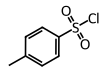
Tosyl chloride
Athanor · official
C7H7ClO2S · 190.65 g/mol
IUPAC name: 4-methylbenzenesulfonyl chloride
Also called TsCl, p-toluenesulfonyl chloride, tosyl chloride

 DangerMay be corrosive to metals · Causes severe skin burns and eye damage · Causes skin irritation · May cause an allergic skin reaction · Causes serious eye damage · May cause respiratory irritation
Names and identifiers
- IUPAC name
- 4-methylbenzenesulfonyl chloride
- Synonyms
- TsCl, p-toluenesulfonyl chloride, tosyl chloride
+ 37 more
4-Toluenesulfonyl chloride, RefChem:169391, P-TOLUENESULFONYL CHLORIDE, 4-Methylbenzenesulfonyl chloride, p-Tosyl chloride, 4-methylbenzene-1-sulfonyl chloride, p-Toluenesulphonyl chloride, p-Tolylsulfonyl chloride, p-Toluenesulfochloride, tosylchloride, p-Toluenesulfonic acid chloride, p-Methylbenzenesulfonyl chloride, para-Toluenesulfonyl chloride, 4-Tosyl chloride, Benzenesulfonyl chloride, 4-methyl-, 4-toluene sulfonyl chloride, p-Toluene sulphonyl chloride, Toluenesulfonyl chloride, p-toluensulfonyl chloride, 4-methyl-benzenesulfonyl chloride, p-Toluenesulfonyl chloride(PTSC), p-Methylphenylsulfonyl chloride, p-Toluenesulfonic chloride, p-toluene sulfonyl chloride, toluene-p-sulfonyl chloride, Toluene-4-sulfonyl chloride, MFCD00007450, NSC 175822, 4-methylphenylsulfonyl chloride, PTSC, Tenofovir Impurity 64, 4-toluenesulphonyl chloride, toluene-4-sulphonyl chloride, Para-toluene sulphonyl chloride, 027KYN78B4, BR1703, NSC-175822
- Molecular formula
- C7H7ClO2S
- Empirical formula
- C7H7ClO2S
- Molecular weight
- 190.65 g/mol
- Exact mass
- 189.98553
- CAS number
- 98-59-9
- PubChem CID
- 7397
- Canonical SMILES
- CC1=CC=C(C=C1)S(=O)(=O)Cl
- Isomeric SMILES
- CC1=CC=C(C=C1)S(=O)(=O)Cl
- InChI
- InChI=1S/C7H7ClO2S/c1-6-2-4-7(5-3-6)11(8,9)10/h2-5H,1H3
- InChIKey
- YYROPELSRYBVMQ-UHFFFAOYSA-N
- Molfile
Names, InChI and the identifiers from PubChem, retrieved 2026-10-14.
Physical properties
- Appearance
- P-toluene sulfonylchloride appears as a white to gray powdered solid with a distinctive odor. Insoluble in water and denser than water. Contact may irritate skin, eyes and mucous membranes. May be toxic by ingestion, inhalation and skin absorption. Used to make other chemicals.[1]
2 values
From CAMEO Chemicals, the most authoritative source here.
Value As written Source –shown P-toluene sulfonylchloride appears as a white to gray powdered solid with a distinctive odor. Insoluble in water and denser than water. Contact may irritate skin, eyes and mucous membranes. May be toxic by ingestion, inhalation and skin absorption. Used to make other chemicals. [1] CAMEO Chemicals – COLOURLESS-TO-YELLOW HYGROSCOPIC CRYSTALS WITH PUNGENT ODOUR. [2] ILO-WHO International Chemical Safety Cards (ICSCs) - Melting point
- 69-71 °C[2]
- Density
- 1.33 @25 °C[4]
2 values
2 of 2 sources agree on it (most common value).
Value As written Source – 1.3 g/cm³ [2] ILO-WHO International Chemical Safety Cards (ICSCs) –shown 1.33 @25 °C [4] PAC Chemical Database, U.S. Department of Energy - Solubility in water
- Solubility in water: reaction[2]
- log P
- 3.49[2]
- Vapor pressure
- Vapor pressure, Pa at 25 °C: 0.16[2]
2 values
Sources disagree; from ILO-WHO International Chemical Safety Cards (ICSCs), the most authoritative.
Value As written Source 0.0012 mmHgshown Vapor pressure, Pa at 25 °C: 0.16 [2] ILO-WHO International Chemical Safety Cards (ICSCs) 1 mmHg 1 [mm Hg] @88 °C [4] PAC Chemical Database, U.S. Department of Energy - Flash point
- 128 °C c.c.[2]
- Autoignition temperature
- 492 °C[2]
Each value as its source reports it, with the source's number after it (listed under References). Where several sources report a property, the row shows the value most of them agree on, the rule the app uses; open the values to see every one.
Calculated
- Heavy atoms
- 11
- Rings
- 1
- Aromatic rings
- 1
- Fraction sp³ carbons (Fsp3)
- 0.14
- H-bond donors
- 0
- H-bond acceptors
- 2
- Rotatable bonds
- 1
- TPSA (Ų)
- 34.1 computed here · PubChem 42.5
- Formal charge
- 0
- XLogP3
- 3 PubChem
- Complexity
- 209 PubChem
- Stereocenters
- None
- Double-bond geometry
- None specified
- Point group
- Cs of one 3D conformer with its hydrogens, by Athanor’s engine (as in the app)
Elemental analysis
- C44.10%
- H3.70%
- Cl18.60%
- O16.78%
- S16.82%
Isotope pattern
Each peak is a nominal mass with its abundance-weighted exact mass, as a percentage of the tallest, from IUPAC natural isotope abundances.
Computed from the structure with RDKit 2026.09 when this page was built, beside PubChem's own computed values from its record; where the two differ, both are shown.
Predicted
- log P
- 1.92 Crippen (Wildman and Crippen 1999)
- log S (water solubility)
- -2.57 ESOL (Delaney 2004), log mol/L
- Synthetic accessibility
- 1.64 SA score, 1 easy to 10 hard (Ertl and Schuffenhauer 2009)
Drug-likeness: Lipinski’s rule of five
- Molecular weight ≤ 500: 190.65
- log P ≤ 5 (Crippen): 1.92
- H-bond donors ≤ 5: 0
- H-bond acceptors ≤ 10: 2
Passes all four rules.
¹³C NMR shifts, predicted
Predictions, not measurements; each names its method. A measured log P, where a source reports one, is under Physical properties.
Safety
Danger
Most widely reported: 926 company reports to ECHA. Source [5].
- Corrosive
- Harmful or irritant
- H290May be corrosive to metals (20% of reports)
- H314Causes severe skin burns and eye damage (62% of reports)
- H315Causes skin irritation (32.3% of reports)
- H317May cause an allergic skin reaction (21% of reports)
- H318Causes serious eye damage (85.9% of reports)
- H335May cause respiratory irritation (53.1% of reports)
Precautionary statements: P234, P260, P261, P264, P264+P265, P271, P272, P280, P301+P330+P331, P302+P352, P302+P361+P354, P304+P340, P305+P354+P338, P316, P317, P319, P321, P332+P317, P333+P317, P362+P364, P363, P390, P403+P233, P405, P406, P501
View all classifications (2)
- [5] European Chemicals Agency (ECHA)This chemical does not meet GHS hazard criteria for 5.7% (53 of 926) of reports.
- [5] European Chemicals Agency (ECHA) · 926 reports · DangerH290, H314, H315, H317, H318, H335
First aid
- Excerpt from ERG Guide 154 [Substances - Toxic and/or Corrosive (Non-Combustible)]: Refer to the "General First Aid" section. Specific First Aid: For corrosives, in case of contact, immediately flush skin or eyes with running water for at least 30 minutes. Additional flushing may be required. (ERG, 2024)[1]
- Fresh air, rest.[2]
- Remove contaminated clothes. Rinse skin with plenty of water or shower.[2]
- Rinse with plenty of water (remove contact lenses if easily possible). Refer immediately for medical attention.[2]
Storage
- Dry. Well closed. Store in an area without drain or sewer access.[2]
Safety data sheets on the supplier’s page: BOC Sciences, Glentham Life Sciences Ltd., TCI (Tokyo Chemical Industry).
Always read the supplier’s safety data sheet before working with it.
Spectra
- NMRHazardous Substances Data Bank (HSDB) · NMRShiftDB
- 1H NMRSpectraBase (Varian A-60)
- 13C NMRSpectraBase
- 17O NMRSpectraBase
- GC-MSNIST Mass Spectrometry Data Center · NIST Mass Spectrometry Data Center · NIST Mass Spectrometry Data Center · SpectraBase
- Other MSHazardous Substances Data Bank (HSDB)
- IRHazardous Substances Data Bank (HSDB)
- FTIRSpectraBase (Bruker IFS 85 · KBr-Pellet)
- ATR-IRSpectraBase
- Vapor Phase IRSpectraBase (DIGILAB FTS-14 · Vapor Phase)
- RamanSpectraBase
Experimental spectra held by these sources; each link opens the source's own record.
Literature
Reading PubChem, OpenAlex and GSRS…
Bioactivity
Reading ChEMBL…
References
- [1]CAMEO Chemicals · Public domain (NOAA) · via PubChem · retrieved 2026-10-14
- [2]ILO-WHO International Chemical Safety Cards (ICSCs) · CC BY 4.0 · via PubChem · retrieved 2026-10-14
- [3]Hazardous Substances Data Bank (HSDB) · Public domain (US NLM) · via PubChem · retrieved 2026-10-14
- [4]PAC Chemical Database, U.S. Department of Energy · Public domain (US DOE) · via PubChem · retrieved 2026-10-14
- [5]European Chemicals Agency (ECHA) · ECHA legal notice: reuse with acknowledgement · via PubChem · retrieved 2026-10-14
- [6]NMRShiftDB · Linked only · via PubChem · retrieved 2026-10-14
- [7]SpectraBase · Linked only · via PubChem · retrieved 2026-10-14
- [8]NIST Mass Spectrometry Data Center · Linked only · via PubChem · retrieved 2026-10-14
- ·Calculated values: computed by Athanor with RDKit 2026.09 from the structure.
- ·Literature on PubChem
Data last updated 2026-10-14.