
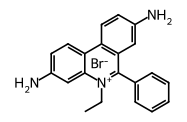
Ethidium bromide
Athanor · official
C21H20BrN3 · 394.3 g/mol
IUPAC name: 5-ethyl-6-phenylphenanthridin-5-ium-3,8-diamine bromide
Also called EtBr, EB, homidium bromide, gel stain, intercalator

 DangerHarmful if swallowed · Fatal if inhaled · Suspected of causing genetic defects
Names and identifiers
- IUPAC name
- 5-ethyl-6-phenylphenanthridin-5-ium-3,8-diamine bromide
- Synonyms
- EtBr, EB, homidium bromide
+ 39 more
gel stain, intercalator, Homidium bromide, Dromilac, 3,8-Diamino-5-ethyl-6-phenylphenanthridinium bromide, Ethydium bromide, Bromure d'homidium, Bromuro de homidio, Homidii bromidum, 2,7-Diamino-10-ethyl-9-phenylphenanthridinium bromide, 2,7-Diamino-9-phenyl-10-ethylphenanthridinium bromide, 2,7-Diamino-9-phenylphenanthridine ethobromide, DTXSID8025258, NSC-268986, RD 1572, 059NUO2Z1L, CHEBI:4883, DTXCID605258, Bromide, Ethidium, Bromide, Homidium, RefChem:138396, 214-984-6, 3,8-Diamino-5-ethyl-6-phenylphenanthridin-5-ium bromide, Phenanthridinium, 3,8-diamino-5-ethyl-6-phenyl-, bromide, Ethidium (bromide), Ethidium bromide(EB), Phenanthridinium, 3,8-diamino-5-ethyl-6-phenyl-, bromide (1:1), 5-ethyl-6-phenylphenanthridin-5-ium-3,8-diamine;bromide, MLS002702536, NSC268986, NCGC00091387-01, NCGC00095070-01, CHEMBL284328, Homidium bromide [INN:BAN], CAS-1239-45-8, Homidii bromidum [INN-Latin], CCRIS 1017, HSDB 7297, Bromure d'homidium [INN-French]
- Molecular formula
- C21H20BrN3
- Empirical formula
- C21H20BrN3
- Molecular weight
- 394.3 g/mol
- Exact mass
- 393.08406
- CAS number
- 1239-45-8
- PubChem CID
- 14710
- Canonical SMILES
- CC[N+]1=C2C=C(C=CC2=C3C=CC(=CC3=C1C4=CC=CC=C4)N)N.[Br-]
- Isomeric SMILES
- CC[N+]1=C2C=C(C=CC2=C3C=CC(=CC3=C1C4=CC=CC=C4)N)N.[Br-]
- InChI
- InChI=1S/C21H19N3.BrH/c1-2-24-20-13-16(23)9-11-18(20)17-10-8-15(22)12-19(17)21(24)14-6-4-3-5-7-14;/h3-13,23H,2,22H2,1H3;1H
- InChIKey
- ZMMJGEGLRURXTF-UHFFFAOYSA-N
- Molfile
Names, InChI and the identifiers from PubChem, retrieved 2026-10-14.
Physical properties
- Appearance
- Maroon powder[2]
2 values
From Hazardous Substances Data Bank (HSDB), the most authoritative source here.
Value As written Source – RED-TO-BROWN CRYSTALS. [1] ILO-WHO International Chemical Safety Cards (ICSCs) –shown Maroon powder [2] Hazardous Substances Data Bank (HSDB)cites Green FJ; The Sigma-Aldrich Handbook of Stains, Dyes and Indicators. Milwaukee, WI: Aldrich Chemical Company, Inc., p. 318 (1990) - Melting point
- 238-240 °C[1]
2 values
Sources disagree; from ILO-WHO International Chemical Safety Cards (ICSCs), the most authoritative.
Value As written Source 260 to 262 °C 260-262 °C (decomposes) [2] Hazardous Substances Data Bank (HSDB)cites Green FJ; The Sigma-Aldrich Handbook of Stains, Dyes and Indicators. Milwaukee, WI: Aldrich Chemical Company, Inc., p. 318 (1990) 238 to 240 °Cshown 238-240 °C [1] ILO-WHO International Chemical Safety Cards (ICSCs) - Density
- 0.34 g/cm³[1]
- Solubility in water
- Solubility in water, g/100ml at 20 °C: 5[1]
2 values
From ILO-WHO International Chemical Safety Cards (ICSCs), the most authoritative source here.
Value As written Source – Solubility in 2-methoxyethanol is 20 mg/mL; ethanol, 2 mg/mL [2] Hazardous Substances Data Bank (HSDB)cites Green FJ; The Sigma-Aldrich Handbook of Stains, Dyes and Indicators. Milwaukee, WI: Aldrich Chemical Company, Inc., p. 318 (1990) –shown Solubility in water, g/100ml at 20 °C: 5 [1] ILO-WHO International Chemical Safety Cards (ICSCs) - log P
- -1.1[1]
2 values
Sources disagree; from ILO-WHO International Chemical Safety Cards (ICSCs), the most authoritative.
Value As written Source – log Kow= -0.38 /Estimated/ [2] Hazardous Substances Data Bank (HSDB)cites US EPA; Estimation Program Interface (EPI) Suite. Ver.3.11. June 10, 2003. Available from, as of Sept 22, 2004: https://www.epa.gov/oppt/exposure/pubs/episuitedl.htm –shown -1.1 [1] ILO-WHO International Chemical Safety Cards (ICSCs) - Vapor pressure
- 1.2 × 10⁻¹² mmHg at 25 °C (estimated)[2]
- Flash point
- >100 °C[1]
Each value as its source reports it, with the source's number after it (listed under References). Where several sources report a property, the row shows the value most of them agree on, the rule the app uses; open the values to see every one.
Calculated
- Heavy atoms
- 25
- Rings
- 4
- Aromatic rings
- 4
- Fraction sp³ carbons (Fsp3)
- 0.1
- H-bond donors
- 2
- H-bond acceptors
- 2 computed here · PubChem 3
- Rotatable bonds
- 2
- TPSA (Ų)
- 55.9
- Formal charge
- 0
- Complexity
- 419 PubChem
- Stereocenters
- None
- Double-bond geometry
- None specified
- Point group
- C1 of one 3D conformer with its hydrogens, by Athanor’s engine (as in the app)
Elemental analysis
- C63.97%
- H5.11%
- Br20.26%
- N10.66%
Isotope pattern
Each peak is a nominal mass with its abundance-weighted exact mass, as a percentage of the tallest, from IUPAC natural isotope abundances.
Computed from the structure with RDKit 2026.09 when this page was built, beside PubChem's own computed values from its record; where the two differ, both are shown.
Predicted
- log P
- 1.14 Crippen (Wildman and Crippen 1999)
- log S (water solubility)
- -3.46 ESOL (Delaney 2004), log mol/L
- Synthetic accessibility
- 2.62 SA score, 1 easy to 10 hard (Ertl and Schuffenhauer 2009)
Drug-likeness: Lipinski’s rule of five
- Molecular weight ≤ 500: 394.32
- log P ≤ 5 (Crippen): 1.14
- H-bond donors ≤ 5: 2
- H-bond acceptors ≤ 10: 2
Passes all four rules.
¹³C NMR shifts, predicted
Predictions, not measurements; each names its method. A measured log P, where a source reports one, is under Physical properties.
Safety
Danger
Harmonized EU classification (CLP Annex VI). Source [3].
- Acute toxicity
- Health hazard
- H302Harmful if swallowed
- H330Fatal if inhaled
- H341Suspected of causing genetic defects
Precautionary statements: P203, P260, P264, P270, P271, P280, P284, P301+P317, P304+P340, P316, P318, P320, P330, P403+P233, P405, P501
View all classifications (2)
- [3] Regulation (EC) No 1272/2008 of the European Parliament and of the Council · DangerH302, H330, H341
- [4] European Chemicals Agency (ECHA) · 34 reports · DangerH302, H330, H331, H341
Exposure limits
- MAK (Maximale Arbeitsplatz Konzentration): Carcinogen category: 3; germ cell mutagen group: 3B[1]
First aid
Storage
- Fireproof. Separated from strong oxidants and food and feedstuffs.[1]
- Ethidium bromide should be handled in the laboratory using the "basic prudent practices" described in Chapter 5.C. Because of its mutagenicity, stock solutions of this compound should be prepared in a fume hood, and protective gloves should be worn at all times while handling this substance. Operations capable of generating ethidium bromide dust or aerosols of ethidium bromide solutions should be conducted in a fume hood to prevent exposure by inhalation.[2]
Safety data sheets on the supplier’s page: AppChem, Accel Scientific, LGC Standards.
Always read the supplier’s safety data sheet before working with it.
Spectra
- 1H NMRSpectraBase (Varian CFT-20)
- UVHazardous Substances Data Bank (HSDB)
- FTIRSpectraBase (KBr WAFER)
- ATR-IRSpectraBase (Bruker Tensor 27 FT-IR · ATR-Neat (DuraSamplIR II))
Experimental spectra held by these sources; each link opens the source's own record.
Literature
Reading PubChem, OpenAlex and GSRS…
Bioactivity
Reading ChEMBL…
References
- [1]ILO-WHO International Chemical Safety Cards (ICSCs) · CC BY 4.0 · via PubChem · retrieved 2026-10-14
- [2]Hazardous Substances Data Bank (HSDB) · Public domain (US NLM) · via PubChem · retrieved 2026-10-14
- [3]Regulation (EC) No 1272/2008 of the European Parliament and of the Council · EU reuse policy, CC BY 4.0 · via PubChem · retrieved 2026-10-14
- [4]European Chemicals Agency (ECHA) · ECHA legal notice: reuse with acknowledgement · via PubChem · retrieved 2026-10-14
- [5]SpectraBase · Linked only · via PubChem · retrieved 2026-10-14
- ·Calculated values: computed by Athanor with RDKit 2026.09 from the structure.
- ·Literature on PubChem
Data last updated 2026-10-14.