
Nitroglycerin
Athanor · official
C3H5N3O9 · 227.09 g/mol
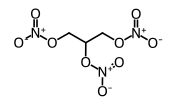
IUPAC name: 1,3-dinitrooxypropan-2-yl nitrate
Also called glyceryl trinitrate, GTN, Nitrostat, dynamite


 Danger(Deleted) Unstable Explosive · Fatal if swallowed · Fatal in contact with skin · Fatal if inhaled · Toxic to aquatic life with long lasting effects
Names and identifiers
- IUPAC name
- 1,3-dinitrooxypropan-2-yl nitrate
- Synonyms
- glyceryl trinitrate, GTN, Nitrostat
+ 38 more
dynamite, Glyceryl trinitrate, Trinitroglycerin, Nitroglycerine, Nitroglycerol, Glycerol trinitrate, Trinitroglycerol, Nitro-dur, Minitran, Trinitrin, Nitronet, Tridil, Nitroglyn, Nitrolingual, Nitrong, Niong, Nitora, Transderm-nitro, Nitro-Bid, Lenitral, Natispray, Nitrocine, Nitrolan, NitroMist, Glycerin trinitrate, Nitroglicerina, Angiolingual, Cardamist, Klavikordal, Myoglycerin, Niglycon, Nitrodisc, Nitrogard, Nitrolowe, Nitromel, Nitronal, Nitrorectal, Percutol
- Molecular formula
- C3H5N3O9
- Empirical formula
- C3H5N3O9
- Molecular weight
- 227.09 g/mol
- Exact mass
- 227.00258
- CAS number
- 55-63-0
- PubChem CID
- 4510
- Canonical SMILES
- C(C(CO[N+](=O)[O-])O[N+](=O)[O-])O[N+](=O)[O-]
- Isomeric SMILES
- C(C(CO[N+](=O)[O-])O[N+](=O)[O-])O[N+](=O)[O-]
- InChI
- InChI=1S/C3H5N3O9/c7-4(8)13-1-3(15-6(11)12)2-14-5(9)10/h3H,1-2H2
- InChIKey
- SNIOPGDIGTZGOP-UHFFFAOYSA-N
- Molfile
Names, InChI and the identifiers from PubChem, retrieved 2026-10-14.
Physical properties
- Appearance
- Colorless to pale-yellow, viscous liquid or solid (below 56 degrees F) Note: An explosive ingredient in dynamite (20-40%) with ethylene glycol dinitrate (80-60%).[6]
11 values
From Hazardous Substances Data Bank (HSDB), the most authoritative source here.
Value As written Source – Glyceryl trinitrate solution appears as a colorless solution of glyceryl trinitrate (nitroglycerin) in water. If allowed to dry out, the remaining nitroglycerin is explosive. [1] CAMEO Chemicals – Nitroglycerin, desensitized, [liquid] appears as a pale yellow, viscous liquid that is slightly soluble in water and more dense than water. Sensitive to shock and heat. May explode under prolonged exposure to fire or heat. Primary hazard is the blast of an instantaneous explosion and not flying fragment or projectiles. Used medicinally. [1] CAMEO Chemicals – Nitroglycerin, solution in alcohol, with more than 1% but not more than 5% nitroglycerin appears as a dilute solution in ethanol. If the ethanol evaporates the nitroglycerine will become shock sensitive. May then detonate if shocked or heated. [1] CAMEO Chemicals – Nitroglycerin, solution in alcohol, with not more than 1% nitroglycerin appears as a flammable, colorless solution of nitroglycerin in alcohol. If allowed to dry out, the remaining nitroglycerin is explosive. [1] CAMEO Chemicals – Spirits of nitroglycerin, [1 to 10%] appears as a mixture of nitroglycerin and ethanol. If ethanol evaporates the nitroglycerin becomes shock sensitive and may detonate by friction or impact. [1] CAMEO Chemicals – Liquid; Dry Powder [2] EPA Chemical Data Reporting (CDR) – COLOURLESS-TO-YELLOW VISCOUS LIQUID OR PALE YELLOW CRYSTALS. [3] ILO-WHO International Chemical Safety Cards (ICSCs) – A colorless solution of glyceryl trinitrate (nitroglycerin) in water. [4] Occupational Safety and Health Administration (OSHA) – Colorless to pale-yellow, viscous liquid or solid (below 56 °F). [Note: An explosive ingredient in dynamite (20-40%) with ethylene glycol dinitrate (80-60%).] [5] The National Institute for Occupational Safety and Health (NIOSH) – VISCOUS LIQUID [6] Hazardous Substances Data Bank (HSDB)cites Lewis, R.J., Sr (Ed.). Hawley's Condensed Chemical Dictionary. 13th ed. New York, NY: John Wiley & Sons, Inc. 1997., p. 797 –shown Colorless to pale-yellow, viscous liquid or solid (below 56 degrees F) Note: An explosive ingredient in dynamite (20-40%) with ethylene glycol dinitrate (80-60%). [6] Hazardous Substances Data Bank (HSDB)cites NIOSH. NIOSH Pocket Guide to Chemical Hazards & Other Databases. U.S. Department of Health & Human Services, Public Health Service, Center for Disease Control & Prevention. DHHS (NIOSH) Publication No. 2001-145 (CD-ROM) August 2001. - Melting point
- 13.5 °C[3]
5 values
5 of 5 sources agree on it (most common value).
Value As written Source 13 °C 56 °F (NIOSH, 2024) [1] CAMEO Chemicals 13.5 °Cshown 13.5 °C [3] ILO-WHO International Chemical Safety Cards (ICSCs) 13 °C 56 °F [4] Occupational Safety and Health Administration (OSHA) 13.5 °C 13.5 °C [7] PAC Chemical Database, U.S. Department of Energy 13 °C 56 °F [5] The National Institute for Occupational Safety and Health (NIOSH) - Boiling point
- Reported, but no value passed the checks.
The 4 values and why
- Begins to decompose at 122-140 °F (NIOSH, 2024) (could not be read; source [1])
- at 2kPa: 160 °C (could not be read; source [3])
- Begins to decompose at 122-140 °F (could not be read; source [4])
- Begins to decompose at 122-140 °F (could not be read; source [5])
- Density
- 1.5931 @ 20°C[7]
5 values
5 of 5 sources agree on it (most common value).
Value As written Source – 1.6 (NIOSH, 2024) - Denser than water [1] CAMEO Chemicals – Relative density (water = 1): 1.6 [3] ILO-WHO International Chemical Safety Cards (ICSCs) – 1.6 [4] Occupational Safety and Health Administration (OSHA) –shown 1.5931 @ 20°C [7] PAC Chemical Database, U.S. Department of Energy – 1.60 [5] The National Institute for Occupational Safety and Health (NIOSH) 12 more values were reported but failed the checks (unreadable or out of range), so they are not shown.
- Solubility in water
- Solubility in water: poor[3]
4 values
From ILO-WHO International Chemical Safety Cards (ICSCs), the most authoritative source here.
Value As written Source – 0.1 % (NIOSH, 2024) [1] CAMEO Chemicals – For more Solubility (Complete) data for NITROGLYCERIN (6 total), please visit the HSDB record page. [6] Hazardous Substances Data Bank (HSDB) –shown Solubility in water: poor [3] ILO-WHO International Chemical Safety Cards (ICSCs) – 0.1% [5] The National Institute for Occupational Safety and Health (NIOSH) - log P
- 1.62[3]
2 values
2 of 2 sources agree on it (most common value).
Value As written Source – log Kow = 1.62 [6] Hazardous Substances Data Bank (HSDB)cites Hansch, C., Leo, A., D. Hoekman. Exploring QSAR - Hydrophobic, Electronic, and Steric Constants. Washington, DC: American Chemical Society., 1995., p. 6 –shown 1.62 [3] ILO-WHO International Chemical Safety Cards (ICSCs) - Vapor pressure
- Vapor pressure, Pa at 20 °C: 0.03[3]
2 values
Sources disagree; from ILO-WHO International Chemical Safety Cards (ICSCs), the most authoritative.
Value As written Source 0.0002 mmHg 2.0X10⁻⁴ mm Hg @ 20 °C [6] Hazardous Substances Data Bank (HSDB)cites Kemp MD et al; J Phys Chem 61: 240-42 (1957) 0.00023 mmHgshown Vapor pressure, Pa at 20 °C: 0.03 [3] ILO-WHO International Chemical Safety Cards (ICSCs) 3 more values were reported but failed the checks (unreadable or out of range), so they are not shown.
- Flash point
- 270 °C (518 °F, NFPA 2010)[1]
- Autoignition temperature
- 270 °C (518 °F)[6]
- Viscosity
- 36.0 centipoise @ 20 °C[6]
Each value as its source reports it, with the source's number after it (listed under References). Where several sources report a property, the row shows the value most of them agree on, the rule the app uses; open the values to see every one.
Calculated
- Heavy atoms
- 15
- Rings
- 0
- Aromatic rings
- 0
- Fraction sp³ carbons (Fsp3)
- 1
- H-bond donors
- 0
- H-bond acceptors
- 9
- Rotatable bonds
- 8 computed here · PubChem 5
- TPSA (Ų)
- 157.1 computed here · PubChem 165
- Formal charge
- 0
- XLogP3
- 1.6 PubChem
- Complexity
- 218 PubChem
- Stereocenters
- None
- Double-bond geometry
- None specified
- Point group
- C1 of one 3D conformer with its hydrogens, by Athanor’s engine (as in the app)
Elemental analysis
- C15.87%
- H2.22%
- N18.50%
- O63.41%
Isotope pattern
Each peak is a nominal mass with its abundance-weighted exact mass, as a percentage of the tallest, from IUPAC natural isotope abundances.
Computed from the structure with RDKit 2026.09 when this page was built, beside PubChem's own computed values from its record; where the two differ, both are shown.
Predicted
- log P
- -1.02 Crippen (Wildman and Crippen 1999)
- log S (water solubility)
- -0.08 ESOL (Delaney 2004), log mol/L
- Synthetic accessibility
- 3.38 SA score, 1 easy to 10 hard (Ertl and Schuffenhauer 2009)
Drug-likeness: Lipinski’s rule of five
- Molecular weight ≤ 500: 227.08
- log P ≤ 5 (Crippen): -1.02
- H-bond donors ≤ 5: 0
- H-bond acceptors ≤ 10: 9
Passes all four rules.
¹³C NMR shifts, predicted
Predictions, not measurements; each names its method. A measured log P, where a source reports one, is under Physical properties.
Safety
Danger
Harmonized EU classification (CLP Annex VI). Source [8].
- Explosive
- Acute toxicity
- Health hazard
- Environmental hazard
- H200(Deleted) Unstable Explosive
- H300Fatal if swallowed
- H310Fatal in contact with skin
- H330Fatal if inhaled
- H411Toxic to aquatic life with long lasting effects
Precautionary statements: P201, P202, P260, P262, P264, P270, P271, P273, P280, P281, P284, P301+P316, P302+P352, P304+P340, P316, P319, P320, P321, P330, P361+P364, P372, P373, P380, P391, P401, P403+P233, P405, P501
View all classifications (3)
- [8] Regulation (EC) No 1272/2008 of the European Parliament and of the Council · DangerH200, H300, H310, H330, H411
- [8] Regulation (EC) No 1272/2008 of the European Parliament and of the Council · DangerH201, H300, H310, H330, H411
- [9] European Chemicals Agency (ECHA) · 93 reports · DangerH200, H300+H310+H330, H300, H310, H330, H373, H411
Exposure limits
First aid
- Excerpt from ERG Guide 113 [Flammable Materials (Wet / Desensitized Explosive)]: Refer to the "General First Aid" section. (ERG, 2024)[1]
- Excerpt from NIOSH Pocket Guide for Nitroglycerine: Eye: Irrigate immediately - If this chemical contacts the eyes, immediately wash (irrigate) the eyes with large amounts of water, occasionally lifting the lower and upper lids. Get medical attention immediately. Skin: SOAP WASH immediately - If this chemical contacts the skin, immediately wash the contaminated skin with soap and water.[1]
- Excerpt from ERG Guide 127 [Flammable Liquids (Water-Miscible)]: Refer to the "General First Aid" section. Specific First Aid: Wash skin with soap and water. In case of burns, immediately cool affected skin for as long as possible with cold water. Do not remove clothing if adhering to skin. (ERG, 2024)[1]
- Excerpt from ERG Guide 112 [Explosives - Division 1.1, 1.2, 1.3 or 1.5]: Refer to the "General First Aid" section. (ERG, 2024)[1]
Storage
- Store only if stabilized. Store in an area without drain or sewer access. Fireproof. Well closed. Separated from food and feedstuffs.[3]
- Nitroglycerin injections are practically colorless and stable in their intact containers. The solutions are not explosive. Storage should be at room temperature; the containers should be protected from freezing. Exposure to light, even high intensity light, does not adversely affect nitroglycerin stability. (nitroglycerin injections)[6]
- Store at room temp not above 25 °C (77 °F). Do not refrigerate. (nitroglycerin trans dermal systems)[6]
Incompatibilities
Safety data sheets on the supplier’s page: Sigma-Aldrich, Angene Chemical, Clearsynth.
Always read the supplier’s safety data sheet before working with it.
Spectra
- GC-MSNIST Mass Spectrometry Data Center · NIST Mass Spectrometry Data Center · NIST Mass Spectrometry Data Center · SpectraBase
- Other MSHazardous Substances Data Bank (HSDB)
- IRHazardous Substances Data Bank (HSDB)
- FTIRSpectraBase (Layer between KBr)
Experimental spectra held by these sources; each link opens the source's own record.
Literature
Reading PubChem, OpenAlex and GSRS…
Bioactivity
Reading ChEMBL…
References
- [1]CAMEO Chemicals · Public domain (NOAA) · via PubChem · retrieved 2026-10-14
- [2]EPA Chemical Data Reporting (CDR) · Public domain (US EPA) · via PubChem · retrieved 2026-10-14
- [3]ILO-WHO International Chemical Safety Cards (ICSCs) · CC BY 4.0 · via PubChem · retrieved 2026-10-14
- [4]Occupational Safety and Health Administration (OSHA) · Public domain (US DOL) · via PubChem · retrieved 2026-10-14
- [5]The National Institute for Occupational Safety and Health (NIOSH) · Public domain (US CDC) · via PubChem · retrieved 2026-10-14
- [6]Hazardous Substances Data Bank (HSDB) · Public domain (US NLM) · via PubChem · retrieved 2026-10-14
- [7]PAC Chemical Database, U.S. Department of Energy · Public domain (US DOE) · via PubChem · retrieved 2026-10-14
- [8]Regulation (EC) No 1272/2008 of the European Parliament and of the Council · EU reuse policy, CC BY 4.0 · via PubChem · retrieved 2026-10-14
- [9]European Chemicals Agency (ECHA) · ECHA legal notice: reuse with acknowledgement · via PubChem · retrieved 2026-10-14
- [10]Emergency Response Guidebook (ERG) · Public domain (US DOT) · via PubChem · retrieved 2026-10-14
- [11]NIST Mass Spectrometry Data Center · Linked only · via PubChem · retrieved 2026-10-14
- [12]SpectraBase · Linked only · via PubChem · retrieved 2026-10-14
- ·Calculated values: computed by Athanor with RDKit 2026.09 from the structure.
- ·Literature on PubChem
Data last updated 2026-10-14.