
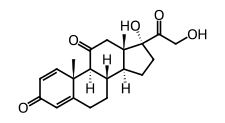
Prednisone
Athanor · official
C21H26O5 · 358.4 g/mol
IUPAC name: (8S,9S,10R,13S,14S,17R)-17-hydroxy-17-(2-hydroxyacetyl)-10,13-dimethyl-6,7,8,9,12,14,15,16-octahydrocyclopenta[a]phenanthrene-3,11-dione
Also called Deltasone, corticosteroid
 DangerMay damage fertility or the unborn child · Suspected of damaging fertility or the unborn child · Causes damage to organs through prolonged or repeated exposure · May causes damage to organs through prolonged or repeated exposure
Names and identifiers
- IUPAC name
- (8S,9S,10R,13S,14S,17R)-17-hydroxy-17-(2-hydroxyacetyl)-10,13-dimethyl-6,7,8,9,12,14,15,16-octahydrocyclopenta[a]phenanthrene-3,11-dione
- Synonyms
- Deltasone, corticosteroid, Dehydrocortisone
+ 36 more
Decortin, Meticorten, Metacortandracin, Supercortil, Paracort, Deltacortisone, Colisone, Decortisyl, Prednison, Orasone, 1,2-Dehydrocortisone, Di-Adreson, Ancortone, Bicortone, Decortancyl, Deltacortone, Hostacortin, Prednilonga, Servisone, Sterapred, Dacortin, Deltison, Encorton, Lodotra, Cortan, Delta-Cortelan, Prednicen-M, Delta-Dome, Ultracortene, Cortidelt, Dekortin, Delta E, Enkorton, Lisacort, Prednizon, Pronison
- Molecular formula
- C21H26O5
- Empirical formula
- C21H26O5
- Molecular weight
- 358.4 g/mol
- Exact mass
- 358.17802
- CAS number
- 53-03-2
- PubChem CID
- 5865
- Canonical SMILES
- CC12CC(=O)C3C(C1CCC2(C(=O)CO)O)CCC4=CC(=O)C=CC34C
- Isomeric SMILES
- C[C@]12CC(=O)[C@H]3[C@H]([C@@H]1CC[C@@]2(C(=O)CO)O)CCC4=CC(=O)C=C[C@]34C
- InChI
- InChI=1S/C21H26O5/c1-19-7-5-13(23)9-12(19)3-4-14-15-6-8-21(26,17(25)11-22)20(15,2)10-16(24)18(14)19/h5,7,9,14-15,18,22,26H,3-4,6,8,10-11H2,1-2H3/t14-,15-,18+,19-,20-,21-/m0/s1
- InChIKey
- XOFYZVNMUHMLCC-ZPOLXVRWSA-N
- Molfile
Names, InChI and the identifiers from PubChem, retrieved 2026-10-14.
Physical properties
- Appearance
- White to practically white, crystalline powder[2]
2 values
From Hazardous Substances Data Bank (HSDB), the most authoritative source here.
Value As written Source – Prednisone is an odorless white crystalline powder. (NTP, 1992) [1] CAMEO Chemicalscites National Toxicology Program, Institute of Environmental Health Sciences, National Institutes of Health (NTP). 1992. National Toxicology Program Chemical Repository Database. Research Triangle Park, North Carolina. –shown White to practically white, crystalline powder [2] Hazardous Substances Data Bank (HSDB)cites Osol, A. and J.E. Hoover, et al. (eds.). Remington's Pharmaceutical Sciences. 15th ed. Easton, Pennsylvania: Mack Publishing Co., 1975., p. 897 - Odor
- Odorless[2]
- Melting point
- 233 to 235 °C (451 to 455 °F) (DEC) (NTP, 1992)[1]
- Solubility in water
- Very slightly soluble (NTP, 1992)[1]
- log P
- log Kow = 1.46[2]
Each value as its source reports it, with the source's number after it (listed under References). Where several sources report a property, the row shows the value most of them agree on, the rule the app uses; open the values to see every one.
Calculated
- Heavy atoms
- 26
- Rings
- 4
- Aromatic rings
- 0
- Fraction sp³ carbons (Fsp3)
- 0.67
- H-bond donors
- 2
- H-bond acceptors
- 5
- Rotatable bonds
- 2
- TPSA (Ų)
- 91.7
- Formal charge
- 0
- XLogP3
- 1.5 PubChem
- Complexity
- 764 PubChem
- Stereocenters
- 6 definedCIP: C2: S · C6: S · C7: S · C16: R · C18: S · C21: R
- Double-bond geometry
- None specified
- Point group
- C1 of one 3D conformer with its hydrogens, by Athanor’s engine (as in the app)
Elemental analysis
- C70.37%
- H7.31%
- O22.32%
Isotope pattern
Each peak is a nominal mass with its abundance-weighted exact mass, as a percentage of the tallest, from IUPAC natural isotope abundances.
Computed from the structure with RDKit 2026.09 when this page was built, beside PubChem's own computed values from its record; where the two differ, both are shown.
Predicted
- log P
- 1.77 Crippen (Wildman and Crippen 1999)
- log S (water solubility)
- -3.04 ESOL (Delaney 2004), log mol/L
- Synthetic accessibility
- 4.39 SA score, 1 easy to 10 hard (Ertl and Schuffenhauer 2009)
Drug-likeness: Lipinski’s rule of five
- Molecular weight ≤ 500: 358.43
- log P ≤ 5 (Crippen): 1.77
- H-bond donors ≤ 5: 2
- H-bond acceptors ≤ 10: 5
Passes all four rules.
¹³C NMR shifts, predicted
Predictions, not measurements; each names its method. A measured log P, where a source reports one, is under Physical properties.
Safety
Danger
Most widely reported: 169 company reports to ECHA. Source [3].
- Health hazard
- H360May damage fertility or the unborn child (33.7% of reports)
- H361Suspected of damaging fertility or the unborn child (65.1% of reports)
- H372Causes damage to organs through prolonged or repeated exposure (32% of reports)
- H373May causes damage to organs through prolonged or repeated exposure (20.1% of reports)
Precautionary statements: P203, P260, P264, P270, P280, P318, P319, P405, P501
View all classifications (2)
- [3] European Chemicals Agency (ECHA) · 169 reports · DangerH360, H361, H372, H373
- [2] Hazardous Substances Data Bank (HSDB) · WarningH361
First aid
- Eyes: First check the victim for contact lenses and remove if present. Flush victim's eyes with water or normal saline solution for 20 to 30 minutes while simultaneously calling a hospital or poison control center. Do not put any ointments, oils, or medication in the victim's eyes without specific instructions from a physician. Immediately transport the victim after flushing eyes to a hospital even if no symptoms (such as redness or irritation) develop. Skin: Immediately flood affected skin with water while removing and isolating all contaminated clothing.[1]
Storage
- Keep container tightly closed in a dry and well-ventilated place.[2]
- Prednisone tablets should be stored in well closed containers at a temperature less than 40 °C, preferably between 15-30 °C. Prednisone syrup should be stored in tight containers. Prednisone oral solution and oral concentrate solution should be stored in tight containers at 15-30 °C.[2]
Incompatibilities
- Incompatible materials: Strong oxidizing agents[2]
Safety data sheets on the supplier’s page: MedChemexpress MCE, Sigma-Aldrich, AKos Consulting & Solutions.
Always read the supplier’s safety data sheet before working with it.
Spectra
- 1H NMRSpectraBase (Varian CFT-20)
- 13C NMRSpectraBase
- GC-MSSpectraBase
- MS-MSHuman Metabolome Database (HMDB) (Positive) · Human Metabolome Database (HMDB) (Positive) · Human Metabolome Database (HMDB) (Positive) · Human Metabolome Database (HMDB) (Positive) · Human Metabolome Database (HMDB) (Positive) · Human Metabolome Database (HMDB) (Positive)
- LC-MSMassBank Europe (Exploris 480 Orbitrap (Thermo Scientific) · LC-ESI-QFT · POSITIVE) · MassBank Europe (Exploris 480 Orbitrap (Thermo Scientific) · LC-ESI-QFT · NEGATIVE) · MassBank Europe (Bruker maXis Impact · LC-ESI-QTOF · POSITIVE) · MassBank Europe (Bruker maXis Impact · LC-ESI-QTOF · POSITIVE) · MassBank Europe (Bruker maXis Impact · LC-ESI-QTOF · POSITIVE) · MassBank Europe (Bruker maXis Impact · LC-ESI-QTOF · POSITIVE)
- Other MSHazardous Substances Data Bank (HSDB) · MassBank of North America (MoNA) (Agilent 6560 · positive) · MassBank of North America (MoNA) (Agilent 6560 · positive)
- UVHazardous Substances Data Bank (HSDB)
- UV-VISSpectraBase
- IRHazardous Substances Data Bank (HSDB)
- FTIRSpectraBase (KBr WAFER)
- ATR-IRSpectraBase (Bio-Rad FTS · ATR-Neat (DuraSamplIR II))
- RamanSpectraBase (FT-Raman)
Experimental spectra held by these sources; each link opens the source's own record.
Literature
Reading PubChem, OpenAlex and GSRS…
Bioactivity
Reading ChEMBL…
References
- [1]CAMEO Chemicals · Public domain (NOAA) · via PubChem · retrieved 2026-10-14
- [2]Hazardous Substances Data Bank (HSDB) · Public domain (US NLM) · via PubChem · retrieved 2026-10-14
- [3]European Chemicals Agency (ECHA) · ECHA legal notice: reuse with acknowledgement · via PubChem · retrieved 2026-10-14
- [4]SpectraBase · Linked only · via PubChem · retrieved 2026-10-14
- [5]Human Metabolome Database (HMDB) · Linked only · via PubChem · retrieved 2026-10-14
- [6]MassBank Europe · Linked only · via PubChem · retrieved 2026-10-14
- [7]MassBank of North America (MoNA) · CC BY 4.0 · via PubChem · retrieved 2026-10-14
- ·Calculated values: computed by Athanor with RDKit 2026.09 from the structure.
- ·Literature on PubChem
Data last updated 2026-10-14.