
Folic acid
Athanor · official
C19H19N7O6 · 441.4 g/mol
IUPAC name: (2S)-2-[[4-[(2-amino-4-oxo-3H-pteridin-6-yl)methylamino]benzoyl]amino]pentanedioic acid
Also called vitamin B9, folate, pteroylglutamic acid, vitamin M, folacin
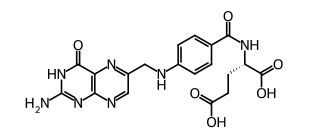
Names and identifiers
- IUPAC name
- (2S)-2-[[4-[(2-amino-4-oxo-3H-pteridin-6-yl)methylamino]benzoyl]amino]pentanedioic acid
- Synonyms
- vitamin B9, folate, pteroylglutamic acid
+ 40 more
vitamin M, folacin, Pteroylglutamic acid, Vitamin M, Folacid, Folacin, Vitamin Bc, PteGlu, Vitamin B9, Foliamin, Folicet, Folvite, Incafolic, Acifolic, Cytofol, Folcidin, Folettes, Folipac, Folsan, Millafol, Folsaure, Pteroyl-L-glutamic acid, Folbal, Folsav, Vitamin Be, Foldine, Pteroylmonoglutamic acid, Pteroyl-L-monoglutamic acid, Facid, Antianemia factor, Factor U, Folico (Italy), Folina (Italy), Acfol (Spain), Folasic (Australia), Usaf cb-13, Foldine [France], Acidum folicum, Acido folico, Dosfolat B activ
- Molecular formula
- C19H19N7O6
- Empirical formula
- C19H19N7O6
- Molecular weight
- 441.4 g/mol
- Exact mass
- 441.13968
- CAS number
- 59-30-3
- PubChem CID
- 135398658
- Canonical SMILES
- C1=CC(=CC=C1C(=O)NC(CCC(=O)O)C(=O)O)NCC2=CN=C3C(=N2)C(=O)NC(=N3)N
- Isomeric SMILES
- C1=CC(=CC=C1C(=O)N[C@@H](CCC(=O)O)C(=O)O)NCC2=CN=C3C(=N2)C(=O)NC(=N3)N
- InChI
- InChI=1S/C19H19N7O6/c20-19-25-15-14(17(30)26-19)23-11(8-22-15)7-21-10-3-1-9(2-4-10)16(29)24-12(18(31)32)5-6-13(27)28/h1-4,8,12,21H,5-7H2,(H,24,29)(H,27,28)(H,31,32)(H3,20,22,25,26,30)/t12-/m0/s1
- InChIKey
- OVBPIULPVIDEAO-LBPRGKRZSA-N
- Molfile
Names, InChI and the identifiers from PubChem, retrieved 2026-10-14.
Physical properties
- Appearance
- Folic acid appears as odorless orange-yellow needles or platelets. Darkens and chars from approximately 250 °C (482 °F).[1]
- Odor
- Odorless or almost odorless[2]
- Melting point
- 250 °C (482 °F) (decomposes) (NTP, 1992)[1]
- Solubility in water
- Almost insoluble (NTP, 1992)[1]
- log P
- log Kow = -2.81 (estimated)[2]
- pKa
- Reported, but no value passed the checks.
The value and why
- pKa = 3.5, 4.3 (carboxylic acid moieties) /Estimated/ (could not be read; source [2])
- Vapor pressure
- 6.2 × 10⁻²⁰ mmHg at 25 °C (estimated)[2]
Each value as its source reports it, with the source's number after it (listed under References). Where several sources report a property, the row shows the value most of them agree on, the rule the app uses; open the values to see every one.
Calculated
- Heavy atoms
- 32
- Rings
- 3
- Aromatic rings
- 3
- Fraction sp³ carbons (Fsp3)
- 0.21
- H-bond donors
- 6
- H-bond acceptors
- 9 computed here · PubChem 10
- Rotatable bonds
- 9
- TPSA (Ų)
- 213.3 computed here · PubChem 209
- Formal charge
- 0
- XLogP3
- -1.1 PubChem
- Complexity
- 767 PubChem
- Stereocenters
- 1 definedCIP: C17: S
- Double-bond geometry
- None specified
- Point group
- C1 of one 3D conformer with its hydrogens, by Athanor’s engine (as in the app)
Elemental analysis
- C51.70%
- H4.34%
- N22.21%
- O21.75%
Isotope pattern
Each peak is a nominal mass with its abundance-weighted exact mass, as a percentage of the tallest, from IUPAC natural isotope abundances.
Computed from the structure with RDKit 2026.09 when this page was built, beside PubChem's own computed values from its record; where the two differ, both are shown.
Predicted
- log P
- -0.04 Crippen (Wildman and Crippen 1999)
- log S (water solubility)
- -2.32 ESOL (Delaney 2004), log mol/L
- Synthetic accessibility
- 3.05 SA score, 1 easy to 10 hard (Ertl and Schuffenhauer 2009)
Drug-likeness: Lipinski’s rule of five
- Molecular weight ≤ 500: 441.4
- log P ≤ 5 (Crippen): -0.04
- H-bond donors ≤ 5: 6
- H-bond acceptors ≤ 10: 9
Breaks 1 of the four rules.
¹³C NMR shifts, predicted
Predictions, not measurements; each names its method. A measured log P, where a source reports one, is under Physical properties.
Safety
This chemical does not meet GHS hazard criteria for 92.6% (188 of 203) of all reports.[3]
First aid
- Eyes: First check the victim for contact lenses and remove if present. Flush victim's eyes with water or normal saline solution for 20 to 30 minutes while simultaneously calling a hospital or poison control center. Do not put any ointments, oils, or medication in the victim's eyes without specific instructions from a physician. Immediately transport the victim after flushing eyes to a hospital even if no symptoms (such as redness or irritation) develop. Skin: Immediately flood affected skin with water while removing and isolating all contaminated clothing.[1]
Storage
- Store below 40 °C (104 °F), preferably between 15 and 30 °C (59 and 86 °F), unless otherwise specified by manufacturer. Protect from freezing.[2]
Incompatibilities
- Folic acid is incompatible with oxidizing and reducing agents and with heavy metal ions.[2]
Safety data sheets on the supplier’s page: Veeprho, Aladdin Scientific, Xianglong Pharmaceutical Standards (XL Standards).
Always read the supplier’s safety data sheet before working with it.
Spectra
- 1H NMRHuman Metabolome Database (HMDB) (Varian · 500 MHz · Water) · Human Metabolome Database (HMDB) (JEOL · 400 MHz · DMSO-d6) · Human Metabolome Database (HMDB) (Bruker · D2O) · SpectraBase
- 13C NMRHuman Metabolome Database (HMDB) (JEOL · 22.53 MHz · DMSO-d6) · Human Metabolome Database (HMDB) (Bruker · D2O) · SpectraBase
- 1H-13C NMRHuman Metabolome Database (HMDB) (Bruker · 600 MHz · Water)
- MS-MSHuman Metabolome Database (HMDB) (Quattro_QQQ · Positive) · Human Metabolome Database (HMDB) (Quattro_QQQ · Positive) · Human Metabolome Database (HMDB) (Quattro_QQQ · Positive) · Human Metabolome Database (HMDB) (Positive) · Human Metabolome Database (HMDB) (Positive) · Human Metabolome Database (HMDB) (Positive)
- LC-MSMassBank Europe (Exploris 480 Orbitrap (Thermo Scientific) · LC-ESI-QFT · POSITIVE) · MassBank Europe (Exploris 480 Orbitrap (Thermo Scientific) · LC-ESI-QFT · NEGATIVE) · MassBank Europe (Agilent 6530 QTOF · LC-ESI-QTOF · POSITIVE) · MassBank Europe (Agilent 6530 QTOF · LC-ESI-QTOF · POSITIVE) · MassBank Europe (maXis plus UHR-ToF-MS, Bruker Daltonics · LC-ESI-QTOF · POSITIVE) · MassBank Europe (maXis plus UHR-ToF-MS, Bruker Daltonics · LC-ESI-QTOF · POSITIVE)
- Other MSHazardous Substances Data Bank (HSDB) · MassBank of North America (MoNA) (Agilent 6550 iFunnel · Q-TOF · ESI) · MassBank of North America (MoNA) (Agilent 6550 iFunnel · Q-TOF · ESI) · MassBank of North America (MoNA) (TQD, Waters · Flow-injection QqQ/MS · ESI)
- UVHazardous Substances Data Bank (HSDB)
- IRHazardous Substances Data Bank (HSDB)
- FTIRSpectraBase (KBr WAFER)
- RamanSpectraBase (FT-Raman)
Experimental spectra held by these sources; each link opens the source's own record.
Literature
Reading PubChem, OpenAlex and GSRS…
Bioactivity
Reading ChEMBL…
References
- [1]CAMEO Chemicals · Public domain (NOAA) · via PubChem · retrieved 2026-10-14
- [2]Hazardous Substances Data Bank (HSDB) · Public domain (US NLM) · via PubChem · retrieved 2026-10-14
- [3]European Chemicals Agency (ECHA) · ECHA legal notice: reuse with acknowledgement · via PubChem · retrieved 2026-10-14
- [4]Human Metabolome Database (HMDB) · Linked only · via PubChem · retrieved 2026-10-14
- [5]SpectraBase · Linked only · via PubChem · retrieved 2026-10-14
- [6]NIST Mass Spectrometry Data Center · Linked only · via PubChem · retrieved 2026-10-14
- [7]MassBank Europe · Linked only · via PubChem · retrieved 2026-10-14
- [8]MassBank of North America (MoNA) · CC BY 4.0 · via PubChem · retrieved 2026-10-14
- ·Calculated values: computed by Athanor with RDKit 2026.09 from the structure.
- ·Literature on PubChem
Data last updated 2026-10-14.