
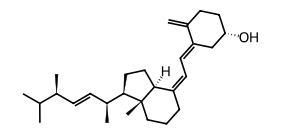
Ergocalciferol
Athanor · official
C28H44O · 396.6 g/mol
IUPAC name: (1S,3Z)-3-[(2E)-2-[(1R,3aS,7aR)-1-[(E,2R,5R)-5,6-dimethylhept-3-en-2-yl]-7a-methyl-2,3,3a,5,6,7-hexahydro-1H-inden-4-ylidene]ethylidene]-4-methylidenecyclohexan-1-ol
Also called vitamin D2, vitamin D, calciferol

 DangerToxic if swallowed · Toxic in contact with skin · Fatal if inhaled
Names and identifiers
- IUPAC name
- (1S,3Z)-3-[(2E)-2-[(1R,3aS,7aR)-1-[(E,2R,5R)-5,6-dimethylhept-3-en-2-yl]-7a-methyl-2,3,3a,5,6,7-hexahydro-1H-inden-4-ylidene]ethylidene]-4-methylidenecyclohexan-1-ol
- Synonyms
- vitamin D2, vitamin D, calciferol
+ 38 more
VITAMIN D2, Calciferol, Viosterol, Deltalin, Ergorone, Oleovitamin D2, Drisdol, Ostelin, Ercalciol, Sterogyl, Detalup, Condocaps, Crystallina, Fortodyl, Mulsiferol, Radsterin, Condol, Deratol, Diactol, Ertron, Geltabs, Daral, Novovitamin-D, Divit urto, D-Tracetten, Hi-Deratol, Calciferon 2, Dee-Ronal, Vitavel-D, Dee-Ron, Vio-D, Rodine C, Calciferolum, Hyperkil, Rodinec, Ergocalciferolum, Mina D2, Radiostol
- Molecular formula
- C28H44O
- Empirical formula
- C28H44O
- Molecular weight
- 396.6 g/mol
- Exact mass
- 396.33922
- CAS number
- 50-14-6
- PubChem CID
- 5280793
- Canonical SMILES
- CC(C)C(C)C=CC(C)C1CCC2C1(CCCC2=CC=C3CC(CCC3=C)O)C
- Isomeric SMILES
- C[C@H](/C=C/[C@H](C)C(C)C)[C@H]1CC[C@@H]\2[C@@]1(CCC/C2=C\C=C/3\C[C@H](CCC3=C)O)C
- InChI
- InChI=1S/C28H44O/c1-19(2)20(3)9-10-22(5)26-15-16-27-23(8-7-17-28(26,27)6)12-13-24-18-25(29)14-11-21(24)4/h9-10,12-13,19-20,22,25-27,29H,4,7-8,11,14-18H2,1-3,5-6H3/b10-9+,23-12+,24-13-/t20-,22+,25-,26+,27-,28+/m0/s1
- InChIKey
- MECHNRXZTMCUDQ-RKHKHRCZSA-N
- Molfile
Names, InChI and the identifiers from PubChem, retrieved 2026-10-14.
Physical properties
- Appearance
- White crystals[2]
3 values
From Hazardous Substances Data Bank (HSDB), the most authoritative source here.
Value As written Source – Ergocalciferol appears as odorless white crystals. Used as a dietary supplement and food additive. (EPA, 1998) [1] CAMEO Chemicalscites U.S. Environmental Protection Agency. 1998. Extremely Hazardous Substances (EHS) Chemical Profiles and Emergency First Aid Guides. Washington, D.C.: U.S. Government Printing Office. –shown White crystals [2] Hazardous Substances Data Bank (HSDB)cites Lewis, R.J., Sr (Ed.). Hawley's Condensed Chemical Dictionary. 13th ed. New York, NY: John Wiley & Sons, Inc. 1997., p. 452 – Colorless crystals [2] Hazardous Substances Data Bank (HSDB)cites Tomlin CDS, ed; The e-Pesticide Manual. Ergocalciferol. 13th ed. PC CD-ROM, Version 3.0, 2003-04. Surrey, UK: British Crop Protection Council, (2003) - Odor
- Odorless[2]
- Melting point
- 116.5 °C[2]
2 values
2 of 2 sources agree on it (most common value).
Value As written Source 115 to 118 °C 239 to 244 °F (EPA, 1998) [1] CAMEO Chemicalscites U.S. Environmental Protection Agency. 1998. Extremely Hazardous Substances (EHS) Chemical Profiles and Emergency First Aid Guides. Washington, D.C.: U.S. Government Printing Office. 116.5 °Cshown 116.5 °C [2] Hazardous Substances Data Bank (HSDB)cites Lide, D.R., G.W.A. Milne (eds.). Handbook of Data on Organic Compounds. Volume I. 3rd ed. CRC Press, Inc. Boca Raton ,FL. 1994., p. V5: 4913 - Solubility in water
- In water, 50 mg/L at 25 °C[2]
4 values
From Hazardous Substances Data Bank (HSDB), the most authoritative source here.
Value As written Source – Soluble in alcohol, chloroform, ether, and fatty oils. [2] Hazardous Substances Data Bank (HSDB)cites Osol, A. and J.E. Hoover, et al. (eds.). Remington's Pharmaceutical Sciences. 15th ed. Easton, Pennsylvania: Mack Publishing Co., 1975., p. 940 – SOL IN FATTY ACIDS [2] Hazardous Substances Data Bank (HSDB)cites Sax, N.I. Dangerous Properties of Industrial Materials. 6th ed. New York, NY: Van Nostrand Reinhold, 1984., p. 1294 – Solubility in acetone 69.5, benzene 10, hexane 1 (all in g/L, room temperature) [2] Hazardous Substances Data Bank (HSDB)cites Tomlin CDS, ed; The e-Pesticide Manual. Ergocalciferol. 13th ed. PC CD-ROM, Version 3.0, 2003-04. Surrey, UK: British Crop Protection Council, (2003) –shown In water, 50 mg/L at 25 °C [2] Hazardous Substances Data Bank (HSDB)cites Tomlin CDS, ed; The e-Pesticide Manual. Ergocalciferol. 13th ed. PC CD-ROM, Version 3.0, 2003-04. Surrey, UK: British Crop Protection Council, (2003) - log P
- log Kow = 10.44 (estimated)[2]
Each value as its source reports it, with the source's number after it (listed under References). Where several sources report a property, the row shows the value most of them agree on, the rule the app uses; open the values to see every one.
Calculated
- Heavy atoms
- 29
- Rings
- 3
- Aromatic rings
- 0
- Fraction sp³ carbons (Fsp3)
- 0.71
- H-bond donors
- 1
- H-bond acceptors
- 1
- Rotatable bonds
- 5
- TPSA (Ų)
- 20.2
- Formal charge
- 0
- XLogP3
- 7.4 PubChem
- Complexity
- 678 PubChem
- Stereocenters
- 6 definedCIP: C2: S · C5: R · C10: R · C13: S · C18: R · C24: S
- Double-bond geometry
- C3=C4: E · C14=C20: Z · C21=C22: E
- Point group
- C1 of one 3D conformer with its hydrogens, by Athanor’s engine (as in the app)
Elemental analysis
- C84.79%
- H11.18%
- O4.03%
Isotope pattern
Each peak is a nominal mass with its abundance-weighted exact mass, as a percentage of the tallest, from IUPAC natural isotope abundances.
Computed from the structure with RDKit 2026.09 when this page was built, beside PubChem's own computed values from its record; where the two differ, both are shown.
Predicted
- log P
- 7.64 Crippen (Wildman and Crippen 1999)
- log S (water solubility)
- -6.78 ESOL (Delaney 2004), log mol/L
- Synthetic accessibility
- 4.6 SA score, 1 easy to 10 hard (Ertl and Schuffenhauer 2009)
Drug-likeness: Lipinski’s rule of five
- Molecular weight ≤ 500: 396.66
- log P ≤ 5 (Crippen): 7.64
- H-bond donors ≤ 5: 1
- H-bond acceptors ≤ 10: 1
Breaks 1 of the four rules.
¹³C NMR shifts, predicted
Predictions, not measurements; each names its method. A measured log P, where a source reports one, is under Physical properties.
Safety
Danger
Harmonized EU classification (CLP Annex VI). Source [3].
- Acute toxicity
- Health hazard
- H301Toxic if swallowed
- H311Toxic in contact with skin
- H330Fatal if inhaled
Precautionary statements: P260, P262, P264, P270, P271, P280, P284, P301+P316, P302+P352, P304+P340, P316, P319, P320, P321, P330, P361+P364, P403+P233, P405, P501
View all classifications (2)
- [3] Regulation (EC) No 1272/2008 of the European Parliament and of the Council · DangerH301, H311, H330
- [4] European Chemicals Agency (ECHA) · 249 reports · DangerH300+H310+H330, H300, H301, H310, H311, H330, H372, H413
First aid
- Note: Emesis, activated charcoal, and cathartics are seldom necessary with acute ingestion unless extremely large amounts are ingested (more than 100 times the Recommended Daily Allowance for Vitamin D2). Signs and Symptoms of Acute Ergocalciferol Exposure: Signs and symptoms of acute exposure to ergocalciferol may include the following: Thirst, itching, fatigue, muscular weakness, nervousness, headache, nausea, vomiting, and diarrhea.[1]
Storage
- Ergocalciferol capsules, oral solution, and tablets should be stored in tight, light-resistant containers at a temperature less than 40 °C, preferably between 15-30 °C.[2]
- Ergocalciferol injection should be protected from light and stored at a temperature less than 40 °C, preferably between 15-30 °C.[2]
Safety data sheets on the supplier’s page: BLD Pharm, AbaChemScene, Sigma-Aldrich.
Always read the supplier’s safety data sheet before working with it.
Spectra
- NMRHazardous Substances Data Bank (HSDB)
- 1H NMRHuman Metabolome Database (HMDB) (Bruker · 600 MHz · CDCl3) · SpectraBase
- 13C NMRSpectraBase
- 1H-13C NMRHuman Metabolome Database (HMDB) (Bruker · 600 MHz · CDCl3)
- GC-MSHuman Metabolome Database (HMDB) (GC-MS) · MassBank of North America (MoNA) (GC-MS)
- MS-MSHuman Metabolome Database (HMDB) (LC-ESI-QTOF · positive) · Human Metabolome Database (HMDB) (LC-ESI-QTOF (UPLC Q-Tof Premier, Waters) · Positive) · Human Metabolome Database (HMDB) (Quattro_QQQ · Positive) · Human Metabolome Database (HMDB) (Quattro_QQQ · Positive)
- LC-MSMassBank Europe (UPLC Q-Tof Premier, Waters · LC-ESI-QTOF · POSITIVE) · MassBank of North America (MoNA) (Quattro_QQQ · positive) · MassBank of North America (MoNA) (UPLC Q-Tof Premier, Waters · LC-ESI-QTOF · ESI) · MassBank of North America (MoNA) (Q-Tof Premier, Waters · LC-Q-TOF/MS · ESI)
- Other MSHazardous Substances Data Bank (HSDB) · MassBank of North America (MoNA) (TQD, Waters · Flow-injection QqQ/MS · ESI) · MassBank of North America (MoNA) (TQD, Waters · Flow-injection QqQ/MS · ESI)
- UVHazardous Substances Data Bank (HSDB)
- IRHazardous Substances Data Bank (HSDB)
- ATR-IRSpectraBase (Bio-Rad FTS · ATR-Neat (DuraSamplIR II) ground)
- RamanSpectraBase (FT-Raman)
Experimental spectra held by these sources; each link opens the source's own record.
Literature
Reading PubChem, OpenAlex and GSRS…
Bioactivity
Reading ChEMBL…
References
- [1]CAMEO Chemicals · Public domain (NOAA) · via PubChem · retrieved 2026-10-14
- [2]Hazardous Substances Data Bank (HSDB) · Public domain (US NLM) · via PubChem · retrieved 2026-10-14
- [3]Regulation (EC) No 1272/2008 of the European Parliament and of the Council · EU reuse policy, CC BY 4.0 · via PubChem · retrieved 2026-10-14
- [4]European Chemicals Agency (ECHA) · ECHA legal notice: reuse with acknowledgement · via PubChem · retrieved 2026-10-14
- [5]Human Metabolome Database (HMDB) · Linked only · via PubChem · retrieved 2026-10-14
- [6]SpectraBase · Linked only · via PubChem · retrieved 2026-10-14
- [7]MassBank of North America (MoNA) · CC BY 4.0 · via PubChem · retrieved 2026-10-14
- [8]MassBank Europe · Linked only · via PubChem · retrieved 2026-10-14
- ·Calculated values: computed by Athanor with RDKit 2026.09 from the structure.
- ·Literature on PubChem
Data last updated 2026-10-14.