
Testosterone
Athanor · official
C19H28O2 · 288.4 g/mol
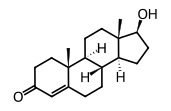
IUPAC name: (8R,9S,10R,13S,14S,17S)-17-hydroxy-10,13-dimethyl-1,2,6,7,8,9,11,12,14,15,16,17-dodecahydrocyclopenta[a]phenanthren-3-one
Also called Androgel, androgen, male sex hormone


 DangerHarmful if swallowed · May cause cancer · Suspected of causing cancer · May damage fertility or the unborn child · Suspected of damaging fertility or the unborn child · May cause harm to breast-fed children · Causes damage to organs through prolonged or repeated exposure · Very toxic to aquatic life · Very toxic to aquatic life with long lasting effects
Names and identifiers
- IUPAC name
- (8R,9S,10R,13S,14S,17S)-17-hydroxy-10,13-dimethyl-1,2,6,7,8,9,11,12,14,15,16,17-dodecahydrocyclopenta[a]phenanthren-3-one
- Synonyms
- Androgel, androgen, male sex hormone
+ 38 more
Virosterone, Homosterone, Mertestate, Testim, Androderm, Testosteron, Androlin, Sustanon, Testiculosterone, Orquisteron, Primoteston, Testosteroid, Andrusol, Homosteron, Primotest, Sustanone, Testobase, Testoderm, Testrone, Testryl, Teslen, Synandrol F, Andronaq, Neotestis, Testandrone, Testogel, Testopropon, Relibra, Cristerona T, Testoviron Schering, Testoviron T, Geno-cristaux gremy, Andropatch, trans-Testosterone, 17beta-Hydroxyandrost-4-en-3-one, Testostosterone, Sustason 250, Percutacrine androgenique
- Molecular formula
- C19H28O2
- Empirical formula
- C19H28O2
- Molecular weight
- 288.4 g/mol
- Exact mass
- 288.20893
- CAS number
- 58-22-0
- PubChem CID
- 6013
- Canonical SMILES
- CC12CCC3C(C1CCC2O)CCC4=CC(=O)CCC34C
- Isomeric SMILES
- C[C@]12CC[C@H]3[C@H]([C@@H]1CC[C@@H]2O)CCC4=CC(=O)CC[C@]34C
- InChI
- InChI=1S/C19H28O2/c1-18-9-7-13(20)11-12(18)3-4-14-15-5-6-17(21)19(15,2)10-8-16(14)18/h11,14-17,21H,3-10H2,1-2H3/t14-,15-,16-,17-,18-,19-/m0/s1
- InChIKey
- MUMGGOZAMZWBJJ-DYKIIFRCSA-N
- Molfile
Names, InChI and the identifiers from PubChem, retrieved 2026-10-14.
Physical properties
- Appearance
- White or slightly cream-white crystals or crystalline powder[2]
2 values
From Hazardous Substances Data Bank (HSDB), the most authoritative source here.
Value As written Source – White or slightly cream-white crystals or crystalline powder. [1] Occupational Safety and Health Administration (OSHA) –shown White or slightly cream-white crystals or crystalline powder [2] Hazardous Substances Data Bank (HSDB)cites Larranaga, M.D., Lewis, R.J. Sr., Lewis, R.A.; Hawley's Condensed Chemical Dictionary 16th Edition. John Wiley & Sons, Inc. Hoboken, NJ 2016., p. 1313 - Odor
- Odorless[2]
- Melting point
- 151.0 °C[2]
3 values
Sources disagree; from Hazardous Substances Data Bank (HSDB), the most authoritative.
Value As written Source 151.0 °Cshown 151.0 °C [2] Hazardous Substances Data Bank (HSDB)cites Larranaga, M.D., Lewis, R.J. Sr., Lewis, R.A.; Hawley's Condensed Chemical Dictionary 16th Edition. John Wiley & Sons, Inc. Hoboken, NJ 2016., p. 3-304 153 to 157 °C MP: 153-157 °C [2] Hazardous Substances Data Bank (HSDB)cites Larranaga, M.D., Lewis, R.J. Sr., Lewis, R.A.; Hawley's Condensed Chemical Dictionary 16th Edition. John Wiley & Sons, Inc. Hoboken, NJ 2016., p. 1313 155 °C 311 °F [1] Occupational Safety and Health Administration (OSHA) - Solubility in water
- Insoluble in water[2]
3 values
From Hazardous Substances Data Bank (HSDB), the most authoritative source here.
Value As written Source – In water, 23.4 mg/L at 25 °C [2] Hazardous Substances Data Bank (HSDB)cites Yalkowsky, S.H., He, Yan, Jain, P. Handbook of Aqueous Solubility Data Second Edition. CRC Press, Boca Raton, FL 2010, p. 1205 –shown Insoluble in water [2] Hazardous Substances Data Bank (HSDB)cites Larranaga, M.D., Lewis, R.J. Sr., Lewis, R.A.; Hawley's Condensed Chemical Dictionary 16th Edition. John Wiley & Sons, Inc. Hoboken, NJ 2016., p. 3-304 – In ethanol: 1 in 5; in chloroform: 1 in 2; in diethyl ether: 1 in 100; in ethyl oleate: 1 in 150. Sol in acetone, dioxane and fixed oils [2] Hazardous Substances Data Bank (HSDB)cites IARC. Monographs on the Evaluation of the Carcinogenic Risk of Chemicals to Humans. Geneva: World Health Organization, International Agency for Research on Cancer, 1972-PRESENT. (Multivolume work). - log P
- log Kow = 3.32[2]
- Vapor pressure
- Reported, but no value passed the checks.
The value and why
- 1.7x10⁻⁸ mmHg (est) (no temperature given; source [1])
Each value as its source reports it, with the source's number after it (listed under References). Where several sources report a property, the row shows the value most of them agree on, the rule the app uses; open the values to see every one.
Calculated
- Heavy atoms
- 21
- Rings
- 4
- Aromatic rings
- 0
- Fraction sp³ carbons (Fsp3)
- 0.84
- H-bond donors
- 1
- H-bond acceptors
- 2
- Rotatable bonds
- 0
- TPSA (Ų)
- 37.3
- Formal charge
- 0
- XLogP3
- 3.3 PubChem
- Complexity
- 508 PubChem
- Stereocenters
- 6 definedCIP: C2: S · C5: S · C6: R · C15: R · C17: S · C20: S
- Double-bond geometry
- None specified
- Point group
- C1 of one 3D conformer with its hydrogens, by Athanor’s engine (as in the app)
Elemental analysis
- C79.12%
- H9.79%
- O11.09%
Isotope pattern
Each peak is a nominal mass with its abundance-weighted exact mass, as a percentage of the tallest, from IUPAC natural isotope abundances.
Computed from the structure with RDKit 2026.09 when this page was built, beside PubChem's own computed values from its record; where the two differ, both are shown.
Predicted
- log P
- 3.88 Crippen (Wildman and Crippen 1999)
- log S (water solubility)
- -4.07 ESOL (Delaney 2004), log mol/L
- Synthetic accessibility
- 3.9 SA score, 1 easy to 10 hard (Ertl and Schuffenhauer 2009)
Drug-likeness: Lipinski’s rule of five
- Molecular weight ≤ 500: 288.43
- log P ≤ 5 (Crippen): 3.88
- H-bond donors ≤ 5: 1
- H-bond acceptors ≤ 10: 2
Passes all four rules.
¹³C NMR shifts, predicted
Predictions, not measurements; each names its method. A measured log P, where a source reports one, is under Physical properties.
Safety
Danger
Most widely reported: 231 company reports to ECHA. Source [3].
- Harmful or irritant
- Health hazard
- Environmental hazard
- H302Harmful if swallowed (64.9% of reports)
- H350May cause cancer (34.2% of reports)
- H351Suspected of causing cancer (66.2% of reports)
- H360May damage fertility or the unborn child (76.2% of reports)
- H361Suspected of damaging fertility or the unborn child (19% of reports)
- H362May cause harm to breast-fed children (28.1% of reports)
- H372Causes damage to organs through prolonged or repeated exposure (15.6% of reports)
- H400Very toxic to aquatic life (64.9% of reports)
- H410Very toxic to aquatic life with long lasting effects (15.2% of reports)
Precautionary statements: P203, P260, P263, P264, P270, P273, P280, P301+P317, P318, P319, P330, P391, P405, P501
View all classifications (2)
- [3] European Chemicals Agency (ECHA) · 231 reports · DangerH302, H350, H351, H360, H361, H362, H372, H400, H410
- [2] Hazardous Substances Data Bank (HSDB) · DangerH302, H351, H360, H400
Storage
- Keep container tightly closed in a dry and well-ventilated place. Storage class (TRGS 510): Non-combustible, acute toxic Cat.3 / toxic hazardous materials or hazardous materials causing chronic effects.[2]
- Commercially available testosterone preparations should be stored at a temperature less than 40 °C, preferably between 15-30 °C; freezing of the sterile suspension and injections should be avoided. A precipitate may form if the injections are stored at a low temperature; however, this will dissolve after shaking and warming to room temperature. Use of a wet needle or syringe may cause the parenteral solutions to become cloudy; however, this will not affect potency.[2]
Incompatibilities
- Incompatible materials: Strong oxidizing agents.[2]
Always read the supplier’s safety data sheet before working with it.
Spectra
- NMRHazardous Substances Data Bank (HSDB)
- 1H NMRHuman Metabolome Database (HMDB) (Varian · 500 MHz · CDCl3) · Human Metabolome Database (HMDB) (JEOL · 400 MHz · CDCl3) · SpectraBase (Varian A-60)
- 13C NMRHazardous Substances Data Bank (HSDB) · Human Metabolome Database (HMDB) (JEOL · 100.54 MHz · CDCl3) · SpectraBase
- 1H-13C NMRHuman Metabolome Database (HMDB) (Bruker · 600 MHz · CDCl3)
- GC-MSHuman Metabolome Database (HMDB) (GC-MS) · Human Metabolome Database (HMDB) (GC-MS) · Human Metabolome Database (HMDB) (GC-MS) · Human Metabolome Database (HMDB) (GC-MS) · Human Metabolome Database (HMDB) (EI-B · positive) · Human Metabolome Database (HMDB) (EI-B · positive)
- MS-MSHuman Metabolome Database (HMDB) (Positive) · Human Metabolome Database (HMDB) (Positive) · Human Metabolome Database (HMDB) (Positive) · Human Metabolome Database (HMDB) (Positive) · Human Metabolome Database (HMDB) (Positive) · Human Metabolome Database (HMDB) (Positive)
- LC-MSMassBank Europe (Agilent 6560 QTOF · LC-ESI-QTOF · POSITIVE) · MassBank Europe (Agilent 6560 QTOF · LC-ESI-QTOF · POSITIVE) · MassBank Europe (Agilent 6560 QTOF · LC-ESI-QTOF · POSITIVE) · MassBank Europe (Bruker maXis Impact · LC-ESI-QTOF · POSITIVE) · MassBank Europe (Bruker maXis Impact · LC-ESI-QTOF · POSITIVE) · MassBank Europe (Bruker maXis Impact · LC-ESI-QTOF · POSITIVE)
- Other MSHazardous Substances Data Bank (HSDB) · MassBank Europe (JEOL JMS-01-SG-2 · EI-B · POSITIVE) · MassBank Europe (HITACHI RMU-6E · EI-B · POSITIVE) · MassBank Europe (HITACHI M-80 · EI-B · POSITIVE) · MassBank of North America (MoNA) (Agilent 6560 · positive) · MassBank of North America (MoNA) (Agilent 6560 · positive)
- UVHazardous Substances Data Bank (HSDB)
- IRHazardous Substances Data Bank (HSDB)
- FTIRSpectraBase (KBr WAFER)
- ATR-IRSpectraBase (Bio-Rad FTS · ATR-Neat (DuraSamplIR II))
- RamanSpectraBase (FT-Raman)
Experimental spectra held by these sources; each link opens the source's own record.
Literature
Reading PubChem, OpenAlex and GSRS…
Bioactivity
Reading ChEMBL…
References
- [1]Occupational Safety and Health Administration (OSHA) · Public domain (US DOL) · via PubChem · retrieved 2026-10-14
- [2]Hazardous Substances Data Bank (HSDB) · Public domain (US NLM) · via PubChem · retrieved 2026-10-14
- [3]European Chemicals Agency (ECHA) · ECHA legal notice: reuse with acknowledgement · via PubChem · retrieved 2026-10-14
- [4]Human Metabolome Database (HMDB) · Linked only · via PubChem · retrieved 2026-10-14
- [5]SpectraBase · Linked only · via PubChem · retrieved 2026-10-14
- [6]MassBank of North America (MoNA) · CC BY 4.0 · via PubChem · retrieved 2026-10-14
- [7]NIST Mass Spectrometry Data Center · Linked only · via PubChem · retrieved 2026-10-14
- [8]MassBank Europe · Linked only · via PubChem · retrieved 2026-10-14
- ·Calculated values: computed by Athanor with RDKit 2026.09 from the structure.
- ·Literature on PubChem
Data last updated 2026-10-14.