
Erythromycin
Athanor · official
C37H67NO13 · 733.9 g/mol
IUPAC name: 6-[4-(dimethylamino)-3-hydroxy-6-methyloxan-2-yl]oxy-14-ethyl-7,12,13-trihydroxy-4-(5-hydroxy-4-methoxy-4,6-dimethyloxan-2-yl)oxy-3,5,7,9,11,13-hexamethyl-oxacyclotetradecane-2,10-dione
Also called Erythrocin, macrolide, EES
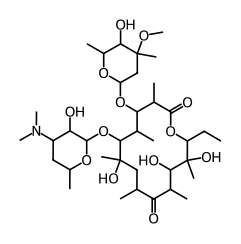
Names and identifiers
- IUPAC name
- 6-[4-(dimethylamino)-3-hydroxy-6-methyloxan-2-yl]oxy-14-ethyl-7,12,13-trihydroxy-4-(5-hydroxy-4-methoxy-4,6-dimethyloxan-2-yl)oxy-3,5,7,9,11,13-hexamethyl-oxacyclotetradecane-2,10-dione
- Synonyms
- Erythrocin, macrolide, EES
+ 38 more
DTXSID90859206, 6-((4-(Dimethylamino)-3-hydroxy-6-methyloxan-2-yl)oxy)-14-ethyl-7,12,13-trihydroxy-4-((5-hydroxy-4-methoxy-4,6-dimethyloxan-2-yl)oxy)-3,5,7,9,11,13-hexamethyl-1-oxacyclotetradecane-2,10-dione, 6-{[4-(Dimethylamino)-3-hydroxy-6-methyloxan-2-yl]oxy}-14-ethyl-7,12,13-trihydroxy-4-[(5-hydroxy-4-methoxy-4,6-dimethyloxan-2-yl)oxy]-3,5,7,9,11,13-hexamethyl-1-oxacyclotetradecane-2,10-dione, RefChem:1073650, DTXCID80196652, Erythromid, Abboticin, Erycinum, Ilocaps, Erycin, Kesso-Mycin, Taimoxin-F, Pantomicina, ERYTHROMYCIN A DIHYDRATE, erythro, Ermycin, E- mycin, Erycin, Robimysin, Erycen, Erytab, Inderm, Aknin, Theramycin Z, Ak-Mycin, C37H67NO13, IndermRetcin, Erythromycin D3, Erythromycin, sodium salt, CHEMBL1671887, component of Drixin (Salt/Mix), SCHEMBL15263177, BDBM86313, component of T-stat (Salt/Mix), Erythromycin sodium lauryl sulfate, ULGZDMOVFRHVEP-UHFFFAOYSA-N, HMS5079F04, NSC_12560, s1635, SBB057401
- Molecular formula
- C37H67NO13
- Empirical formula
- C37H67NO13
- Molecular weight
- 733.9 g/mol
- Exact mass
- 733.46124
- CAS number
- 114-07-8
- PubChem CID
- 3255
- Canonical SMILES
- CCC1C(C(C(C(=O)C(CC(C(C(C(C(C(=O)O1)C)OC2CC(C(C(O2)C)O)(C)OC)C)OC3C(C(CC(O3)C)N(C)C)O)(C)O)C)C)O)(C)O
- Isomeric SMILES
- CCC1C(C(C(C(=O)C(CC(C(C(C(C(C(=O)O1)C)OC2CC(C(C(O2)C)O)(C)OC)C)OC3C(C(CC(O3)C)N(C)C)O)(C)O)C)C)O)(C)O
- InChI
- InChI=1S/C37H67NO13/c1-14-25-37(10,45)30(41)20(4)27(39)18(2)16-35(8,44)32(51-34-28(40)24(38(11)12)15-19(3)47-34)21(5)29(22(6)33(43)49-25)50-26-17-36(9,46-13)31(42)23(7)48-26/h18-26,28-32,34,40-42,44-45H,14-17H2,1-13H3
- InChIKey
- ULGZDMOVFRHVEP-UHFFFAOYSA-N
- Molfile
Names, InChI and the identifiers from PubChem, retrieved 2026-10-14.
Calculated
- Heavy atoms
- 51
- Rings
- 3
- Aromatic rings
- 0
- Fraction sp³ carbons (Fsp3)
- 0.95
- H-bond donors
- 5
- H-bond acceptors
- 14
- Rotatable bonds
- 7
- TPSA (Ų)
- 193.9 computed here · PubChem 194
- Formal charge
- 0
- XLogP3
- 2.7 PubChem
- Complexity
- 1180 PubChem
- Stereocenters
- 0 defined, 18 undefinedCIP: C3: undefined · C7: undefined · C9: undefined · C11: undefined · C13: undefined · C17: undefined · C19: undefined · C22: undefined · C24: undefined · C26: undefined · C28: undefined · C31: undefined
- Double-bond geometry
- None specified
- Point group
- C1 of one 3D conformer with its hydrogens, by Athanor’s engine (as in the app)
Elemental analysis
- C60.55%
- H9.20%
- N1.91%
- O28.34%
Isotope pattern
Each peak is a nominal mass with its abundance-weighted exact mass, as a percentage of the tallest, from IUPAC natural isotope abundances.
Computed from the structure with RDKit 2026.09 when this page was built, beside PubChem's own computed values from its record; where the two differ, both are shown.
Predicted
- log P
- 1.79 Crippen (Wildman and Crippen 1999)
- log S (water solubility)
- -5.05 ESOL (Delaney 2004), log mol/L
- Synthetic accessibility
- 6.09 SA score, 1 easy to 10 hard (Ertl and Schuffenhauer 2009)
Drug-likeness: Lipinski’s rule of five
- Molecular weight ≤ 500: 733.94
- log P ≤ 5 (Crippen): 1.79
- H-bond donors ≤ 5: 5
- H-bond acceptors ≤ 10: 14
Breaks 2 of the four rules.
¹³C NMR shifts, predicted
Predictions, not measurements; each names its method. A measured log P, where a source reports one, is under Physical properties.
Safety
No GHS hazard classification was found in the sources.
Safety data sheets on the supplier’s page: Chem-Space.com Database, Shenghe Chemical, Cooke Chemical Co., Ltd.
Always read the supplier’s safety data sheet before working with it.
Spectra
- 13C NMRSpectraBase (Varian HR-220)
- GC-MSNIST Mass Spectrometry Data Center · NIST Mass Spectrometry Data Center · SpectraBase
- LC-MSMassBank of North America (MoNA) (LTQ Orbitrap XL Thermo Scientific · LC-ESI-ITFT · ESI) · MassBank of North America (MoNA) (LTQ Orbitrap XL Thermo Scientific · LC-ESI-ITFT · ESI) · MassBank of North America (MoNA) (LTQ Orbitrap XL Thermo Scientific · LC-ESI-ITFT · ESI) · SpectraBase (Thermo Fisher Q Exactive Orbitrap · HCD)
Experimental spectra held by these sources; each link opens the source's own record.
Literature
Reading PubChem, OpenAlex and GSRS…
Bioactivity
Reading ChEMBL…
References
- [1]SpectraBase · Linked only · via PubChem · retrieved 2026-10-14
- [2]NIST Mass Spectrometry Data Center · Linked only · via PubChem · retrieved 2026-10-14
- [3]MassBank of North America (MoNA) · CC BY 4.0 · via PubChem · retrieved 2026-10-14
- ·Calculated values: computed by Athanor with RDKit 2026.09 from the structure.
- ·Literature on PubChem
Data last updated 2026-10-14.