
Ciprofloxacin
Athanor · official
C17H18FN3O3 · 331.34 g/mol
IUPAC name: 1-cyclopropyl-6-fluoro-4-oxo-7-piperazin-1-ylquinoline-3-carboxylic acid
Also called Cipro, fluoroquinolone
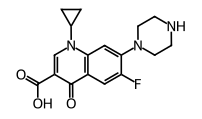
Names and identifiers
- IUPAC name
- 1-cyclopropyl-6-fluoro-4-oxo-7-piperazin-1-ylquinoline-3-carboxylic acid
- Synonyms
- Cipro, fluoroquinolone, Ciprofloxacine
+ 36 more
Ciprobay, Ciprofloxacina, 1-Cyclopropyl-6-fluoro-1,4-dihydro-4-oxo-7-(1-piperazinyl)-3-quinolinecarboxylic acid, Ciprofloxacino, Ciprofloxacinum, 1-cyclopropyl-6-fluoro-4-oxo-7-(piperazin-1-yl)-1,4-dihydroquinoline-3-carboxylic acid, Ciprocinol, Bacquinor, Cifloxin, Ciprodar, Otiprio, BAY q 3939, CPFX, BAYQ3939, 1-cyclopropyl-6-fluoro-4-oxo-7-piperazin-1-ylquinoline-3-carboxylic acid, 1-Cyclopropyl-6-fluoro-4-oxo-7-(1-piperazinyl)-1,4-dihydro-3-quinolinecarboxylic acid, 1-CYCLOPROPYL-6-FLUORO-4-OXO-7-PIPERAZIN-1-YL-1,4-DIHYDROQUINOLINE-3-CARBOXYLIC ACID, Velmonit, NSC-758467, 5E8K9I0O4U, CIPRO IN DEXTROSE 5% IN PLASTIC CONTAINER, DTXSID8022824, BAY O 9867 FREE BASE, BAY-O-9867 FREE BASE, BAY-Q-3939, CIPRO IN SODIUM CHLORIDE 0.9% IN PLASTIC CONTAINER, 3-Quinolinecarboxylic acid, 1-cyclopropyl-6-fluoro-1,4-dihydro-4-oxo-7-(1-piperazinyl)-, Bay 09867, CHEBI:100241, 3-Quinolinecarboxylic acid, 1,4-dihydro-1-cyclopropyl-6-fluoro-4-oxo-7-(1-piperazinyl)-, 1-Cyclopropyl-6-fluoro-4-oxo-7-piperazin-1-yl-1,4-dihydro-quinoline-3-carboxylic acid, 1-cyclopropyl-6-fluoro-7-hexahydro-1-pyrazinyl-4-oxo-1,4-dihydro-3-quinolinecarboxylic acid, 1-Cyclopropyl-6-fluoro-7-(4-methyl-piperazin-1-yl)-4-oxo-1,4-dihydro-quinoline-3-carboxylic acid, Ciprofloxacin In Dextrose 5%, 1-cyclopropyl-6-fluoro-4-oxo-7-piperazin-4-ium-1-ylquinoline-3-carboxylate, RefChem:6412
- Molecular formula
- C17H18FN3O3
- Empirical formula
- C17H18FN3O3
- Molecular weight
- 331.34 g/mol
- Exact mass
- 331.13322
- CAS number
- 85721-33-1
- PubChem CID
- 2764
- Canonical SMILES
- C1CC1N2C=C(C(=O)C3=CC(=C(C=C32)N4CCNCC4)F)C(=O)O
- Isomeric SMILES
- C1CC1N2C=C(C(=O)C3=CC(=C(C=C32)N4CCNCC4)F)C(=O)O
- InChI
- InChI=1S/C17H18FN3O3/c18-13-7-11-14(8-15(13)20-5-3-19-4-6-20)21(10-1-2-10)9-12(16(11)22)17(23)24/h7-10,19H,1-6H2,(H,23,24)
- InChIKey
- MYSWGUAQZAJSOK-UHFFFAOYSA-N
- Molfile
Names, InChI and the identifiers from PubChem, retrieved 2026-10-14.
Physical properties
- Appearance
- Faint to light yellow crystalline powder[1]
- Solubility in water
- In water, 30,000 mg/L at 20 °C[1]
3 values
From Hazardous Substances Data Bank (HSDB), the most authoritative source here.
Value As written Source – Water Solubility: approx 36 mg/ml @ 25 °C /Ciprofloxacin hydrochloride/ [1] Hazardous Substances Data Bank (HSDB)cites McEvoy, G.K. (ed.). American Hospital Formulary Service- Drug Information 2001. Bethesda, MD: American Society of Health-System Pharmacists, Inc. 2001 (Plus Supplements)., p. 739 – Soluble in dilute (0.1N) hydrochloric acid; practically insoluble in ethanol [1] Hazardous Substances Data Bank (HSDB)cites Physicians' Desk Reference. 55th ed. Montvale, NJ: Medical Economics Co, p. 852 (2001) –shown In water, 30,000 mg/L at 20 °C [1] Hazardous Substances Data Bank (HSDB)cites Nowara A et al; J Agric Food Chem 45: 1459-1463 (1997) - log P
- log Kow = 0.28 (non-ionized)[1]
- pKa
- pKa = 6.09 (carboxylic acid group)[1]
2 values
Only one source reports it.
Value As written Source –shown pKa = 6.09 (carboxylic acid group) [1] Hazardous Substances Data Bank (HSDB)cites Torniainen K et al; Int J Pharm 132: 53-61 (1996) – pKa = 8.74 (nitrogen on piperazinyl ring) [1] Hazardous Substances Data Bank (HSDB)cites Torniainen K et al; Int J Pharm 132: 53-61 (1996)
Each value as its source reports it, with the source's number after it (listed under References). Where several sources report a property, the row shows the value most of them agree on, the rule the app uses; open the values to see every one.
Calculated
- Heavy atoms
- 24
- Rings
- 4
- Aromatic rings
- 2
- Fraction sp³ carbons (Fsp3)
- 0.41
- H-bond donors
- 2
- H-bond acceptors
- 4 computed here · PubChem 7
- Rotatable bonds
- 3
- TPSA (Ų)
- 74.6 computed here · PubChem 72.9
- Formal charge
- 0
- XLogP3
- -1.1 PubChem
- Complexity
- 571 PubChem
- Stereocenters
- None
- Double-bond geometry
- None specified
- Point group
- C1 of one 3D conformer with its hydrogens, by Athanor’s engine (as in the app)
Elemental analysis
- C61.62%
- H5.48%
- F5.73%
- N12.68%
- O14.49%
Isotope pattern
Each peak is a nominal mass with its abundance-weighted exact mass, as a percentage of the tallest, from IUPAC natural isotope abundances.
Computed from the structure with RDKit 2026.09 when this page was built, beside PubChem's own computed values from its record; where the two differ, both are shown.
Predicted
- log P
- 1.58 Crippen (Wildman and Crippen 1999)
- log S (water solubility)
- -3 ESOL (Delaney 2004), log mol/L
- Synthetic accessibility
- 2.47 SA score, 1 easy to 10 hard (Ertl and Schuffenhauer 2009)
Drug-likeness: Lipinski’s rule of five
- Molecular weight ≤ 500: 331.35
- log P ≤ 5 (Crippen): 1.58
- H-bond donors ≤ 5: 2
- H-bond acceptors ≤ 10: 4
Passes all four rules.
¹³C NMR shifts, predicted
Predictions, not measurements; each names its method. A measured log P, where a source reports one, is under Physical properties.
Safety
Most widely reported: 102 company reports to ECHA. Source [2].
- H412Harmful to aquatic life with long lasting effects (26.5% of reports)
Precautionary statements: P273, P501
Storage
- Ciprofloxacin hydrochloride conventional tablets should be stored in tight containers at a temperature less than 30 °C, and protected from intense UV light. Extended-release tablets containing ciprofloxacin hydrochloride and base (Cipro XR) and extended-release tablets containing ciprofloxacin hydrochloride (ProQuin XR) should be stored at 25 °C, but may be exposed to temperatures ranging from 15-30 °C. Ciprofloxacin microcapsules for oral suspension and the diluent provided by the manufacturer should be stored at less than 25 °C and protected from freezing.[1]
- Ciprofloxacin for oral suspension: Prior to reconstitution, store below 25 °C (77 °F). Protect from freezing. After reconstitution, store below 30 °C (86 °F). Protect from freezing. The suspension is stable for 14 days when stored in a refrigerator or at room temperature below 39 °C or 86 °F.[1]
- Ciprofloxacin tablets USP: Store below 30 °C (86 °F) in a well closed container.[1]
- Ciprofloxacin injection USP: Store in a cool place between 8 and 15 °C (46-59 °F) or at controlled room temperature (between 20 and 25 °C (68 and 77 °F). ... Protect from light and freezing.[1]
Safety data sheets on the supplier’s page: AbaChemScene, Hairui Chemical, Enamine.
Always read the supplier’s safety data sheet before working with it.
Spectra
- 13C NMRSpectraBase
- 15N NMRSpectraBase
- GC-MSNIST Mass Spectrometry Data Center · SpectraBase (DI)
- MS-MSHuman Metabolome Database (HMDB) (Positive) · Human Metabolome Database (HMDB) (Positive) · Human Metabolome Database (HMDB) (Positive) · Human Metabolome Database (HMDB) (Positive) · Human Metabolome Database (HMDB) (Positive) · Human Metabolome Database (HMDB) (Positive)
- LC-MSMassBank Europe (Exploris 480 Orbitrap (Thermo Scientific) · LC-ESI-QFT · POSITIVE) · MassBank Europe (Bruker maXis Impact · LC-ESI-QTOF · POSITIVE) · MassBank Europe (Bruker maXis Impact · LC-ESI-QTOF · POSITIVE) · MassBank Europe (Bruker maXis Impact · LC-ESI-QTOF · POSITIVE) · MassBank Europe (Bruker maXis Impact · LC-ESI-QTOF · POSITIVE) · MassBank Europe (Bruker maXis Impact · LC-ESI-QTOF · POSITIVE)
- Other MSMassBank of North America (MoNA) (Orbitrap · positive) · MassBank of North America (MoNA) (Orbitrap · positive) · MassBank of North America (MoNA) (Orbitrap · positive)
- ATR-IRSpectraBase (Bio-Rad FTS · ATR-Neat (DuraSamplIR II))
- RamanSpectraBase (FT-Raman)
Experimental spectra held by these sources; each link opens the source's own record.
Literature
Reading PubChem, OpenAlex and GSRS…
Bioactivity
Reading ChEMBL…
References
- [1]Hazardous Substances Data Bank (HSDB) · Public domain (US NLM) · via PubChem · retrieved 2026-10-14
- [2]European Chemicals Agency (ECHA) · ECHA legal notice: reuse with acknowledgement · via PubChem · retrieved 2026-10-14
- [3]SpectraBase · Linked only · via PubChem · retrieved 2026-10-14
- [4]NIST Mass Spectrometry Data Center · Linked only · via PubChem · retrieved 2026-10-14
- [5]Human Metabolome Database (HMDB) · Linked only · via PubChem · retrieved 2026-10-14
- [6]MassBank Europe · Linked only · via PubChem · retrieved 2026-10-14
- [7]MassBank of North America (MoNA) · CC BY 4.0 · via PubChem · retrieved 2026-10-14
- ·Calculated values: computed by Athanor with RDKit 2026.09 from the structure.
- ·Literature on PubChem
Data last updated 2026-10-14.