
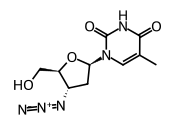
Zidovudine
Athanor · official
C10H13N5O4 · 267.24 g/mol
IUPAC name: 1-[(2R,4S,5S)-4-azido-5-(hydroxymethyl)oxolan-2-yl]-5-methylpyrimidine-2,4-dione
Also called AZT, Retrovir, azidothymidine, HIV
 DangerSuspected of causing genetic defects · May cause cancer · Suspected of causing cancer · Suspected of damaging fertility or the unborn child · Causes damage to organs through prolonged or repeated exposure
Names and identifiers
- IUPAC name
- 1-[(2R,4S,5S)-4-azido-5-(hydroxymethyl)oxolan-2-yl]-5-methylpyrimidine-2,4-dione
- Synonyms
- AZT, Retrovir, azidothymidine
+ 38 more
HIV, Azidothymidine, 3'-Azido-3'-deoxythymidine, Thymidine, 3'-azido-3'-deoxy-, Zidovudinum, Compound S, Zidovudina, BW A509U, zidovudin, BWA509U, BW-A-509U, 3'-Deoxy-3'-azidothymidine, BW-A509U, DTXSID8020127, DRG-0004, 3'-azt, 1-[(2R,4S,5S)-4-azido-5-(hydroxymethyl)oxolan-2-yl]-5-methylpyrimidine-2,4-dione, 3'-Azidothymidine, NSC 602670, 4B9XT59T7S, 1-[(2R,4S,5S)-4-azido-5-(hydroxymethyl)oxolan-2-yl]-5-methyl-1,2,3,4-tetrahydropyrimidine-2,4-dione, CHEBI:10110, BW-A 509U, NSC-602670, DTXCID60127, AZT Antiviral, TRIZIVIR COMPONENT ZIDOVUDINE, AZT, Antiviral, 1-(3-Azido-2,3-dideoxy-beta-D-ribofuranosyl)-5-methylpyrimidine-2,4-(1H,3H)-dione, AZT (Antiviral), Antiviral AZT, LAMIVUDINE/ZIDOVUDINE TEVA COMPONENT ZIDOVUDINE, 3'-Azido-2',3'-Dideoxythymidine, BWA-509U, 3' Azido 3' deoxythymidine, BWA 509U, 3' Azido 2',3' Dideoxythymidine, 1-((2R,4S,5S)-4-azido-5-(hydroxymethyl)oxolan-2-yl)-5-methylpyrimidine-2,4-dione
- Molecular formula
- C10H13N5O4
- Empirical formula
- C10H13N5O4
- Molecular weight
- 267.24 g/mol
- Exact mass
- 267.09675
- CAS number
- 30516-87-1
- PubChem CID
- 35370
- Canonical SMILES
- CC1=CN(C(=O)NC1=O)C2CC(C(O2)CO)N=[N+]=[N-]
- Isomeric SMILES
- CC1=CN(C(=O)NC1=O)[C@H]2C[C@@H]([C@H](O2)CO)N=[N+]=[N-]
- InChI
- InChI=1S/C10H13N5O4/c1-5-3-15(10(18)12-9(5)17)8-2-6(13-14-11)7(4-16)19-8/h3,6-8,16H,2,4H2,1H3,(H,12,17,18)/t6-,7+,8+/m0/s1
- InChIKey
- HBOMLICNUCNMMY-XLPZGREQSA-N
- Molfile
Names, InChI and the identifiers from PubChem, retrieved 2026-10-14.
Physical properties
- Appearance
- White to beige, crystalline solid[2]
2 values
From Hazardous Substances Data Bank (HSDB), the most authoritative source here.
Value As written Source – 3'-azido-3'-deoxythymidine is a slightly off-white odorless powdery solid. (NTP, 1992) [1] CAMEO Chemicalscites National Toxicology Program, Institute of Environmental Health Sciences, National Institutes of Health (NTP). 1992. National Toxicology Program Chemical Repository Database. Research Triangle Park, North Carolina. –shown White to beige, crystalline solid [2] Hazardous Substances Data Bank (HSDB)cites McEvoy, G.K. (ed.). American Hospital Formulary Service - Drug Information 2003. Bethesda, MD: American Society of Health-System Pharmacists, Inc. 2003 (Plus Supplements)., p. 737 - Odor
- Odorless[2]
- Melting point
- 106 to 112 °C (223 to 234 °F, NTP 1992)[1]
- Solubility in water
- 71 mg/ml in alc @ 25 °C[2]
3 values
From Hazardous Substances Data Bank (HSDB), the most authoritative source here.
Value As written Source – 10 to 50 mg/mL at 63 °F (NTP, 1992) [1] CAMEO Chemicalscites National Toxicology Program, Institute of Environmental Health Sciences, National Institutes of Health (NTP). 1992. National Toxicology Program Chemical Repository Database. Research Triangle Park, North Carolina. –shown 71 mg/ml in alc @ 25 °C [2] Hazardous Substances Data Bank (HSDB)cites McEvoy, G.K. (ed.). American Hospital Formulary Service - Drug Information 2003. Bethesda, MD: American Society of Health-System Pharmacists, Inc. 2003 (Plus Supplements)., p. 737 – In water, 20,000 mg/l @ 25 °C [2] Hazardous Substances Data Bank (HSDB)cites McEvoy, G.K. (ed.). American Hospital Formulary Service - Drug Information 2003. Bethesda, MD: American Society of Health-System Pharmacists, Inc. 2003 (Plus Supplements)., p. 737 - log P
- log Kow = 0.05[2]
- Vapor pressure
- 5.2 × 10⁻²⁰ mmHg @ 25 °C (estimated)[2]
Each value as its source reports it, with the source's number after it (listed under References). Where several sources report a property, the row shows the value most of them agree on, the rule the app uses; open the values to see every one.
Calculated
- Heavy atoms
- 19
- Rings
- 2
- Aromatic rings
- 1
- Fraction sp³ carbons (Fsp3)
- 0.6
- H-bond donors
- 2
- H-bond acceptors
- 5 computed here · PubChem 6
- Rotatable bonds
- 3
- TPSA (Ų)
- 133.1 computed here · PubChem 93.2
- Formal charge
- 0
- XLogP3
- 0 PubChem
- Complexity
- 484 PubChem
- Stereocenters
- 3 definedCIP: C5: R · C7: S · C11: S
- Double-bond geometry
- None specified
- Point group
- C1 of one 3D conformer with its hydrogens, by Athanor’s engine (as in the app)
Elemental analysis
- C44.94%
- H4.90%
- N26.21%
- O23.95%
Isotope pattern
Each peak is a nominal mass with its abundance-weighted exact mass, as a percentage of the tallest, from IUPAC natural isotope abundances.
Computed from the structure with RDKit 2026.09 when this page was built, beside PubChem's own computed values from its record; where the two differ, both are shown.
Predicted
- log P
- -0.2 Crippen (Wildman and Crippen 1999)
- log S (water solubility)
- -1.41 ESOL (Delaney 2004), log mol/L
- Synthetic accessibility
- 3.85 SA score, 1 easy to 10 hard (Ertl and Schuffenhauer 2009)
Drug-likeness: Lipinski’s rule of five
- Molecular weight ≤ 500: 267.25
- log P ≤ 5 (Crippen): -0.2
- H-bond donors ≤ 5: 2
- H-bond acceptors ≤ 10: 5
Passes all four rules.
¹³C NMR shifts, predicted
Predictions, not measurements; each names its method. A measured log P, where a source reports one, is under Physical properties.
Safety
Danger
Most widely reported: 99 company reports to ECHA. Source [3].
- Health hazard
- H341Suspected of causing genetic defects (54.5% of reports)
- H350May cause cancer (53.5% of reports)
- H351Suspected of causing cancer (45.5% of reports)
- H361Suspected of damaging fertility or the unborn child (54.5% of reports)
- H372Causes damage to organs through prolonged or repeated exposure (52.5% of reports)
Precautionary statements: P203, P260, P264, P270, P280, P318, P319, P405, P501
First aid
- Eyes: First check the victim for contact lenses and remove if present. Flush victim's eyes with water or normal saline solution for 20 to 30 minutes while simultaneously calling a hospital or poison control center. Do not put any ointments, oils, or medication in the victim's eyes without specific instructions from a physician. Immediately transport the victim after flushing eyes to a hospital even if no symptoms (such as redness or irritation) develop. Skin: Immediately flood affected skin with water while removing and isolating all contaminated clothing.[1]
Storage
- Commercially available zidovudine ... Should be stored @ 15-25 °C. Zidovudine may not be adversely affected by short-term exposure to heat and sunlight, but capsules of the drug may become discolored or brittle as a result of such exposure and should be protected from light, heat, and moisture.[2]
- Precautions FOR "carcinogens": Storage site should be as close as practical to lab in which carcinogens are to be used, so that only small quantities required for ... Expt need to be carried. Carcinogens should be kept in only one section of cupboard, an explosion-proof refrigerator or freezer (depending on chemicophysical properties ...) that bears appropriate label. An inventory ... Should be kept, showing quantity of carcinogen & date it was acquired ... Facilities for dispensing ... Should be contiguous to storage area. (chemical Carcinogens)[2]
Safety data sheets on the supplier’s page: abcr GmbH, Sigma-Aldrich, LGC Standards.
Always read the supplier’s safety data sheet before working with it.
Spectra
- 1H NMRHuman Metabolome Database (HMDB) (JEOL · 400 MHz · DMSO-d6) · SpectraBase (Bruker WM-250)
- 13C NMRHuman Metabolome Database (HMDB) (JEOL · 100.40 MHz · DMSO-d6) · SpectraBase
- GC-MSSpectraBase
- MS-MSHuman Metabolome Database (HMDB) (Negative) · Human Metabolome Database (HMDB) (Negative) · Human Metabolome Database (HMDB) (Positive) · Human Metabolome Database (HMDB) (Positive) · Human Metabolome Database (HMDB) (Positive) · Human Metabolome Database (HMDB) (Positive)
- LC-MSMassBank Europe (Exploris 480 Orbitrap (Thermo Scientific) · LC-ESI-QFT · NEGATIVE) · MassBank Europe (TripleTOF 5600 SCIEX · LC-ESI-QTOF · NEGATIVE) · MassBank Europe (TripleTOF 5600 SCIEX · LC-ESI-QTOF · NEGATIVE) · MassBank Europe (TripleTOF 5600 SCIEX · LC-ESI-QTOF · NEGATIVE) · MassBank Europe (TripleTOF 5600 SCIEX · LC-ESI-QTOF · NEGATIVE) · MassBank Europe (TripleTOF 5600 SCIEX · LC-ESI-QTOF · NEGATIVE)
- UVHazardous Substances Data Bank (HSDB)
- ATR-IRSpectraBase (Bio-Rad FTS · ATR-Neat (DuraSamplIR II))
- RamanSpectraBase (FT-Raman)
Experimental spectra held by these sources; each link opens the source's own record.
Literature
Reading PubChem, OpenAlex and GSRS…
Bioactivity
Reading ChEMBL…
References
- [1]CAMEO Chemicals · Public domain (NOAA) · via PubChem · retrieved 2026-10-14
- [2]Hazardous Substances Data Bank (HSDB) · Public domain (US NLM) · via PubChem · retrieved 2026-10-14
- [3]European Chemicals Agency (ECHA) · ECHA legal notice: reuse with acknowledgement · via PubChem · retrieved 2026-10-14
- [4]Human Metabolome Database (HMDB) · Linked only · via PubChem · retrieved 2026-10-14
- [5]SpectraBase · Linked only · via PubChem · retrieved 2026-10-14
- [6]NIST Mass Spectrometry Data Center · Linked only · via PubChem · retrieved 2026-10-14
- [7]MassBank Europe · Linked only · via PubChem · retrieved 2026-10-14
- [8]MassBank of North America (MoNA) · CC BY 4.0 · via PubChem · retrieved 2026-10-14
- ·Calculated values: computed by Athanor with RDKit 2026.09 from the structure.
- ·Literature on PubChem
Data last updated 2026-10-14.