
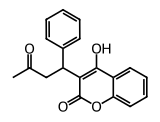
Warfarin
Athanor · official
C19H16O4 · 308.3 g/mol
IUPAC name: 4-hydroxy-3-(3-oxo-1-phenylbutyl)chromen-2-one
Also called Coumadin, Jantoven, anticoagulant


 DangerFatal if swallowed · Fatal in contact with skin · Fatal if inhaled · May damage the unborn child · Causes damage to organs through prolonged or repeated exposure · Toxic to aquatic life with long lasting effects
Names and identifiers
- IUPAC name
- 4-hydroxy-3-(3-oxo-1-phenylbutyl)chromen-2-one
- Synonyms
- Coumadin, Jantoven, anticoagulant
+ 38 more
Coumafene, Zoocoumarin, Coumafen, Brumolin, Coumefene, Dethmor, Kumader, Warfarine, Kumadu, Vampirinip II, Coumarins, Kypfarin, Rodafarin, Solfarin, Dethnel, Kumatox, Maveran, Ratron, Rosex, Temus W, Vampirinip iii, Athrombine-K, Frass-Ratron, Mar-Frin, Rattentraenke, Ratorex, Rattunal, Warfarat, CO-Rax, Rats-no-more, Tox-hid, Rat-Gard, Rat-Kill, Rat-Trol, Ratron G, Ratten-Koederrohr, Coumaphene, Rat-Mix
- Molecular formula
- C19H16O4
- Empirical formula
- C19H16O4
- Molecular weight
- 308.3 g/mol
- Exact mass
- 308.10486
- CAS number
- 81-81-2
- PubChem CID
- 54678486
- Canonical SMILES
- CC(=O)CC(C1=CC=CC=C1)C2=C(C3=CC=CC=C3OC2=O)O
- Isomeric SMILES
- CC(=O)CC(C1=CC=CC=C1)C2=C(C3=CC=CC=C3OC2=O)O
- InChI
- InChI=1S/C19H16O4/c1-12(20)11-15(13-7-3-2-4-8-13)17-18(21)14-9-5-6-10-16(14)23-19(17)22/h2-10,15,21H,11H2,1H3
- InChIKey
- PJVWKTKQMONHTI-UHFFFAOYSA-N
- Molfile
Names, InChI and the identifiers from PubChem, retrieved 2026-10-14.
Physical properties
- Appearance
- White powder[5]
6 values
From Hazardous Substances Data Bank (HSDB), the most authoritative source here.
Value As written Source – Warfarin is an odorless and colorless solid. Used as a rodenticide for Norway rats and for house mice. (EPA, 1998) [1] CAMEO Chemicalscites U.S. Environmental Protection Agency. 1998. Extremely Hazardous Substances (EHS) Chemical Profiles and Emergency First Aid Guides. Washington, D.C.: U.S. Government Printing Office. – COLOURLESS-TO-WHITE POWDER. [2] ILO-WHO International Chemical Safety Cards (ICSCs) – Colorless, odorless, crystalline powder or solid. [3] Occupational Safety and Health Administration (OSHA) – Colorless, odorless, crystalline powder. [Note: Rodenticide.] [4] The National Institute for Occupational Safety and Health (NIOSH) –shown White powder [5] Hazardous Substances Data Bank (HSDB)cites Crop Protection Handbook Volume 99, Meister Media Worldwide, Willoughby, OH 2013, p. 733 – The racemate forms colorless crystals [5] Hazardous Substances Data Bank (HSDB)cites MacBean C, ed; e-Pesticide Manual. 15th ed., ver. 5.1, Alton, UK; British Crop Protection Council. Warfarin (81-81-2) (2008-2010) - Odor
- Odorless[5]
- Melting point
- 161 °C[2]
5 values
5 of 5 sources agree on it (most common value).
Value As written Source 161 °C 322 °F (EPA, 1998) [1] CAMEO Chemicalscites U.S. Environmental Protection Agency. 1998. Extremely Hazardous Substances (EHS) Chemical Profiles and Emergency First Aid Guides. Washington, D.C.: U.S. Government Printing Office. 161 °Cshown 161 °C [2] ILO-WHO International Chemical Safety Cards (ICSCs) 161 °C 322 °F [3] Occupational Safety and Health Administration (OSHA) 161 °C 161 °C [6] PAC Chemical Database, U.S. Department of Energy 161 °C 322 °F [4] The National Institute for Occupational Safety and Health (NIOSH) - Boiling point
- 356 °C @760 [mmHg][6]
- Density
- Relative density (water = 1): 1.4[2]
- Solubility in water
- Solubility in water, g/100ml at 20 °C: 0.0017 (very poor)[2]
6 values
From ILO-WHO International Chemical Safety Cards (ICSCs), the most authoritative source here.
Value As written Source – 0.002 % (NIOSH, 2024) [1] CAMEO Chemicals – Solubility: 1 g in 1.5 mL water, 1.9 mL alcohol, >10,000 mL chloroform, >10,000 mL ether /Warfarin potassium/ [5] Hazardous Substances Data Bank (HSDB)cites Osol, A. (ed.). Remington's Pharmaceutical Sciences. 16th ed. Easton, Pennsylvania: Mack Publishing Co., 1980., p. 768 – In water, 17 mg/L at 20 °C [5] Hazardous Substances Data Bank (HSDB)cites MacBean C, ed; e-Pesticide Manual. 15th ed., ver. 5.1, Alton, UK; British Crop Protection Council. Warfarin (81-81-2) (2008-2010) – In acetone 65, chloroform 56, dioxane 100 (all in g/L, 20 °C) [5] Hazardous Substances Data Bank (HSDB)cites MacBean C, ed; e-Pesticide Manual. 15th ed., ver. 5.1, Alton, UK; British Crop Protection Council. Warfarin (81-81-2) (2008-2010) –shown Solubility in water, g/100ml at 20 °C: 0.0017 (very poor) [2] ILO-WHO International Chemical Safety Cards (ICSCs) – 0.002% [4] The National Institute for Occupational Safety and Health (NIOSH) - log P
- log Kow = 2.70[5]
2 values
Sources disagree; from Hazardous Substances Data Bank (HSDB), the most authoritative.
Value As written Source –shown log Kow = 2.70 [5] Hazardous Substances Data Bank (HSDB)cites Hansch, C., Leo, A., D. Hoekman. Exploring QSAR - Hydrophobic, Electronic, and Steric Constants. Washington, DC: American Chemical Society., 1995., p. 161 – 2.6 [2] ILO-WHO International Chemical Safety Cards (ICSCs) - pKa
- pKa = 5.87[5]
- Vapor pressure
- 0.09 mmHg at 22 °C (71 °F, NIOSH 2024)[1]
3 values
2 of 3 sources agree on it (most common value).
Value As written Source 0.09 mmHgshown 0.09 mmHg at 71 °F (NIOSH, 2024) [1] CAMEO Chemicals 0.09 mmHg 0.09 mmHg at 71 °F [3] Occupational Safety and Health Administration (OSHA) 0.00001 mmHg 0.00001 [mm Hg] @25 °C [6] PAC Chemical Database, U.S. Department of Energy 3 more values were reported but failed the checks (unreadable or out of range), so they are not shown.
Each value as its source reports it, with the source's number after it (listed under References). Where several sources report a property, the row shows the value most of them agree on, the rule the app uses; open the values to see every one.
Calculated
- Heavy atoms
- 23
- Rings
- 3
- Aromatic rings
- 3
- Fraction sp³ carbons (Fsp3)
- 0.16
- H-bond donors
- 1
- H-bond acceptors
- 4
- Rotatable bonds
- 4
- TPSA (Ų)
- 67.5 computed here · PubChem 63.6
- Formal charge
- 0
- XLogP3
- 2.7 PubChem
- Complexity
- 501 PubChem
- Stereocenters
- 0 defined, 1 undefinedCIP: C5: undefined
- Double-bond geometry
- None specified
- Point group
- C1 of one 3D conformer with its hydrogens, by Athanor’s engine (as in the app)
Elemental analysis
- C74.01%
- H5.23%
- O20.76%
Isotope pattern
Each peak is a nominal mass with its abundance-weighted exact mass, as a percentage of the tallest, from IUPAC natural isotope abundances.
Computed from the structure with RDKit 2026.09 when this page was built, beside PubChem's own computed values from its record; where the two differ, both are shown.
Predicted
- log P
- 3.61 Crippen (Wildman and Crippen 1999)
- log S (water solubility)
- -4.28 ESOL (Delaney 2004), log mol/L
- Synthetic accessibility
- 2.63 SA score, 1 easy to 10 hard (Ertl and Schuffenhauer 2009)
Drug-likeness: Lipinski’s rule of five
- Molecular weight ≤ 500: 308.33
- log P ≤ 5 (Crippen): 3.61
- H-bond donors ≤ 5: 1
- H-bond acceptors ≤ 10: 4
Passes all four rules.
¹³C NMR shifts, predicted
Predictions, not measurements; each names its method. A measured log P, where a source reports one, is under Physical properties.
Safety
Danger
Harmonized EU classification (CLP Annex VI). Source [7].
- Acute toxicity
- Health hazard
- Environmental hazard
- H300Fatal if swallowed
- H310Fatal in contact with skin
- H330Fatal if inhaled
- H360DMay damage the unborn child
- H372Causes damage to organs through prolonged or repeated exposure
- H411Toxic to aquatic life with long lasting effects
Precautionary statements: P203, P260, P262, P264, P270, P271, P273, P280, P284, P301+P316, P302+P352, P304+P340, P316, P318, P319, P320, P321, P330, P361+P364, P391, P403+P233, P405, P501
View all classifications (2)
- [7] Regulation (EC) No 1272/2008 of the European Parliament and of the Council · DangerH300, H310, H330, H360D, H372, H411
- [8] European Chemicals Agency (ECHA) · 201 reports · DangerH300, H310, H312, H319, H330, H360, H372, H411, H412
Exposure limits
First aid
- Signs and Symptoms of Warfarin Exposure: Warfarin is an anticoagulant. Hemorrhage is the most common sign and may be manifested by hemorrhagic skin rashes and lip, nose, and upper airway bleeding. Upper airway pain, difficulty in speaking and swallowing, and dyspnea (shortness of breath) may occur. Vomiting, abdominal pain, and bloody stools are common. Back pain may be noted. Emergency Life-Support Procedures: Acute exposure to warfarin may require decontamination and life support for the victims.[1]
- (General first aid procedures) Eye: Irrigate immediately - If this chemical contacts the eyes, immediately wash (irrigate) the eyes with large amounts of water, occasionally lifting the lower and upper lids. Get medical attention immediately. Skin: Soap wash promptly - If this chemical contacts the skin, promptly wash the contaminated skin with soap and water. If this chemical penetrates the clothing, promptly remove the clothing and wash the skin with soap and water.[4]
- Refer for medical attention.[2]
- Remove contaminated clothes. Rinse and then wash skin with water and soap. Refer immediately for medical attention .[2]
Storage
- Separated from strong oxidants and food and feedstuffs. Well closed. Store in an area without drain or sewer access.[2]
- Warfarin (therapeutic) prepn should be stored at a temp less than 40 °C, preferably between 15-30 °C; warfarin potassium & warfarin sodium tablets should be stored in tight, light-resistant containers & warfarin sodium powder for injection should be protected from light. Reconstituted solutions of warfarin sodium should be used immediately. (warfarin potassium & warfarin sodium)[5]
- Do not store near feed and food. ... Store away from heat and open flames.[5]
Incompatibilities
Safety data sheets on the supplier’s page: Enamine, Hunan Huateng Pharmaceutical Co., Ltd., AA BLOCKS.
Always read the supplier’s safety data sheet before working with it.
Spectra
- 1H NMRHuman Metabolome Database (HMDB) (Bruker · 600 MHz · CD3OD) · SpectraBase (Bruker AM-360)
- 13C NMRSpectraBase
- 1H-13C NMRHuman Metabolome Database (HMDB) (Bruker · 600 MHz · CD3OD)
- GC-MSHuman Metabolome Database (HMDB) (EI-B · positive) · MassBank of North America (MoNA) (HITACHI M-80 · EI-B · positive) · MassBank of North America (MoNA) (HITACHI M-80 · EI-B · positive) · NIST Mass Spectrometry Data Center · NIST Mass Spectrometry Data Center · NIST Mass Spectrometry Data Center
- MS-MSHuman Metabolome Database (HMDB) (Negative) · Human Metabolome Database (HMDB) (Positive) · Human Metabolome Database (HMDB) (Negative) · Human Metabolome Database (HMDB) (Positive) · Human Metabolome Database (HMDB) (Positive) · Human Metabolome Database (HMDB) (Negative)
- LC-MSMassBank Europe (Exploris 480 Orbitrap (Thermo Scientific) · LC-ESI-QFT · POSITIVE) · MassBank Europe (Exploris 480 Orbitrap (Thermo Scientific) · LC-ESI-QFT · NEGATIVE) · MassBank Europe (Bruker maXis Impact · LC-ESI-QTOF · POSITIVE) · MassBank Europe (Bruker maXis Impact · LC-ESI-QTOF · POSITIVE) · MassBank Europe (Bruker maXis Impact · LC-ESI-QTOF · POSITIVE) · MassBank Europe (Bruker maXis Impact · LC-ESI-QTOF · POSITIVE)
- Other MSHazardous Substances Data Bank (HSDB) · MassBank Europe (HITACHI M-80 · EI-B · POSITIVE)
- UVHazardous Substances Data Bank (HSDB)
- IRHazardous Substances Data Bank (HSDB)
- FTIRSpectraBase (KBr WAFER)
- ATR-IRSpectraBase (Bio-Rad FTS · ATR-Neat (DuraSamplIR II))
Experimental spectra held by these sources; each link opens the source's own record.
Literature
Reading PubChem, OpenAlex and GSRS…
Bioactivity
Reading ChEMBL…
References
- [1]CAMEO Chemicals · Public domain (NOAA) · via PubChem · retrieved 2026-10-14
- [2]ILO-WHO International Chemical Safety Cards (ICSCs) · CC BY 4.0 · via PubChem · retrieved 2026-10-14
- [3]Occupational Safety and Health Administration (OSHA) · Public domain (US DOL) · via PubChem · retrieved 2026-10-14
- [4]The National Institute for Occupational Safety and Health (NIOSH) · Public domain (US CDC) · via PubChem · retrieved 2026-10-14
- [5]Hazardous Substances Data Bank (HSDB) · Public domain (US NLM) · via PubChem · retrieved 2026-10-14
- [6]PAC Chemical Database, U.S. Department of Energy · Public domain (US DOE) · via PubChem · retrieved 2026-10-14
- [7]Regulation (EC) No 1272/2008 of the European Parliament and of the Council · EU reuse policy, CC BY 4.0 · via PubChem · retrieved 2026-10-14
- [8]European Chemicals Agency (ECHA) · ECHA legal notice: reuse with acknowledgement · via PubChem · retrieved 2026-10-14
- [9]Human Metabolome Database (HMDB) · Linked only · via PubChem · retrieved 2026-10-14
- [10]SpectraBase · Linked only · via PubChem · retrieved 2026-10-14
- [11]MassBank of North America (MoNA) · CC BY 4.0 · via PubChem · retrieved 2026-10-14
- [12]NIST Mass Spectrometry Data Center · Linked only · via PubChem · retrieved 2026-10-14
- [13]MassBank Europe · Linked only · via PubChem · retrieved 2026-10-14
- ·Calculated values: computed by Athanor with RDKit 2026.09 from the structure.
- ·Literature on PubChem
Data last updated 2026-10-14.