
Metoprolol
Athanor · official
C15H25NO3 · 267.36 g/mol
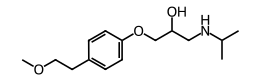
IUPAC name: 1-[4-(2-methoxyethyl)phenoxy]-3-(propan-2-ylamino)propan-2-ol
Also called Lopressor, Toprol, beta blocker


 WarningCauses skin irritation · Causes serious eye irritation · May cause respiratory irritation · Suspected of damaging the unborn child · Toxic to aquatic life with long lasting effects
Names and identifiers
- IUPAC name
- 1-[4-(2-methoxyethyl)phenoxy]-3-(propan-2-ylamino)propan-2-ol
- Synonyms
- Lopressor, Toprol, beta blocker
+ 37 more
(RS)-Metoprolol, Beatrolol, dl-Metoprolol, Seroken, Metoprololum, Spesikor, 1-(Isopropylamino)-3-(4-(2-methoxyethyl)phenoxy)propan-2-ol, CGP 2175, CGP-2175, Metoprolol slow release, DTXSID2023309, GEB06NHM23, 1-(isopropylamino)-3-[4-(2-methoxyethyl)phenoxy]propan-2-ol, 1-[4-(2-methoxyethyl)phenoxy]-3-(propan-2-ylamino)propan-2-ol, H-93/26, 2-Propanol, 1-(4-(2-methoxyethyl)phenoxy)-3-((1-methylethyl)amino)-, 2-Propanol, 1-[4-(2-methoxyethyl)phenoxy]-3-[(1-methylethyl)amino]-, CHEBI:6904, DTXCID503309, Betaloc-Astra, 1-(4-(2-methoxyethyl)phenoxy)-3-(propan-2-ylamino)propan-2-ol, Beloc Duriles, Betaloc Astra, {2-hydroxy-3-[4-(2-methoxyethyl)phenoxy]propyl}(propan-2-yl)amine, 1-(4-(2-Methoxyethyl)-phenoxy)-3-((1-methylethyl)amino)-2-propanol, CGP2175, metoprololo, (2-hydroxy-3-(4-(2-methoxyethyl)phenoxy)propyl)(propan-2-yl)amine, metoprolol CR-XL, Metoprolol CR XL, RefChem:6036, H 9326, H 93 26, C07AB02, 2-Propanol, 1-(4-(2-methoxyethyl)phenoxy)-3-((1-methylethyl)amino)-, (+-)-, (+-)-1-(Isopropylamino)-3-(p-(beta-methoxyethyl)phenoxy)-2-propanol, 253-483-7
- Molecular formula
- C15H25NO3
- Empirical formula
- C15H25NO3
- Molecular weight
- 267.36 g/mol
- Exact mass
- 267.18344
- CAS number
- 37350-58-6
- PubChem CID
- 4171
- Canonical SMILES
- CC(C)NCC(COC1=CC=C(C=C1)CCOC)O
- Isomeric SMILES
- CC(C)NCC(COC1=CC=C(C=C1)CCOC)O
- InChI
- InChI=1S/C15H25NO3/c1-12(2)16-10-14(17)11-19-15-6-4-13(5-7-15)8-9-18-3/h4-7,12,14,16-17H,8-11H2,1-3H3
- InChIKey
- IUBSYMUCCVWXPE-UHFFFAOYSA-N
- Molfile
Names, InChI and the identifiers from PubChem, retrieved 2026-10-14.
Physical properties
- log P
- log Kow = 1.88[1]
Each value as its source reports it, with the source's number after it (listed under References). Where several sources report a property, the row shows the value most of them agree on, the rule the app uses; open the values to see every one.
Calculated
- Heavy atoms
- 19
- Rings
- 1
- Aromatic rings
- 1
- Fraction sp³ carbons (Fsp3)
- 0.6
- H-bond donors
- 2
- H-bond acceptors
- 4
- Rotatable bonds
- 9
- TPSA (Ų)
- 50.7
- Formal charge
- 0
- XLogP3
- 1.9 PubChem
- Complexity
- 215 PubChem
- Stereocenters
- 0 defined, 1 undefinedCIP: C11: undefined
- Double-bond geometry
- None specified
- Point group
- C1 of one 3D conformer with its hydrogens, by Athanor’s engine (as in the app)
Elemental analysis
- C67.38%
- H9.43%
- N5.24%
- O17.95%
Isotope pattern
Each peak is a nominal mass with its abundance-weighted exact mass, as a percentage of the tallest, from IUPAC natural isotope abundances.
Computed from the structure with RDKit 2026.09 when this page was built, beside PubChem's own computed values from its record; where the two differ, both are shown.
Predicted
- log P
- 1.61 Crippen (Wildman and Crippen 1999)
- log S (water solubility)
- -2.15 ESOL (Delaney 2004), log mol/L
- Synthetic accessibility
- 2.39 SA score, 1 easy to 10 hard (Ertl and Schuffenhauer 2009)
Drug-likeness: Lipinski’s rule of five
- Molecular weight ≤ 500: 267.37
- log P ≤ 5 (Crippen): 1.61
- H-bond donors ≤ 5: 2
- H-bond acceptors ≤ 10: 4
Passes all four rules.
¹³C NMR shifts, predicted
Predictions, not measurements; each names its method. A measured log P, where a source reports one, is under Physical properties.
Safety
Warning
Most widely reported: 3 company reports to ECHA. Source [2].
- Harmful or irritant
- Health hazard
- Environmental hazard
- H315Causes skin irritation (66.7% of reports)
- H319Causes serious eye irritation (66.7% of reports)
- H335May cause respiratory irritation (66.7% of reports)
- H361dSuspected of damaging the unborn child (33.3% of reports)
- H411Toxic to aquatic life with long lasting effects (33.3% of reports)
Precautionary statements: P203, P261, P264, P264+P265, P271, P273, P280, P302+P352, P304+P340, P305+P351+P338, P318, P319, P321, P332+P317, P337+P317, P362+P364, P391, P403+P233, P405, P501
View all classifications (3)
- [2] European Chemicals Agency (ECHA) · 3 reports · WarningH315, H319, H335, H361d, H411
- [2] European Chemicals Agency (ECHA)This chemical does not meet GHS hazard criteria for 33.3% (1 of 3) of reports.
- [2] European Chemicals Agency (ECHA) · 3 reports · DangerH228, H302, H315, H319, H332, H335, H361
Storage
- Commercially available preparations of metoprolol tartrate should be protected from light. Metoprolol tartrate tablets should be stored in tight, light-resistant containers at 15-30 °C and metoprolol tartrate injection should be stored at a temperature of 30 °C or less, preferably at 15-30 °C, freezing of the injection should be avoided.[1]
Safety data sheets on the supplier’s page: MolCore, AbMole Bioscience, BenchChem.
Always read the supplier’s safety data sheet before working with it.
Spectra
- 1H NMRHuman Metabolome Database (HMDB) (Varian · 500 MHz · CDCl3) · SpectraBase (Bruker WM-250)
- 1H-13C NMRHuman Metabolome Database (HMDB) (Bruker · 600 MHz · Water)
- GC-MSNIST Mass Spectrometry Data Center · NIST Mass Spectrometry Data Center · NIST Mass Spectrometry Data Center · NIST Mass Spectrometry Data Center · NIST Mass Spectrometry Data Center · SpectraBase
- MS-MSHuman Metabolome Database (HMDB) (Positive) · Human Metabolome Database (HMDB) (Positive) · Human Metabolome Database (HMDB) (Positive) · Human Metabolome Database (HMDB) (Quattro_QQQ · N/A) · Human Metabolome Database (HMDB) (Quattro_QQQ · N/A) · Human Metabolome Database (HMDB) (Quattro_QQQ · N/A)
- LC-MSMassBank Europe (Exploris 480 Orbitrap (Thermo Scientific) · LC-ESI-QFT · POSITIVE) · MassBank Europe (Bruker maXis Impact · LC-ESI-QTOF · POSITIVE) · MassBank Europe (Bruker maXis Impact · LC-ESI-QTOF · POSITIVE) · MassBank Europe (Bruker maXis Impact · LC-ESI-QTOF · POSITIVE) · MassBank Europe (Bruker maXis Impact · LC-ESI-QTOF · POSITIVE) · MassBank Europe (Bruker maXis Impact · LC-ESI-QTOF · POSITIVE)
- Other MSMassBank Europe (waters xevo g2 TOF · ESI-TOF · POSITIVE) · MassBank Europe (waters xevo g2 TOF · ESI-TOF · POSITIVE)
Experimental spectra held by these sources; each link opens the source's own record.
Literature
Reading PubChem, OpenAlex and GSRS…
Bioactivity
Reading ChEMBL…
References
- [1]Hazardous Substances Data Bank (HSDB) · Public domain (US NLM) · via PubChem · retrieved 2026-10-14
- [2]European Chemicals Agency (ECHA) · ECHA legal notice: reuse with acknowledgement · via PubChem · retrieved 2026-10-14
- [3]Human Metabolome Database (HMDB) · Linked only · via PubChem · retrieved 2026-10-14
- [4]SpectraBase · Linked only · via PubChem · retrieved 2026-10-14
- [5]NIST Mass Spectrometry Data Center · Linked only · via PubChem · retrieved 2026-10-14
- [6]MassBank Europe · Linked only · via PubChem · retrieved 2026-10-14
- [7]MassBank of North America (MoNA) · CC BY 4.0 · via PubChem · retrieved 2026-10-14
- ·Calculated values: computed by Athanor with RDKit 2026.09 from the structure.
- ·Literature on PubChem
Data last updated 2026-10-14.