
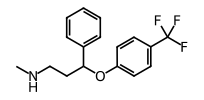
Fluoxetine
Athanor · official
C17H18F3NO · 309.33 g/mol
IUPAC name: N-methyl-3-phenyl-3-[4-(trifluoromethyl)phenoxy]propan-1-amine
Also called Prozac, SSRI, Sarafem


 DangerHarmful if swallowed · Causes skin irritation · Causes serious eye damage · Fatal if inhaled · May cause drowsiness or dizziness · May causes damage to organs through prolonged or repeated exposure · Very toxic to aquatic life with long lasting effects
Names and identifiers
- IUPAC name
- N-methyl-3-phenyl-3-[4-(trifluoromethyl)phenoxy]propan-1-amine
- Synonyms
- Prozac, SSRI, Sarafem
+ 37 more
Fluoxetina, Fluval, N-methyl-3-phenyl-3-[4-(trifluoromethyl)phenoxy]propan-1-amine, Animex-On, Fluoxetinum, Fluoxetin, Fluoxetin ratiopharm, DTXSID7023067, (+-)-N-Methyl-gamma-(4-(trifluoromethyl)phenoxy)benzenepropanamine, NSC-758685, (+-)-N-Methyl-3-phenyl-3-((alpha,alpha,alpha-trifluoro-p-tolyl)oxy)propylamine, 01K63SUP8D, Methyl({3-phenyl-3-[4-(trifluoromethyl)phenoxy]propyl})amine, n-methyl-3-phenyl-3-(4-(trifluoromethyl)phenoxy)propan-1-amine, CHEBI:5118, DTXCID903067, CHEBI:86990, Benzenepropanamine, N-methyl-gamma-(4-(trifluoromethyl)phenoxy)-, (+-)-, DL-N-METHYL-3-(P-TRIFLUOROMETHYLPHENOXY)-3-PHENYLPROPYLAMINE, methyl((3-phenyl-3-(4-(trifluoromethyl)phenoxy)propyl))amine, RefChem:5838, N-Methyl-gamma-(4-(trifluoromethyl)phenoxy)benzenepropanamine, Lilly110140, N06AB03, N-methyl-gamma-(4-(trifluoromethyl)-phenoxy)-benzenepropanamine, Pulvules, Portal, Eufor, Fluoxetina [Spanish], Fluoxetinum [INN-Latin], Fluoxetina [INN-Spanish], N-Methyl-3-(p-trifluoromethylphenoxy)-3-phenylpropylamine, NSC-283480, CHEMBL41, dl-3-(p-Trifluoromethylphenoxy)-N-methyl-3-phenylpropylamine, MFCD00072041, (+/-)-Fluoxetine
- Molecular formula
- C17H18F3NO
- Empirical formula
- C17H18F3NO
- Molecular weight
- 309.33 g/mol
- Exact mass
- 309.13405
- CAS number
- 54910-89-3
- PubChem CID
- 3386
- Canonical SMILES
- CNCCC(C1=CC=CC=C1)OC2=CC=C(C=C2)C(F)(F)F
- Isomeric SMILES
- CNCCC(C1=CC=CC=C1)OC2=CC=C(C=C2)C(F)(F)F
- InChI
- InChI=1S/C17H18F3NO/c1-21-12-11-16(13-5-3-2-4-6-13)22-15-9-7-14(8-10-15)17(18,19)20/h2-10,16,21H,11-12H2,1H3
- InChIKey
- RTHCYVBBDHJXIQ-UHFFFAOYSA-N
- Molfile
Names, InChI and the identifiers from PubChem, retrieved 2026-10-14.
Calculated
- Heavy atoms
- 22
- Rings
- 2
- Aromatic rings
- 2
- Fraction sp³ carbons (Fsp3)
- 0.29
- H-bond donors
- 1
- H-bond acceptors
- 2 computed here · PubChem 5
- Rotatable bonds
- 6
- TPSA (Ų)
- 21.3
- Formal charge
- 0
- XLogP3
- 4 PubChem
- Complexity
- 308 PubChem
- Stereocenters
- 0 defined, 1 undefinedCIP: C5: undefined
- Double-bond geometry
- None specified
- Point group
- C1 of one 3D conformer with its hydrogens, by Athanor’s engine (as in the app)
Elemental analysis
- C66.01%
- H5.87%
- F18.42%
- N4.53%
- O5.17%
Isotope pattern
Each peak is a nominal mass with its abundance-weighted exact mass, as a percentage of the tallest, from IUPAC natural isotope abundances.
Computed from the structure with RDKit 2026.09 when this page was built, beside PubChem's own computed values from its record; where the two differ, both are shown.
Predicted
- log P
- 4.44 Crippen (Wildman and Crippen 1999)
- log S (water solubility)
- -4.56 ESOL (Delaney 2004), log mol/L
- Synthetic accessibility
- 2.45 SA score, 1 easy to 10 hard (Ertl and Schuffenhauer 2009)
Drug-likeness: Lipinski’s rule of five
- Molecular weight ≤ 500: 309.33
- log P ≤ 5 (Crippen): 4.44
- H-bond donors ≤ 5: 1
- H-bond acceptors ≤ 10: 2
Passes all four rules.
¹³C NMR shifts, predicted
Predictions, not measurements; each names its method. A measured log P, where a source reports one, is under Physical properties.
Safety
Danger
Most widely reported: 4 company reports to ECHA. Source [1].
- Corrosive
- Acute toxicity
- Health hazard
- Environmental hazard
- H302Harmful if swallowed
- H315Causes skin irritation
- H318Causes serious eye damage
- H330Fatal if inhaled
- H336May cause drowsiness or dizziness
- H373May causes damage to organs through prolonged or repeated exposure
- H410Very toxic to aquatic life with long lasting effects
Precautionary statements: P260, P261, P264, P264+P265, P270, P271, P273, P280, P284, P301+P317, P302+P352, P304+P340, P305+P354+P338, P316, P317, P319, P320, P321, P330, P332+P317, P362+P364, P391, P403+P233, P405, P501
Safety data sheets on the supplier’s page: Enamine, AChemBlock, J&H Chemical Co.,ltd.
Always read the supplier’s safety data sheet before working with it.
Spectra
- GC-MSNIST Mass Spectrometry Data Center · NIST Mass Spectrometry Data Center · NIST Mass Spectrometry Data Center · NIST Mass Spectrometry Data Center · NIST Mass Spectrometry Data Center · SpectraBase
- MS-MSHuman Metabolome Database (HMDB) (Positive) · Human Metabolome Database (HMDB) (Positive) · Human Metabolome Database (HMDB) (Positive) · Human Metabolome Database (HMDB) (Positive) · Human Metabolome Database (HMDB) (Positive) · Human Metabolome Database (HMDB) (Positive)
- LC-MSMassBank Europe (Exploris 480 Orbitrap (Thermo Scientific) · LC-ESI-QFT · POSITIVE) · MassBank Europe (Exploris 480 Orbitrap (Thermo Scientific) · LC-ESI-QFT · NEGATIVE) · MassBank Europe (Bruker maXis Impact · LC-ESI-QTOF · POSITIVE) · MassBank Europe (Bruker maXis Impact · LC-ESI-QTOF · POSITIVE) · MassBank Europe (Bruker maXis Impact · LC-ESI-QTOF · POSITIVE) · MassBank Europe (Bruker maXis Impact · LC-ESI-QTOF · POSITIVE)
- ATR-IRSpectraBase (Bio-Rad FTS · ATR-Film (MeCl2) (DuraSamplIR II))
- RamanSpectraBase
Experimental spectra held by these sources; each link opens the source's own record.
Literature
Reading PubChem, OpenAlex and GSRS…
Bioactivity
Reading ChEMBL…
References
- [1]European Chemicals Agency (ECHA) · ECHA legal notice: reuse with acknowledgement · via PubChem · retrieved 2026-10-14
- [2]NIST Mass Spectrometry Data Center · Linked only · via PubChem · retrieved 2026-10-14
- [3]SpectraBase · Linked only · via PubChem · retrieved 2026-10-14
- [4]Human Metabolome Database (HMDB) · Linked only · via PubChem · retrieved 2026-10-14
- [5]MassBank Europe · Linked only · via PubChem · retrieved 2026-10-14
- [6]MassBank of North America (MoNA) · CC BY 4.0 · via PubChem · retrieved 2026-10-14
- ·Calculated values: computed by Athanor with RDKit 2026.09 from the structure.
- ·Literature on PubChem
Data last updated 2026-10-14.