
Methadone
Athanor · official
C21H27NO · 309.4 g/mol
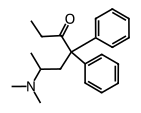
IUPAC name: 6-(dimethylamino)-4,4-diphenylheptan-3-one
Also called Dolophine, Methadose, opioid

 DangerFatal if swallowed · May cause drowsiness or dizziness · Harmful to aquatic life with long lasting effects
Names and identifiers
- IUPAC name
- 6-(dimethylamino)-4,4-diphenylheptan-3-one
- Synonyms
- Dolophine, Methadose, opioid
+ 38 more
dl-Methadone, Diaminon, Phenadone, Dolophin, Heptadone, Ketalgin, Methadon, Adanon, Amidone, Algovetin, Heptanon, Physeptone, Racemic methadone, (+-)-Methadone, Methadonum, Metadona, Metasedin, 6-(dimethylamino)-4,4-diphenylheptan-3-one, Eptadone, Methadona, 3-Heptanone, 6-(dimethylamino)-4,4-diphenyl-, 6-Dimethylamino-4,4-diphenyl-3-heptanone, Methadonum [Latin], Polamivet, UC6VBE7V1Z, K 174, 6-(Dimethylamino)-4,4-diphenyl-3-heptanone, CHEBI:6807, IDS-NM-002, DTXSID7023273, CHEBI:167309, 3-14-00-00279 (Beilstein Handbook Reference), Methadonum (Latin), Phymet, RefChem:6010, DTXCID003273, 200-996-9, Depridol
- Molecular formula
- C21H27NO
- Empirical formula
- C21H27NO
- Molecular weight
- 309.4 g/mol
- Exact mass
- 309.20926
- CAS number
- 76-99-3
- PubChem CID
- 4095
- Canonical SMILES
- CCC(=O)C(CC(C)N(C)C)(C1=CC=CC=C1)C2=CC=CC=C2
- Isomeric SMILES
- CCC(=O)C(CC(C)N(C)C)(C1=CC=CC=C1)C2=CC=CC=C2
- InChI
- InChI=1S/C21H27NO/c1-5-20(23)21(16-17(2)22(3)4,18-12-8-6-9-13-18)19-14-10-7-11-15-19/h6-15,17H,5,16H2,1-4H3
- InChIKey
- USSIQXCVUWKGNF-UHFFFAOYSA-N
- Molfile
Names, InChI and the identifiers from PubChem, retrieved 2026-10-14.
Physical properties
- Melting point
- Reported, but no value passed the checks.
The 2 values and why
- no odor. MP: 232-235 °C. Soluble in water, alcohol, and chloroform (could not be read; source [1])
- practically insoluble in ether and glycerol. pH (1% aqueous solution): 4.5-6.5 /Methadone hydrochloride/ (could not be read; source [1])
- Solubility in water
- Solubility: 1 g in 13 mL water; 8 mL alcohol, 3 mL chloroform; practically insol ublein ether and glycerin. Colorless crystals or a white, crystalline powder (methadone hydrochloride)[1]
- log P
- log Kow = 3.93[1]
- pKa
- pKa = 8.94 (conjugate acid)[1]
Each value as its source reports it, with the source's number after it (listed under References). Where several sources report a property, the row shows the value most of them agree on, the rule the app uses; open the values to see every one.
Calculated
- Heavy atoms
- 23
- Rings
- 2
- Aromatic rings
- 2
- Fraction sp³ carbons (Fsp3)
- 0.38
- H-bond donors
- 0
- H-bond acceptors
- 2
- Rotatable bonds
- 7
- TPSA (Ų)
- 20.3
- Formal charge
- 0
- XLogP3
- 3.9 PubChem
- Complexity
- 346 PubChem
- Stereocenters
- 0 defined, 1 undefinedCIP: C7: undefined
- Double-bond geometry
- None specified
- Point group
- C1 of one 3D conformer with its hydrogens, by Athanor’s engine (as in the app)
Elemental analysis
- C81.51%
- H8.79%
- N4.53%
- O5.17%
Isotope pattern
Each peak is a nominal mass with its abundance-weighted exact mass, as a percentage of the tallest, from IUPAC natural isotope abundances.
Computed from the structure with RDKit 2026.09 when this page was built, beside PubChem's own computed values from its record; where the two differ, both are shown.
Predicted
- log P
- 4.29 Crippen (Wildman and Crippen 1999)
- log S (water solubility)
- -4.39 ESOL (Delaney 2004), log mol/L
- Synthetic accessibility
- 2.71 SA score, 1 easy to 10 hard (Ertl and Schuffenhauer 2009)
Drug-likeness: Lipinski’s rule of five
- Molecular weight ≤ 500: 309.45
- log P ≤ 5 (Crippen): 4.29
- H-bond donors ≤ 5: 0
- H-bond acceptors ≤ 10: 2
Passes all four rules.
¹³C NMR shifts, predicted
Predictions, not measurements; each names its method. A measured log P, where a source reports one, is under Physical properties.
Safety
Danger
Most widely reported: 3 company reports to ECHA. Source [2].
- Acute toxicity
- Harmful or irritant
- H300Fatal if swallowed
- H336May cause drowsiness or dizziness
- H412Harmful to aquatic life with long lasting effects
Precautionary statements: P261, P264, P270, P271, P273, P301+P316, P304+P340, P319, P321, P330, P403+P233, P405, P501
View all classifications (2)
- [2] European Chemicals Agency (ECHA) · 3 reports · DangerH300, H336, H412
- [1] Hazardous Substances Data Bank (HSDB) · DangerH300
Storage
- Methadone hydrochloride preparations should be stored in tight, light-resistant containers. Methadone hydrochloride oral concentrate and oral solution should be stored at 15-30 °C; the tablets and injection should be stored at a controlled room temperature of 25 °C, but may be exposed to temperatures ranging from 15-30 °C.[1]
- Keep container tightly closed in a dry and well-ventilated place. Light sensitive. Keep in a dry place. (methadone hydrochloride)[1]
Incompatibilities
- Incompatible materials: Alkalis, Oxidizing agents, iodides, mercury salts, saccharin sodium, Amaranth, Bordeaux B. (methadone hydrochloride)[1]
Always read the supplier’s safety data sheet before working with it.
Spectra
- GC-MSHuman Metabolome Database (HMDB) (EI-B · positive) · Human Metabolome Database (HMDB) (CI-B · positive) · Human Metabolome Database (HMDB) (EI-B · positive) · MassBank of North America (MoNA) (Unknown · EI-B · positive) · MassBank of North America (MoNA) (Unknown · CI-B · positive) · MassBank of North America (MoNA) (Unknown · CI-B · positive)
- MS-MSHuman Metabolome Database (HMDB) (Positive) · Human Metabolome Database (HMDB) (Positive) · Human Metabolome Database (HMDB) (Positive) · Human Metabolome Database (HMDB) (Positive) · Human Metabolome Database (HMDB) (Positive) · Human Metabolome Database (HMDB) (Positive)
- LC-MSMassBank Europe (Bruker maXis Impact · LC-ESI-QTOF · POSITIVE) · MassBank Europe (Bruker maXis Impact · LC-ESI-QTOF · POSITIVE) · MassBank Europe (Bruker maXis Impact · LC-ESI-QTOF · POSITIVE) · MassBank Europe (Bruker maXis Impact · LC-ESI-QTOF · POSITIVE) · MassBank Europe (Bruker maXis Impact · LC-ESI-QTOF · POSITIVE) · MassBank Europe (TripleTOF 6600 SCIEX · LC-ESI-QTOF · POSITIVE)
- Other MSHazardous Substances Data Bank (HSDB) · MassBank Europe (Unknown · EI-B · POSITIVE) · MassBank Europe (Unknown · CI-B · POSITIVE) · MassBank of North America (MoNA) (positive)
- UVHazardous Substances Data Bank (HSDB)
- IRHazardous Substances Data Bank (HSDB)
- ATR-IRSpectraBase (Bio-Rad FTS · ATR-Film (MeCl2) (DuraSamplIR II))
- RamanSpectraBase
Experimental spectra held by these sources; each link opens the source's own record.
Literature
Reading PubChem, OpenAlex and GSRS…
Bioactivity
Reading ChEMBL…
References
- [1]Hazardous Substances Data Bank (HSDB) · Public domain (US NLM) · via PubChem · retrieved 2026-10-14
- [2]European Chemicals Agency (ECHA) · ECHA legal notice: reuse with acknowledgement · via PubChem · retrieved 2026-10-14
- [3]Human Metabolome Database (HMDB) · Linked only · via PubChem · retrieved 2026-10-14
- [4]MassBank of North America (MoNA) · CC BY 4.0 · via PubChem · retrieved 2026-10-14
- [5]NIST Mass Spectrometry Data Center · Linked only · via PubChem · retrieved 2026-10-14
- [6]SpectraBase · Linked only · via PubChem · retrieved 2026-10-14
- [7]MassBank Europe · Linked only · via PubChem · retrieved 2026-10-14
- ·Calculated values: computed by Athanor with RDKit 2026.09 from the structure.
- ·Literature on PubChem
Data last updated 2026-10-14.