
Dabigatran
Athanor · official
C25H25N7O3 · 471.5 g/mol
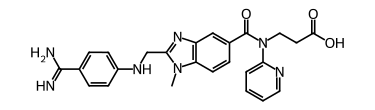
IUPAC name: 3-[[2-[(4-carbamimidoylanilino)methyl]-1-methylbenzimidazole-5-carbonyl]-pyridin-2-ylamino]propanoic acid
Also called Pradaxa, direct thrombin inhibitor, DOAC, anticoagulant
 WarningHarmful if swallowed · Causes skin irritation · Causes serious eye irritation · May cause respiratory irritation
Names and identifiers
- IUPAC name
- 3-[[2-[(4-carbamimidoylanilino)methyl]-1-methylbenzimidazole-5-carbonyl]-pyridin-2-ylamino]propanoic acid
- Synonyms
- Pradaxa, direct thrombin inhibitor, DOAC
+ 39 more
anticoagulant, BIBR-953, Pradaxa (dabigatran), BIBR 953 ZW, 3-[[2-[(4-carbamimidoylanilino)methyl]-1-methylbenzimidazole-5-carbonyl]-pyridin-2-ylamino]propanoic acid, I0VM4M70GC, BIBR-953-ZW, CHEBI:70752, DTXSID50175419, N-((2-((p-Amidinoanilino)methyl)-1-methyl-5-benzimidazolyl)carbonyl)-N-2-pyridyl-beta-alanine, 3-[[2-[[(4-carbamimidoylphenyl)amino]methyl]-1-methylbenzimidazole-5-carbonyl]-pyridin-2-ylamino]propanoic acid, beta-Alanine, N-((2-(((4-(aminoiminomethyl)phenyl)amino)methyl)-1-methyl-1H-benzimidazol-5-yl)carbonyl)-N-2-pyridinyl-, 3-((2-(((4-carbamimidoylphenyl)amino)methyl)-1-methylbenzimidazole-5-carbonyl)-pyridin-2-ylamino)propanoic acid, 3-((2-((4-carbamimidoylanilino)methyl)-1-methylbenzimidazole-5-carbonyl)-pyridin-2-ylamino)propanoic acid, BETA-ALANINE, N-[[2-[[[4-(AMINOIMINOMETHYL)PHENYL]AMINO]METHYL]-1-METHYL-1H-BENZIMIDAZOL-5-YL]CARBONYL]-N-2-PYRIDINYL-, RefChem:54923, Etexilate Mesylate, Dabigatran, Mesylate, Dabigatran Etexilate, DTXCID4097910, N-((2-(((4-(aminoiminomethyl)phenyl)amino)methyl)-1-methyl-1H-benzimidazol-5-yl)carbonyl)-N-2-pyridinyl-beta-alanine, 859-177-5, BIBR 953, MFCD09837830, 3-(2-(((4-carbamimidoylphenyl)amino)methyl)-1-methyl-N-(pyridin-2-yl)-1H-benzo[d]imidazole-5-carboxamido)propanoic acid, Dabigatran (BIBR 953), CHEMBL48361, 3-[1-(2-{[(4-carbamimidoylphenyl)amino]methyl}-1-methyl-1H-1,3-benzodiazol-5-yl)-N-(pyridin-2-yl)formamido]propanoic acid, C25H25N7O3, b-Alanine,N-[[2-[[[4-(aminoiminomethyl)phenyl]amino]methyl]-1-methyl-1H-benzimidazol-5-yl]carbonyl]-N-2-pyridinyl-, N-[(2-{[(4-Carbamimidoylphenyl)amino]methyl}-1-Methyl-1h-Benzimidazol-5-Yl)carbonyl]-N-Pyridin-2-Yl-Beta-Alanine, 1-Methyl-2-[(4-amidinophenyl)aminomethyl]benzimidazol-5-yl-carboxylic acid-N-(2-pyridyl)-N-(2-hydroxycarbonylethyl)amide, BIBR-953ZW, 3-[[2-[[(4-CARBAMIMIDOYLPHENYL)AMINO]METHYL]-1-METHYL-BENZOIMIDAZOLE-5-CARBONYL]-PYRIDIN-2-YL-AMINO]PROPANOIC ACID, Dabigatran Standard, 3-(((2-(((4-Carbamimidoylphenyl)amino)methyl)-1-methyl-1H-benzimidazol-5-yl)carbonyl)(pyridin-2-yl)amino)propanoic acid, 3-{[(2-{[(4-Carbamimidoylphenyl)amino]methyl}-1-methyl-1H-benzimidazol-5-yl)carbonyl](pyridin-2-yl)amino}propanoic acid, BIBR 953; BIBR 953ZW; Dabigatran; N-[[2-[[[4-(aminoiminomethyl)phenyl]amino]methyl]-1-methyl-1H-benzimidazol-5-yl]carbonyl]-N-2-pyridinyl-beta-Alanine; N-[[2-[[[4-(Aminoiminomethyl)phenyl]amino]methyl]-1-methyl-1H-benzimidazol-5-yl]carbonyl]-N-2-pyridinyl-beta-alanine, Dabigatran [INN], DABIGATRAN [MI]
- Molecular formula
- C25H25N7O3
- Empirical formula
- C25H25N7O3
- Molecular weight
- 471.5 g/mol
- Exact mass
- 471.20189
- CAS number
- 211914-51-1
- PubChem CID
- 216210
- Canonical SMILES
- CN1C2=C(C=C(C=C2)C(=O)N(CCC(=O)O)C3=CC=CC=N3)N=C1CNC4=CC=C(C=C4)C(=N)N
- Isomeric SMILES
- CN1C2=C(C=C(C=C2)C(=O)N(CCC(=O)O)C3=CC=CC=N3)N=C1CNC4=CC=C(C=C4)C(=N)N
- InChI
- InChI=1S/C25H25N7O3/c1-31-20-10-7-17(25(35)32(13-11-23(33)34)21-4-2-3-12-28-21)14-19(20)30-22(31)15-29-18-8-5-16(6-9-18)24(26)27/h2-10,12,14,29H,11,13,15H2,1H3,(H3,26,27)(H,33,34)
- InChIKey
- YBSJFWOBGCMAKL-UHFFFAOYSA-N
- Molfile
Names, InChI and the identifiers from PubChem, retrieved 2026-10-14.
Calculated
- Heavy atoms
- 35
- Rings
- 4
- Aromatic rings
- 4
- Fraction sp³ carbons (Fsp3)
- 0.16
- H-bond donors
- 4
- H-bond acceptors
- 6 computed here · PubChem 7
- Rotatable bonds
- 9
- TPSA (Ų)
- 150.2 computed here · PubChem 150
- Formal charge
- 0
- XLogP3
- 1.7 PubChem
- Complexity
- 757 PubChem
- Stereocenters
- None
- Double-bond geometry
- None specified
- Point group
- C1 of one 3D conformer with its hydrogens, by Athanor’s engine (as in the app)
Elemental analysis
- C63.68%
- H5.34%
- N20.79%
- O10.18%
Isotope pattern
Each peak is a nominal mass with its abundance-weighted exact mass, as a percentage of the tallest, from IUPAC natural isotope abundances.
Computed from the structure with RDKit 2026.09 when this page was built, beside PubChem's own computed values from its record; where the two differ, both are shown.
Predicted
- log P
- 2.99 Crippen (Wildman and Crippen 1999)
- log S (water solubility)
- -4.49 ESOL (Delaney 2004), log mol/L
- Synthetic accessibility
- 2.61 SA score, 1 easy to 10 hard (Ertl and Schuffenhauer 2009)
Drug-likeness: Lipinski’s rule of five
- Molecular weight ≤ 500: 471.52
- log P ≤ 5 (Crippen): 2.99
- H-bond donors ≤ 5: 4
- H-bond acceptors ≤ 10: 6
Passes all four rules.
¹³C NMR shifts, predicted
Predictions, not measurements; each names its method. A measured log P, where a source reports one, is under Physical properties.
Safety
Warning
Most widely reported: 2 company reports to ECHA. Source [2].
- Harmful or irritant
- H302Harmful if swallowed (50% of reports)
- H315Causes skin irritation (50% of reports)
- H319Causes serious eye irritation (50% of reports)
- H335May cause respiratory irritation (50% of reports)
Precautionary statements: P261, P264, P264+P265, P270, P271, P280, P301+P317, P302+P352, P304+P340, P305+P351+P338, P319, P321, P330, P332+P317, P337+P317, P362+P364, P403+P233, P405, P501
View all classifications (2)
- [2] European Chemicals Agency (ECHA)This chemical does not meet GHS hazard criteria for 50% (1 of 2) of reports.
- [2] European Chemicals Agency (ECHA) · 2 reports · WarningH302, H315, H319, H335
Storage
- Store blisters (packs) at 25 °C (77 °F); excursions permitted to 15-30 °C (59-86 °F). Store in the original package to protect from moisture.[1]
- Store bottles at 25 °C (77 °F); excursions permitted to 15-30 °C (59-86 °F). Once opened, the product must be used within 4 months. Keep the bottle tightly closed. Store in the original package to protect from moisture.[1]
Safety data sheets on the supplier’s page: Angel Pharmatech Ltd., AstaTech, Inc., AiFChem, an XtalPi Company.
Always read the supplier’s safety data sheet before working with it.
Literature
Reading PubChem, OpenAlex and GSRS…
Bioactivity
Reading ChEMBL…
References
- [1]Hazardous Substances Data Bank (HSDB) · Public domain (US NLM) · via PubChem · retrieved 2026-10-14
- [2]European Chemicals Agency (ECHA) · ECHA legal notice: reuse with acknowledgement · via PubChem · retrieved 2026-10-14
- ·Calculated values: computed by Athanor with RDKit 2026.09 from the structure.
- ·Literature on PubChem
Data last updated 2026-10-14.