
Ethambutol
Athanor · official
C10H24N2O2 · 204.31 g/mol
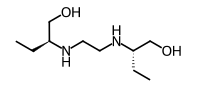
IUPAC name: (2S)-2-[2-[[(2S)-1-hydroxybutan-2-yl]amino]ethylamino]butan-1-ol
Also called Myambutol, tuberculosis

 WarningHarmful if swallowed · May causes damage to organs through prolonged or repeated exposure
Names and identifiers
- IUPAC name
- (2S)-2-[2-[[(2S)-1-hydroxybutan-2-yl]amino]ethylamino]butan-1-ol
- Synonyms
- Myambutol, tuberculosis, Ethambutolum
+ 37 more
(+)-ethambutol, Aethambutolum, Diambutol, D-Ethambutol, (+)-S,S-Ethambutol, (S,S)-ethambutol, Etambutolo, S,S-Ethambutol, (+)-2,2'-(Ethylenediimino)di-1-butanol, (2S)-2-[2-[[(2S)-1-hydroxybutan-2-yl]amino]ethylamino]butan-1-ol, CHEBI:4877, (+)-N,N'-Bis(1-(hydroxymethyl)propyl)ethylenediamine, 8G167061QZ, D-2,2'-(Ethylenediimino)di-1-butanol, D-2,2'-(Ethylenediimino)bis(1-butanol), DTXSID8023006, 1-Butanol, 2,2'-(ethylenediimino)di-, (+)-, D-N,N'-Bis(1-hydroxymethylpropyl)ethylenediamine, (2S,7S)-2,7-diethyl-3,6-diazaoctane-1,8-diol, 1-Butanol, 2,2'-(1,2-ethanediyldiimino)bis-, (S-(R*,R*))-, (2S)-2-[(2-{[(2S)-1-hydroxybutan-2-yl]amino}ethyl)amino]butan-1-ol, 1-Butanol, 2,2'-(1,2-ethanediyldiimino)bis-, (R-(R*,R*))-, (2S)-2-((2-(((2S)-1-hydroxybutan-2-yl)amino)ethyl)amino)butan-1-ol, (2S)-2-(2-(((2S)-1-hydroxybutan-2-yl)amino)ethylamino)butan-1-ol, EMB Hefa, Llorente, Etambutol, RefChem:591358, DTXCID703006, J04AK02, 200-810-6, Etambutol, (2S,2'S)-2,2'-(Ethane-1,2-diylbis(azanediyl))bis(butan-1-ol), Etambutolo [DCIT], Etambutol [INN-Spanish], Ethambutolum [INN-Latin], EMB, Spectrum4_000545
- Molecular formula
- C10H24N2O2
- Empirical formula
- C5H12NO
- Molecular weight
- 204.31 g/mol
- Exact mass
- 204.18378
- CAS number
- 74-55-5
- PubChem CID
- 14052
- Canonical SMILES
- CCC(CO)NCCNC(CC)CO
- Isomeric SMILES
- CC[C@@H](CO)NCCN[C@@H](CC)CO
- InChI
- InChI=1S/C10H24N2O2/c1-3-9(7-13)11-5-6-12-10(4-2)8-14/h9-14H,3-8H2,1-2H3/t9-,10-/m0/s1
- InChIKey
- AEUTYOVWOVBAKS-UWVGGRQHSA-N
- Molfile
Names, InChI and the identifiers from PubChem, retrieved 2026-10-14.
Physical properties
Each value as its source reports it, with the source's number after it (listed under References). Where several sources report a property, the row shows the value most of them agree on, the rule the app uses; open the values to see every one.
Calculated
- Heavy atoms
- 14
- Rings
- 0
- Aromatic rings
- 0
- Fraction sp³ carbons (Fsp3)
- 1
- H-bond donors
- 4
- H-bond acceptors
- 4
- Rotatable bonds
- 9
- TPSA (Ų)
- 64.5
- Formal charge
- 0
- XLogP3
- -0.1 PubChem
- Complexity
- 109 PubChem
- Stereocenters
- 2 definedCIP: C3: S · C10: S
- Double-bond geometry
- None specified
- Point group
- C1 of one 3D conformer with its hydrogens, by Athanor’s engine (as in the app)
Elemental analysis
- C58.79%
- H11.84%
- N13.71%
- O15.66%
Isotope pattern
Each peak is a nominal mass with its abundance-weighted exact mass, as a percentage of the tallest, from IUPAC natural isotope abundances.
Computed from the structure with RDKit 2026.09 when this page was built, beside PubChem's own computed values from its record; where the two differ, both are shown.
Predicted
- log P
- -0.29 Crippen (Wildman and Crippen 1999)
- log S (water solubility)
- -0.33 ESOL (Delaney 2004), log mol/L
- Synthetic accessibility
- 3.21 SA score, 1 easy to 10 hard (Ertl and Schuffenhauer 2009)
Drug-likeness: Lipinski’s rule of five
- Molecular weight ≤ 500: 204.31
- log P ≤ 5 (Crippen): -0.29
- H-bond donors ≤ 5: 4
- H-bond acceptors ≤ 10: 4
Passes all four rules.
¹³C NMR shifts, predicted
Predictions, not measurements; each names its method. A measured log P, where a source reports one, is under Physical properties.
Safety
Warning
From European Chemicals Agency (ECHA). Source [2].
- Harmful or irritant
- Health hazard
- H302Harmful if swallowed
- H373May causes damage to organs through prolonged or repeated exposure
Precautionary statements: P260, P264, P270, P301+P317, P319, P330, P501
Storage
- Ethambutol hydrochloride tablets should be protected from light, moisture, and excessive heat and should be stored in well-closed containers at 15-30 °C.[1]
- Store below 40 °C (104 °F), preferably between 15 and 30 °C (50 and 86 °F), unless otherwise specified by manufacturer. Store in a well-closed container.[1]
Safety data sheets on the supplier’s page: ChemoSapiens, MedChemexpress MCE, Ambinter.
Always read the supplier’s safety data sheet before working with it.
Spectra
- MS-MSHuman Metabolome Database (HMDB) (Positive) · Human Metabolome Database (HMDB) (Positive) · Human Metabolome Database (HMDB) (Positive) · Human Metabolome Database (HMDB) (Positive) · Human Metabolome Database (HMDB) (Positive) · Human Metabolome Database (HMDB) (Positive)
- LC-MSMassBank Europe (Exploris 480 Orbitrap (Thermo Scientific) · LC-ESI-QFT · POSITIVE) · MassBank Europe (LTQ Orbitrap XL Thermo Scientific · LC-ESI-ITFT · POSITIVE) · MassBank Europe (LTQ Orbitrap XL Thermo Scientific · LC-ESI-ITFT · POSITIVE) · MassBank Europe (LTQ Orbitrap XL Thermo Scientific · LC-ESI-ITFT · POSITIVE) · MassBank Europe (LTQ Orbitrap XL Thermo Scientific · LC-ESI-ITFT · POSITIVE) · MassBank Europe (LTQ Orbitrap XL Thermo Scientific · LC-ESI-ITFT · POSITIVE)
- Other MSMassBank Europe (TripleTOF 5600+SCIEX · ESI-QTOF · POSITIVE) · MassBank Europe (TripleTOF 5600+SCIEX · ESI-QTOF · POSITIVE) · MassBank Europe (TripleTOF 5600+SCIEX · ESI-QTOF · POSITIVE) · MassBank Europe (TripleTOF 5600+SCIEX · ESI-QTOF · POSITIVE) · MassBank Europe (TripleTOF 5600+SCIEX · ESI-QTOF · POSITIVE) · MassBank Europe (TripleTOF 5600+SCIEX · ESI-QTOF · POSITIVE)
Experimental spectra held by these sources; each link opens the source's own record.
Literature
Reading PubChem, OpenAlex and GSRS…
Bioactivity
Reading ChEMBL…
References
- [1]Hazardous Substances Data Bank (HSDB) · Public domain (US NLM) · via PubChem · retrieved 2026-10-14
- [2]European Chemicals Agency (ECHA) · ECHA legal notice: reuse with acknowledgement · via PubChem · retrieved 2026-10-14
- [3]Human Metabolome Database (HMDB) · Linked only · via PubChem · retrieved 2026-10-14
- [4]MassBank Europe · Linked only · via PubChem · retrieved 2026-10-14
- [5]MassBank of North America (MoNA) · CC BY 4.0 · via PubChem · retrieved 2026-10-14
- [6]SpectraBase · Linked only · via PubChem · retrieved 2026-10-14
- ·Calculated values: computed by Athanor with RDKit 2026.09 from the structure.
- ·Literature on PubChem
Data last updated 2026-10-14.