
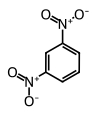
1,3-Dinitrobenzene
Athanor · official
C6H4N2O4 · 168.11 g/mol
Also called m-dinitrobenzene, DNB


 DangerFatal if swallowed · Fatal in contact with skin · Fatal if inhaled · Very toxic to aquatic life · Very toxic to aquatic life with long lasting effects
Names and identifiers
- IUPAC name
- 1,3-dinitrobenzene
- Synonyms
- m-dinitrobenzene, DNB, M-DINITROBENZENE
+ 37 more
2,4-Dinitrobenzene, meta-Dinitrobenzene, Benzene, 1,3-dinitro-, 1,3-Dinitrobenzol, Benzene, m-dinitro-, m-DNB, Dwunitrobenzen, 3-dinitrobenzene, 1,3-Dinitro-benzene, DTXSID9024065, Binitrobenzene, DK8B627BU0, NSC-7189, DTXCID204065, CHEBI:51397, 1,3-DNB, RefChem:72751, 202-776-8, Dinitrobenzene, DINITROPHENYLENE, Dinitrobenzene, m-, NSC 7189, MFCD00007222, NCGC00091351-02, NCGC00091351-03, Dwunitrobenzen [Polish], CAS-99-65-0, 1,3-Dinitrobenceno, CCRIS 1802, HSDB 4017, EINECS 202-776-8, UNII-DK8B627BU0, m-dinitrobenzol, AI3-02913, 1,3-dintrobenzene, 1,3-dinitrobenzeno, meta-dinitrobenzene?
- Molecular formula
- C6H4N2O4
- Empirical formula
- C3H2NO2
- Molecular weight
- 168.11 g/mol
- Exact mass
- 168.01711
- CAS number
- 99-65-0
- PubChem CID
- 7452
- Canonical SMILES
- C1=CC(=CC(=C1)[N+](=O)[O-])[N+](=O)[O-]
- Isomeric SMILES
- C1=CC(=CC(=C1)[N+](=O)[O-])[N+](=O)[O-]
- InChI
- InChI=1S/C6H4N2O4/c9-7(10)5-2-1-3-6(4-5)8(11)12/h1-4H
- InChIKey
- WDCYWAQPCXBPJA-UHFFFAOYSA-N
- Molfile
Names, InChI and the identifiers from PubChem, retrieved 2026-10-14.
Physical properties
- Appearance
- Pale white or yellow, crystalline solid.[4]
5 values
From Hazardous Substances Data Bank (HSDB), the most authoritative source here.
Value As written Source – M-dinitrobenzene is a yellow solid with a slight odor. Sinks in water. (USCG, 1999) [1] CAMEO Chemicalscites U.S. Coast Guard. 1999. Chemical Hazard Response Information System (CHRIS) - Hazardous Chemical Data. Commandant Instruction 16465.12C. Washington, D.C.: U.S. Government Printing Office. – YELLOW CRYSTALS. [2] ILO-WHO International Chemical Safety Cards (ICSCs) – Pale-white or yellow solid. [3] The National Institute for Occupational Safety and Health (NIOSH) – Colorless to yellow, rhombic needles or plates [4] Hazardous Substances Data Bank (HSDB)cites Clayton, G.D., F.E. Clayton (eds.) Patty's Industrial Hygiene and Toxicology. Volumes 2A, 2B, 2C, 2D, 2E, 2F: Toxicology. 4th ed. New York, NY: John Wiley & Sons Inc., 1993-1994., p. 1020 –shown Pale white or yellow, crystalline solid. [4] Hazardous Substances Data Bank (HSDB)cites NIOSH. NIOSH Pocket Guide to Chemical Hazards. DHHS (NIOSH) Publication No. 97-140. Washington, D.C. U.S. Government Printing Office, 1997., p. 116 - Melting point
- 90.3 °C[5]
5 values
5 of 5 sources agree on it (most common value).
Value As written Source 90 °C 194 °F (NTP, 1992) [1] CAMEO Chemicalscites National Toxicology Program, Institute of Environmental Health Sciences, National Institutes of Health (NTP). 1992. National Toxicology Program Chemical Repository Database. Research Triangle Park, North Carolina. 89 to 90 °C 89-90 °C [4] Hazardous Substances Data Bank (HSDB)cites Clayton, G.D., F.E. Clayton (eds.) Patty's Industrial Hygiene and Toxicology. Volumes 2A, 2B, 2C, 2D, 2E, 2F: Toxicology. 4th ed. New York, NY: John Wiley & Sons Inc., 1993-1994., p. 1020 90 °C 90 °C [2] ILO-WHO International Chemical Safety Cards (ICSCs) 90.3 °Cshown 90.3 °C [5] PAC Chemical Database, U.S. Department of Energy 89 °C 192 °F [3] The National Institute for Occupational Safety and Health (NIOSH) - Boiling point
- 300-303 °C[2]
5 values
2 of 5 sources agree on it (most common value).
Value As written Source 291 °C 556 °F at 756 mmHg (NTP, 1992) [1] CAMEO Chemicalscites National Toxicology Program, Institute of Environmental Health Sciences, National Institutes of Health (NTP). 1992. National Toxicology Program Chemical Repository Database. Research Triangle Park, North Carolina. 302.8 °C 302.8 °C @ 770 mm Hg [4] Hazardous Substances Data Bank (HSDB)cites Clayton, G.D., F.E. Clayton (eds.) Patty's Industrial Hygiene and Toxicology. Volumes 2A, 2B, 2C, 2D, 2E, 2F: Toxicology. 4th ed. New York, NY: John Wiley & Sons Inc., 1993-1994., p. 1020 300 to 303 °Cshown 300-303 °C [2] ILO-WHO International Chemical Safety Cards (ICSCs) 291 °C 291 °C @760 [mm Hg] [5] PAC Chemical Database, U.S. Department of Energy 300 °C 572 °F [3] The National Institute for Occupational Safety and Health (NIOSH) - Density
- 1.5751 @ 18°C[5]
4 values
4 of 4 sources agree on it (most common value).
Value As written Source – 1.58 at 64.4 °F (USCG, 1999) - Denser than water [1] CAMEO Chemicalscites U.S. Coast Guard. 1999. Chemical Hazard Response Information System (CHRIS) - Hazardous Chemical Data. Commandant Instruction 16465.12C. Washington, D.C.: U.S. Government Printing Office. – 1.6 g/cm³ [2] ILO-WHO International Chemical Safety Cards (ICSCs) –shown 1.5751 @ 18°C [5] PAC Chemical Database, U.S. Department of Energy – 1.58 [3] The National Institute for Occupational Safety and Health (NIOSH) - Solubility in water
- Solubility in water: very poor[2]
4 values
From ILO-WHO International Chemical Safety Cards (ICSCs), the most authoritative source here.
Value As written Source – 0.02 % (NIOSH, 2024) [1] CAMEO Chemicals – In water, 533 mg/l @ 25 °C [4] Hazardous Substances Data Bank (HSDB)cites Spanggord RJ et al; Environ Fate Studies on Certain Munitions Wastewater Constituents, Final Report, Phase I, Lit Rev, SRI Project No. LSU-7934 (1980) –shown Solubility in water: very poor [2] ILO-WHO International Chemical Safety Cards (ICSCs) – 0.02% [3] The National Institute for Occupational Safety and Health (NIOSH) - log P
- 1.49[2]
2 values
2 of 2 sources agree on it (most common value).
Value As written Source – log Kow= 1.49 [4] Hazardous Substances Data Bank (HSDB)cites Hansch, C., Leo, A., D. Hoekman. Exploring QSAR - Hydrophobic, Electronic, and Steric Constants. Washington, DC: American Chemical Society., 1995., p. 17 –shown 1.49 [2] ILO-WHO International Chemical Safety Cards (ICSCs) - Vapor pressure
- 2 × 10⁻⁴ mmHg @ 25 °C[4]
- Flash point
- 149 °C[2]
4 values
4 of 4 sources agree on it (most common value).
Value As written Source 150 °C 302 °F (NIOSH, 2024) [1] CAMEO Chemicals 150 °C 302 °F (CLOSED CUP) [4] Hazardous Substances Data Bank (HSDB)cites Clayton, G. D. and F. E. Clayton (eds.). Patty's Industrial Hygiene and Toxicology: Volume 2A, 2B, 2C: Toxicology. 3rd ed. New York: John Wiley Sons, 1981-1982., p. 2457 149 °Cshown 149 °C [2] ILO-WHO International Chemical Safety Cards (ICSCs) 150 °C 302 °F [3] The National Institute for Occupational Safety and Health (NIOSH)
Each value as its source reports it, with the source's number after it (listed under References). Where several sources report a property, the row shows the value most of them agree on, the rule the app uses; open the values to see every one.
Calculated
- Heavy atoms
- 12
- Rings
- 1
- Aromatic rings
- 1
- Fraction sp³ carbons (Fsp3)
- 0
- H-bond donors
- 0
- H-bond acceptors
- 4
- Rotatable bonds
- 2 computed here · PubChem 0
- TPSA (Ų)
- 86.3 computed here · PubChem 91.6
- Formal charge
- 0
- XLogP3
- 1.5 PubChem
- Complexity
- 175 PubChem
- Stereocenters
- None
- Double-bond geometry
- None specified
- Point group
- C2v of one 3D conformer with its hydrogens, by Athanor’s engine (as in the app)
Elemental analysis
- C42.87%
- H2.40%
- N16.66%
- O38.07%
Isotope pattern
Each peak is a nominal mass with its abundance-weighted exact mass, as a percentage of the tallest, from IUPAC natural isotope abundances.
Computed from the structure with RDKit 2026.09 when this page was built, beside PubChem's own computed values from its record; where the two differ, both are shown.
Predicted
- log P
- 1.5 Crippen (Wildman and Crippen 1999)
- log S (water solubility)
- -2.07 ESOL (Delaney 2004), log mol/L
- Synthetic accessibility
- 1.77 SA score, 1 easy to 10 hard (Ertl and Schuffenhauer 2009)
Drug-likeness: Lipinski’s rule of five
- Molecular weight ≤ 500: 168.11
- log P ≤ 5 (Crippen): 1.5
- H-bond donors ≤ 5: 0
- H-bond acceptors ≤ 10: 4
Passes all four rules.
¹³C NMR shifts, predicted
Predictions, not measurements; each names its method. A measured log P, where a source reports one, is under Physical properties.
Safety
Danger
Harmonized EU classification (CLP Annex VI). Source [6].
- Acute toxicity
- Health hazard
- Environmental hazard
- H300Fatal if swallowed
- H310Fatal in contact with skin
- H330Fatal if inhaled
- H400Very toxic to aquatic life
- H410Very toxic to aquatic life with long lasting effects
Precautionary statements: P260, P262, P264, P270, P271, P273, P280, P284, P301+P316, P302+P352, P304+P340, P316, P319, P320, P321, P330, P361+P364, P391, P403+P233, P405, P501
View all classifications (2)
- [6] Regulation (EC) No 1272/2008 of the European Parliament and of the Council · DangerH300, H310, H330, H400, H410
- [7] European Chemicals Agency (ECHA) · 52 reports · DangerH300, H310, H330, H373, H400, H410
Exposure limits
First aid
- Eyes: First check the victim for contact lenses and remove if present. Flush victim's eyes with water or normal saline solution for 20 to 30 minutes while simultaneously calling a hospital or poison control center. Do not put any ointments, oils, or medication in the victim's eyes without specific instructions from a physician. Immediately transport the victim after flushing eyes to a hospital even if no symptoms (such as redness or irritation) develop. Skin: Immediately flood affected skin with water while removing and isolating all contaminated clothing.[1]
- (General first aid procedures) Eye: Irrigate immediately - If this chemical contacts the eyes, immediately wash (irrigate) the eyes with large amounts of water, occasionally lifting the lower and upper lids. Get medical attention immediately. Skin: Soap wash immediately - If this chemical contacts the skin, immediately wash the contaminated skin with soap and water.[3]
- Fresh air, rest. Artificial respiration may be needed. Refer for medical attention.[2]
- Remove contaminated clothes. Rinse and then wash skin with water and soap. Refer for medical attention .[2]
Storage
- Separated from strong oxidants, strong bases and food and feedstuffs. See Chemical Dangers.[2]
Incompatibilities
- Mixture with nitric acid is a high explosive. Mixture with tetranitromethane is a high explosive very sensitive to sparks.[4]
- Contact with strong oxidizers may cause fires and explosions. Contact with caustics and metals such as tin and zinc may cause evolution of heat and increase in pressure.[4]
- Strong oxidizers, caustics, metals such as tin & zinc [Note: Prolonged exposure to fire and heat may result in an explosion due to spontaneous decomposition.][3]
Safety data sheets on the supplier’s page: AKos Consulting & Solutions, Enamine, Alfa Chemistry.
Always read the supplier’s safety data sheet before working with it.
Spectra
- NMRHazardous Substances Data Bank (HSDB) · NMRShiftDB
- 1H NMRHuman Metabolome Database (HMDB) (JEOL · 400 MHz · CDCl3) · SpectraBase (BRUKER AC-300)
- 13C NMRHuman Metabolome Database (HMDB) (Varian · 25.16 MHz · CDCl3) · SpectraBase
- 15N NMRSpectraBase
- 17O NMRSpectraBase
- GC-MSHuman Metabolome Database (HMDB) (EI-B · positive) · Human Metabolome Database (HMDB) (EI-B · positive) · Human Metabolome Database (HMDB) (EI-B · positive) · MassBank of North America (MoNA) (Unknown · EI-B · positive) · MassBank of North America (MoNA) (HITACHI M-60 · EI-B · positive) · MassBank of North America (MoNA) (Electron Impact (EI) · positive)
- MS-MSHuman Metabolome Database (HMDB) (APCI-ITFT · negative)
- LC-MSMassBank of North America (MoNA) (LTQ Orbitrap XL Thermo Scientific · APCI-ITFT · APCI)
- Other MSHazardous Substances Data Bank (HSDB) · MassBank Europe (VARIAN MAT-44 · EI-B · POSITIVE) · MassBank Europe (Unknown · EI-B · POSITIVE) · MassBank Europe (HITACHI M-60 · EI-B · POSITIVE) · MassBank Europe (LTQ Orbitrap XL Thermo Scientific · APCI-ITFT · NEGATIVE)
- UVHazardous Substances Data Bank (HSDB)
- UV-VISSpectraBase
- IRHazardous Substances Data Bank (HSDB)
- FTIRSpectraBase (MELT)
- ATR-IRSpectraBase
- Vapor Phase IRSpectraBase (Bruker IFS 85 · Gas-GC)
- RamanSpectraBase
Experimental spectra held by these sources; each link opens the source's own record.
Literature
Reading PubChem, OpenAlex and GSRS…
Bioactivity
Reading ChEMBL…
References
- [1]CAMEO Chemicals · Public domain (NOAA) · via PubChem · retrieved 2026-10-14
- [2]ILO-WHO International Chemical Safety Cards (ICSCs) · CC BY 4.0 · via PubChem · retrieved 2026-10-14
- [3]The National Institute for Occupational Safety and Health (NIOSH) · Public domain (US CDC) · via PubChem · retrieved 2026-10-14
- [4]Hazardous Substances Data Bank (HSDB) · Public domain (US NLM) · via PubChem · retrieved 2026-10-14
- [5]PAC Chemical Database, U.S. Department of Energy · Public domain (US DOE) · via PubChem · retrieved 2026-10-14
- [6]Regulation (EC) No 1272/2008 of the European Parliament and of the Council · EU reuse policy, CC BY 4.0 · via PubChem · retrieved 2026-10-14
- [7]European Chemicals Agency (ECHA) · ECHA legal notice: reuse with acknowledgement · via PubChem · retrieved 2026-10-14
- [8]NMRShiftDB · Linked only · via PubChem · retrieved 2026-10-14
- [9]Human Metabolome Database (HMDB) · Linked only · via PubChem · retrieved 2026-10-14
- [10]SpectraBase · Linked only · via PubChem · retrieved 2026-10-14
- [11]MassBank of North America (MoNA) · CC BY 4.0 · via PubChem · retrieved 2026-10-14
- [12]NIST Mass Spectrometry Data Center · Linked only · via PubChem · retrieved 2026-10-14
- [13]MassBank Europe · Linked only · via PubChem · retrieved 2026-10-14
- ·Calculated values: computed by Athanor with RDKit 2026.09 from the structure.
- ·Literature on PubChem
Data last updated 2026-10-14.