
Dibutyl phthalate
Athanor · official
C16H22O4 · 278.34 g/mol
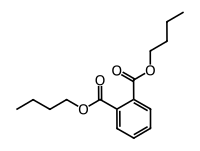
IUPAC name: dibutyl benzene-1,2-dicarboxylate
Also called DBP, phthalate, plasticiser

 DangerMay damage the unborn child; Suspected of damaging fertility · Very toxic to aquatic life
Names and identifiers
- IUPAC name
- dibutyl benzene-1,2-dicarboxylate
- Synonyms
- DBP, phthalate, plasticiser
+ 38 more
Di-n-butyl phthalate, n-Butyl phthalate, Butyl phthalate, Genoplast B, Palatinol C, Celluflex DPB, Unimoll DB, DIBUTYLPHTHALATE, Staflex DBP, Elaol, Ergoplast FDB, Hexaplas M/B, dibutyl benzene-1,2-dicarboxylate, Witcizer 300, Kodaflex DBP, Dibutyl 1,2-benzenedicarboxylate, Dibutyl-o-phthalate, DBP (ester), N-Butylphthalate, Ersoplast FDA, Uniflex DBP, Hatcol DBP, 1,2-Benzenedicarboxylic acid, dibutyl ester, RC Plasticizer DBP, Hatco dbp, Phthalate, di-n-butyl, Phthalic acid, dibutyl ester, Dibutyl o-phthalate, o-Benzenedicarboxylic acid, dibutyl ester, RCRA waste number U069, Benzene-o-dicarboxylic acid di-n-butyl ester, Monocizer dbp, Plasthall dbp, Vestinol c, PX 104, Phthalic acid di-n-butyl ester, DTXSID2021781, Ruifeng vp 201
- Molecular formula
- C16H22O4
- Empirical formula
- C8H11O2
- Molecular weight
- 278.34 g/mol
- Exact mass
- 278.15181
- CAS number
- 84-74-2
- PubChem CID
- 3026
- Canonical SMILES
- CCCCOC(=O)C1=CC=CC=C1C(=O)OCCCC
- Isomeric SMILES
- CCCCOC(=O)C1=CC=CC=C1C(=O)OCCCC
- InChI
- InChI=1S/C16H22O4/c1-3-5-11-19-15(17)13-9-7-8-10-14(13)16(18)20-12-6-4-2/h7-10H,3-6,11-12H2,1-2H3
- InChIKey
- DOIRQSBPFJWKBE-UHFFFAOYSA-N
- Molfile
Names, InChI and the identifiers from PubChem, retrieved 2026-10-14.
Physical properties
- Appearance
- Colorless to faint yellow, oily liquid[6]
6 values
From Hazardous Substances Data Bank (HSDB), the most authoritative source here.
Value As written Source – N-butyl phthalate is a colorless oily liquid. It is insoluble in water. The primary hazard is the threat to the environment. Immediate steps should be taken to limit its spread to the environment. Since it is a liquid it can easily penetrate the soil and contaminate groundwater and nearby streams. It is combustible though it may take some effort to ignite. It is used in paints and plastics and as a reaction media for chemical reactions. [1] CAMEO Chemicals – Liquid; CBI [2] EPA Chemical Data Reporting (CDR) – COLOURLESS-TO-YELLOW VISCOUS LIQUID WITH CHARACTERISTIC ODOUR. [3] ILO-WHO International Chemical Safety Cards (ICSCs) – Colorless to faint-yellow, oily liquid with a slight, aromatic odor. [4] Occupational Safety and Health Administration (OSHA) – Colorless to faint-yellow, oily liquid with a slight, aromatic odor. [5] The National Institute for Occupational Safety and Health (NIOSH) –shown Colorless to faint yellow, oily liquid [6] Hazardous Substances Data Bank (HSDB)cites NIOSH. NIOSH Pocket Guide to Chemical Hazards. Department of Health & Human Services, Centers for Disease Control & Prevention. National Institute for Occupational Safety & Health. DHHS (NIOSH) Publication No. 2010-168 (2010). Available from: https://www.cdc.gov/niosh/npg - Odor
- Slight, aromatic odor[6]
- Melting point
- -35 °C[3]
5 values
5 of 5 sources agree on it (most common value).
Value As written Source −35 °C -31 °F (NTP, 1992) [1] CAMEO Chemicalscites National Toxicology Program, Institute of Environmental Health Sciences, National Institutes of Health (NTP). 1992. National Toxicology Program Chemical Repository Database. Research Triangle Park, North Carolina. −35 °Cshown -35 °C [3] ILO-WHO International Chemical Safety Cards (ICSCs) −35 °C -31 °F [4] Occupational Safety and Health Administration (OSHA) −35 °C -35 °C [7] PAC Chemical Database, U.S. Department of Energy −35 °C -31 °F [5] The National Institute for Occupational Safety and Health (NIOSH) - Boiling point
- 340 °C[3]
5 values
5 of 5 sources agree on it (most common value).
Value As written Source 340 °C 644 °F at 760 mmHg (NTP, 1992) [1] CAMEO Chemicalscites National Toxicology Program, Institute of Environmental Health Sciences, National Institutes of Health (NTP). 1992. National Toxicology Program Chemical Repository Database. Research Triangle Park, North Carolina. 340 °Cshown 340 °C [3] ILO-WHO International Chemical Safety Cards (ICSCs) 340 °C 644 °F [4] Occupational Safety and Health Administration (OSHA) 340 °C 340 °C @760 [mm Hg] [7] PAC Chemical Database, U.S. Department of Energy 340 °C 644 °F [5] The National Institute for Occupational Safety and Health (NIOSH) - Density
- 1.0465 @ 20°C[7]
5 values
5 of 5 sources agree on it (most common value).
Value As written Source – 1.049 at 68 °F (USCG, 1999) - Denser than water [1] CAMEO Chemicalscites U.S. Coast Guard. 1999. Chemical Hazard Response Information System (CHRIS) - Hazardous Chemical Data. Commandant Instruction 16465.12C. Washington, D.C.: U.S. Government Printing Office. – Relative density (water = 1): 1.05 [3] ILO-WHO International Chemical Safety Cards (ICSCs) – 1.05 [4] Occupational Safety and Health Administration (OSHA) –shown 1.0465 @ 20°C [7] PAC Chemical Database, U.S. Department of Energy – 1.05 [5] The National Institute for Occupational Safety and Health (NIOSH) - Solubility in water
- Solubility in water, g/100ml at 25 °C: 0.001[3]
7 values
From ILO-WHO International Chemical Safety Cards (ICSCs), the most authoritative source here.
Value As written Source – less than 1 mg/mL at 68 °F (NTP, 1992) [1] CAMEO Chemicalscites National Toxicology Program, Institute of Environmental Health Sciences, National Institutes of Health (NTP). 1992. National Toxicology Program Chemical Repository Database. Research Triangle Park, North Carolina. – More soluble in /perspiration/ than in water & increased solubility with pH rise [6] Hazardous Substances Data Bank (HSDB)cites ITO ET AL; AICHI IKA DAIGAKU IGAKKAI ZASSHI 7 (3): 183 (1979) – In water, 11.2 mg/L at 20 °C [6] Hazardous Substances Data Bank (HSDB)cites Howard PH et al; Environ Tox and Chem 4: 653-61 (1985) – 0.001% in water at 30 °C [6] Hazardous Substances Data Bank (HSDB)cites Lefaux, R. Practical Toxicology of Plastics. Cleveland: CRC Press Inc., 1968., p. 137 – Soluble in most organic solvents and oils [6] Hazardous Substances Data Bank (HSDB)cites Lefaux, R. Practical Toxicology of Plastics. Cleveland: CRC Press Inc., 1968., p. 137 –shown Solubility in water, g/100ml at 25 °C: 0.001 [3] ILO-WHO International Chemical Safety Cards (ICSCs) – (77 °F): 0.001% [5] The National Institute for Occupational Safety and Health (NIOSH) - log P
- 4.72[3]
2 values
Sources disagree; from ILO-WHO International Chemical Safety Cards (ICSCs), the most authoritative.
Value As written Source – log Kow = 4.50 [6] Hazardous Substances Data Bank (HSDB)cites Ellington JJ, Floyd TL; Octanol/water partition coefficients for eight phthalate esters. EPA/600/S-96/006, Sept. 1996. Athens, GA: US Environ Prot Agency, National Exposure Research Lab (1996) –shown 4.72 [3] ILO-WHO International Chemical Safety Cards (ICSCs) - Vapor pressure
- Vapor pressure = 1.1 mmHg at 150 °C[6]
6 values
2 of 2 sources agree on it (most common value).
Value As written Source 1 mmHg 1 mmHg at 297 °F [1] CAMEO Chemicalscites National Toxicology Program, Institute of Environmental Health Sciences, National Institutes of Health (NTP). 1992. National Toxicology Program Chemical Repository Database. Research Triangle Park, North Carolina. 1.1 mmHg 1.1 mmHg at 302 °F (NTP, 1992) [1] CAMEO Chemicalscites National Toxicology Program, Institute of Environmental Health Sciences, National Institutes of Health (NTP). 1992. National Toxicology Program Chemical Repository Database. Research Triangle Park, North Carolina. 14 mmHg Vapor pressure = 14 mm Hg at 200 °C [6] Hazardous Substances Data Bank (HSDB)cites USEPA/ECAO; Phthalate Atlas Report p.I-3 (1980) 1.1 mmHgshown Vapor pressure = 1.1 mm Hg at 150 °C [6] Hazardous Substances Data Bank (HSDB)cites Lewis, R.J. Sr.; Hawley's Condensed Chemical Dictionary 15th Edition. John Wiley & Sons, Inc. New York, NY 2007., p. 398 0.000014 mmHg Vapor pressure = 1.4X10⁻⁵ torr at 25 °C [6] Hazardous Substances Data Bank (HSDB)cites Giam CS et al; Atmos Environ 14: 65-9 (1980) 0.0000201 mmHg 2.01X10⁻⁵ mm Hg at 25 °C [6] Hazardous Substances Data Bank (HSDB)cites Donovan SF; J Chromatogr A 749: 123-129 (1996) 3 more values were reported but failed the checks (unreadable or out of range), so they are not shown.
- Flash point
- 157 °C c.c.[3]
5 values
5 of 5 sources agree on it (most common value).
Value As written Source 157 °C 315 °F (NTP, 1992) [1] CAMEO Chemicalscites National Toxicology Program, Institute of Environmental Health Sciences, National Institutes of Health (NTP). 1992. National Toxicology Program Chemical Repository Database. Research Triangle Park, North Carolina. 157 °C 315 °F (157 °C) (Closed cup) [6] Hazardous Substances Data Bank (HSDB)cites National Fire Protection Association; Fire Protection Guide to Hazardous Materials. 14TH Edition, Quincy, MA 2010, p. 325-39 157 °Cshown 157 °C c.c. [3] ILO-WHO International Chemical Safety Cards (ICSCs) 157 °C 315 °F [4] Occupational Safety and Health Administration (OSHA) 157 °C 315 °F [5] The National Institute for Occupational Safety and Health (NIOSH) - Autoignition temperature
- 402 °C[3]
3 values
3 of 3 sources agree on it (most common value).
Value As written Source 403 °C 757 °F (USCG, 1999) [1] CAMEO Chemicalscites U.S. Coast Guard. 1999. Chemical Hazard Response Information System (CHRIS) - Hazardous Chemical Data. Commandant Instruction 16465.12C. Washington, D.C.: U.S. Government Printing Office. 403 °C 757 °F (402 °C) [6] Hazardous Substances Data Bank (HSDB)cites National Fire Protection Association; Fire Protection Guide to Hazardous Materials. 14TH Edition, Quincy, MA 2010, p. 325-39 402 °Cshown 402 °C [3] ILO-WHO International Chemical Safety Cards (ICSCs) - Viscosity
- Reported, but no value passed the checks.
The value and why
- 0.203 poise at 20 °C (could not be read; source [6])
Each value as its source reports it, with the source's number after it (listed under References). Where several sources report a property, the row shows the value most of them agree on, the rule the app uses; open the values to see every one.
Calculated
- Heavy atoms
- 20
- Rings
- 1
- Aromatic rings
- 1
- Fraction sp³ carbons (Fsp3)
- 0.5
- H-bond donors
- 0
- H-bond acceptors
- 4
- Rotatable bonds
- 8 computed here · PubChem 10
- TPSA (Ų)
- 52.6
- Formal charge
- 0
- XLogP3
- 4.7 PubChem
- Complexity
- 271 PubChem
- Stereocenters
- None
- Double-bond geometry
- None specified
- Point group
- C1 of one 3D conformer with its hydrogens, by Athanor’s engine (as in the app)
Elemental analysis
- C69.04%
- H7.97%
- O22.99%
Isotope pattern
Each peak is a nominal mass with its abundance-weighted exact mass, as a percentage of the tallest, from IUPAC natural isotope abundances.
Computed from the structure with RDKit 2026.09 when this page was built, beside PubChem's own computed values from its record; where the two differ, both are shown.
Predicted
- log P
- 3.6 Crippen (Wildman and Crippen 1999)
- log S (water solubility)
- -3.53 ESOL (Delaney 2004), log mol/L
- Synthetic accessibility
- 1.76 SA score, 1 easy to 10 hard (Ertl and Schuffenhauer 2009)
Drug-likeness: Lipinski’s rule of five
- Molecular weight ≤ 500: 278.35
- log P ≤ 5 (Crippen): 3.6
- H-bond donors ≤ 5: 0
- H-bond acceptors ≤ 10: 4
Passes all four rules.
¹³C NMR shifts, predicted
Predictions, not measurements; each names its method. A measured log P, where a source reports one, is under Physical properties.
Safety
Danger
Harmonized EU classification (CLP Annex VI). Source [8].
- Health hazard
- Environmental hazard
- H360DfMay damage the unborn child; Suspected of damaging fertility
- H400Very toxic to aquatic life
Precautionary statements: P203, P273, P280, P318, P391, P405, P501
View all classifications (4)
- [8] Regulation (EC) No 1272/2008 of the European Parliament and of the Council · DangerH360Df, H400
- [9] European Chemicals Agency (ECHA)This chemical does not meet GHS hazard criteria for < 0.1% (1 of 1322) of reports.
- [9] European Chemicals Agency (ECHA) · 1,322 reports · DangerH360
- [6] Hazardous Substances Data Bank (HSDB) · DangerH360, H400
Exposure limits
First aid
- Eyes: First check the victim for contact lenses and remove if present. Flush victim's eyes with water or normal saline solution for 20 to 30 minutes while simultaneously calling a hospital or poison control center. Do not put any ointments, oils, or medication in the victim's eyes without specific instructions from a physician. Immediately transport the victim after flushing eyes to a hospital even if no symptoms (such as redness or irritation) develop. Skin: Immediately flood affected skin with water while removing and isolating all contaminated clothing.[1]
- (General first aid procedures) Eye: Irrigate immediately - If this chemical contacts the eyes, immediately wash (irrigate) the eyes with large amounts of water, occasionally lifting the lower and upper lids. Get medical attention immediately. Skin: Wash regularly Breathing: Respiratory support Swallow: Medical attention immediately - If this chemical has been swallowed, get medical attention immediately.[5]
- Fresh air, rest.[3]
- Remove contaminated clothes. Rinse skin with plenty of water or shower.[3]
Storage
Incompatibilities
- Liquid chlorine reacts explosively with ...dibutyl phthalate.[6]
- Nitrates; strong oxidizers, alkalis and acids; liquid chlorine.[6]
- A mixture of the ester (dibutyl phthalate) and liquid chlorine confined in a stainless steel bomb reacted explosively at 118 °C.[6]
- Strong oxidizing agents, nitrates, bases, acids, chlorine[6]
Safety data sheets on the supplier’s page: A2B Chem, Chem-Space.com Database, Hairui Chemical.
Always read the supplier’s safety data sheet before working with it.
Spectra
- NMRHazardous Substances Data Bank (HSDB)
- 1H NMRHuman Metabolome Database (HMDB) (JEOL · 90 MHz · CDCl3) · SpectraBase (Varian A-60)
- 13C NMRHuman Metabolome Database (HMDB) (Varian · 25.16 MHz · CDCl3) · SpectraBase
- GC-MSHuman Metabolome Database (HMDB) (CI-B · positive) · Human Metabolome Database (HMDB) (EI-B · positive) · Human Metabolome Database (HMDB) (EI-B · positive) · Human Metabolome Database (HMDB) (CI-B · positive) · Human Metabolome Database (HMDB) (EI-B · positive) · Human Metabolome Database (HMDB) (CI-B · positive)
- MS-MSHuman Metabolome Database (HMDB) (Negative) · Human Metabolome Database (HMDB) (Positive) · Human Metabolome Database (HMDB) (Positive) · Human Metabolome Database (HMDB) (Negative) · Human Metabolome Database (HMDB) (Positive) · Human Metabolome Database (HMDB) (Negative)
- LC-MSMassBank Europe (maXis plus UHR-ToF-MS, Bruker Daltonics · LC-ESI-QTOF · POSITIVE) · MassBank Europe (maXis plus UHR-ToF-MS, Bruker Daltonics · LC-ESI-QTOF · POSITIVE) · MassBank Europe (maXis plus UHR-ToF-MS, Bruker Daltonics · LC-ESI-QTOF · POSITIVE) · MassBank Europe (Q Exactive Plus Orbitrap Thermo Scientific · LC-ESI-QFT · POSITIVE) · MassBank Europe (Q Exactive Plus Orbitrap Thermo Scientific · LC-ESI-QFT · POSITIVE) · MassBank Europe (Q Exactive Plus Orbitrap Thermo Scientific · LC-ESI-QFT · POSITIVE)
- Other MSHazardous Substances Data Bank (HSDB) · MassBank Europe (Unknown · CI-B · POSITIVE) · MassBank Europe (JEOL JMS-01-SG-2 · EI-B · POSITIVE) · MassBank Europe (HITACHI M-80 · EI-B · POSITIVE) · MassBank Europe (HITACHI M-80 · CI-B · POSITIVE) · MassBank Europe (HITACHI M-80B · EI-B · POSITIVE)
- UVHazardous Substances Data Bank (HSDB)
- IRHazardous Substances Data Bank (HSDB)
- FTIRSpectraBase (BETWEEN SALTS)
- ATR-IRSpectraBase (Bio-Rad FTS · ATR-Neat (DurasamplIR II))
- Near IRSpectraBase (INSTRUMENT PARAMETERS=INST=BRUKER,RSN=9351,REO=2,CNM=HEI,ZFF=2 · NIR Spectrometer= BRUKER IFS 88)
- Vapor Phase IRSpectraBase (DIGILAB FTS-14 · Vapor Phase)
- RamanHazardous Substances Data Bank (HSDB) · SpectraBase (Bio-Rad FTS 175C with Raman accessory · FT-Raman)
Experimental spectra held by these sources; each link opens the source's own record.
Literature
Reading PubChem, OpenAlex and GSRS…
Bioactivity
Reading ChEMBL…
References
- [1]CAMEO Chemicals · Public domain (NOAA) · via PubChem · retrieved 2026-10-14
- [2]EPA Chemical Data Reporting (CDR) · Public domain (US EPA) · via PubChem · retrieved 2026-10-14
- [3]ILO-WHO International Chemical Safety Cards (ICSCs) · CC BY 4.0 · via PubChem · retrieved 2026-10-14
- [4]Occupational Safety and Health Administration (OSHA) · Public domain (US DOL) · via PubChem · retrieved 2026-10-14
- [5]The National Institute for Occupational Safety and Health (NIOSH) · Public domain (US CDC) · via PubChem · retrieved 2026-10-14
- [6]Hazardous Substances Data Bank (HSDB) · Public domain (US NLM) · via PubChem · retrieved 2026-10-14
- [7]PAC Chemical Database, U.S. Department of Energy · Public domain (US DOE) · via PubChem · retrieved 2026-10-14
- [8]Regulation (EC) No 1272/2008 of the European Parliament and of the Council · EU reuse policy, CC BY 4.0 · via PubChem · retrieved 2026-10-14
- [9]European Chemicals Agency (ECHA) · ECHA legal notice: reuse with acknowledgement · via PubChem · retrieved 2026-10-14
- [10]Human Metabolome Database (HMDB) · Linked only · via PubChem · retrieved 2026-10-14
- [11]SpectraBase · Linked only · via PubChem · retrieved 2026-10-14
- [12]MassBank Europe · Linked only · via PubChem · retrieved 2026-10-14
- [13]MassBank of North America (MoNA) · CC BY 4.0 · via PubChem · retrieved 2026-10-14
- [14]NIST Mass Spectrometry Data Center · Linked only · via PubChem · retrieved 2026-10-14
- ·Calculated values: computed by Athanor with RDKit 2026.09 from the structure.
- ·Literature on PubChem
Data last updated 2026-10-14.