
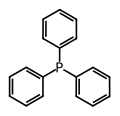
Triphenylphosphine
Athanor · official
C18H15P · 262.3 g/mol
IUPAC name: triphenylphosphane
Also called PPh3, TPP, Mitsunobu


 DangerHarmful if swallowed · May cause an allergic skin reaction · Causes serious eye damage · Causes damage to organs through prolonged or repeated exposure · May causes damage to organs through prolonged or repeated exposure · May cause long lasting harmful effects to aquatic life
Names and identifiers
- IUPAC name
- triphenylphosphane
- Synonyms
- PPh3, TPP, Mitsunobu
+ 35 more
Triphenylphosphane, Triphenyl phosphine, Phosphine, triphenyl-, Triphenylphosphorus, Triphenylphosphide, Trifenylfosfin, PP 360, DTXSID5026251, NSC-10, 26D26OA393, NSC-215203, DTXCID906251, CHEBI:183318, RefChem:6333, 210-036-0, Triphenylphosphine resin, triphenyl-phosphane, triphenylphosphin, Phosphorus triphenyl, NSC 10, NSC 215203, Ph3P, MFCD20489348, Phosphorustriphenyl, MFCD00003043, triphenylphoshine, WLN: RPR&R, Trifenylfosfin [Czech], C18H15P, TRIPHENYL PHOSPHOROUS, CAS-603-35-0, CCRIS 4889, HSDB 4266, Triphenyl phosphine resin, EINECS 210-036-0
- Molecular formula
- C18H15P
- Empirical formula
- C18H15P
- Molecular weight
- 262.3 g/mol
- Exact mass
- 262.09114
- CAS number
- 603-35-0
- PubChem CID
- 11776
- Canonical SMILES
- C1=CC=C(C=C1)P(C2=CC=CC=C2)C3=CC=CC=C3
- Isomeric SMILES
- C1=CC=C(C=C1)P(C2=CC=CC=C2)C3=CC=CC=C3
- InChI
- InChI=1S/C18H15P/c1-4-10-16(11-5-1)19(17-12-6-2-7-13-17)18-14-8-3-9-15-18/h1-15H
- InChIKey
- RIOQSEWOXXDEQQ-UHFFFAOYSA-N
- Molfile
Names, InChI and the identifiers from PubChem, retrieved 2026-10-14.
Physical properties
- Appearance
- Triphenyl phosphine appears as white crystals. (NTP, 1992)[1]
4 values
From CAMEO Chemicals, the most authoritative source here.
Value As written Source –shown Triphenyl phosphine appears as white crystals. (NTP, 1992) [1] CAMEO Chemicalscites National Toxicology Program, Institute of Environmental Health Sciences, National Institutes of Health (NTP). 1992. National Toxicology Program Chemical Repository Database. Research Triangle Park, North Carolina. – Liquid; Dry Powder; Liquid; CBI; Large Crystals; Other Solid; Dry Powder [2] EPA Chemical Data Reporting (CDR) – ODOURLESS WHITE CRYSTALS. [3] ILO-WHO International Chemical Safety Cards (ICSCs) – WHITE CRYSTALLINE SOLID [4] Hazardous Substances Data Bank (HSDB)cites Hawley, G.G. The Condensed Chemical Dictionary. 9th ed. New York: Van Nostrand Reinhold Co., 1977., p. 891 - Melting point
- 80 °C (176 °F, NTP 1992)[1]
3 values
3 of 3 sources agree on it (most common value).
Value As written Source 80 °Cshown 176 °F (NTP, 1992) [1] CAMEO Chemicalscites National Toxicology Program, Institute of Environmental Health Sciences, National Institutes of Health (NTP). 1992. National Toxicology Program Chemical Repository Database. Research Triangle Park, North Carolina. 80 °C 80 °C [3] ILO-WHO International Chemical Safety Cards (ICSCs) 79 °C 79 °C [5] PAC Chemical Database, U.S. Department of Energy - Boiling point
- 377 °C[3]
2 values
Only one source reports it.
Value As written Source > 360 °C greater than 680 °F at 760 mmHg (NTP, 1992) [1] CAMEO Chemicalscites National Toxicology Program, Institute of Environmental Health Sciences, National Institutes of Health (NTP). 1992. National Toxicology Program Chemical Repository Database. Research Triangle Park, North Carolina. 377 °Cshown 377 °C [3] ILO-WHO International Chemical Safety Cards (ICSCs) - Density
- 1.194 @25 °C[5]
3 values
2 of 3 sources agree on it (most common value).
Value As written Source – 1.194 at 77 °F (NTP, 1992) - Denser than water [1] CAMEO Chemicalscites National Toxicology Program, Institute of Environmental Health Sciences, National Institutes of Health (NTP). 1992. National Toxicology Program Chemical Repository Database. Research Triangle Park, North Carolina. – 1.1 g/cm³ [3] ILO-WHO International Chemical Safety Cards (ICSCs) –shown 1.194 @25 °C [5] PAC Chemical Database, U.S. Department of Energy - Solubility in water
- Solubility in water, mg/l at 25 °C: 0.09 (very poor)[3]
3 values
From ILO-WHO International Chemical Safety Cards (ICSCs), the most authoritative source here.
Value As written Source – Insoluble (NTP, 1992) [1] CAMEO Chemicalscites National Toxicology Program, Institute of Environmental Health Sciences, National Institutes of Health (NTP). 1992. National Toxicology Program Chemical Repository Database. Research Triangle Park, North Carolina. – SOL IN CARBON TETRACHLORIDE [4] Hazardous Substances Data Bank (HSDB)cites Hawley, G.G. The Condensed Chemical Dictionary. 9th ed. New York: Van Nostrand Reinhold Co., 1977., p. 891 –shown Solubility in water, mg/l at 25 °C: 0.09 (very poor) [3] ILO-WHO International Chemical Safety Cards (ICSCs) - log P
- 5.69[3]
- Vapor pressure
- Vapor pressure, Pa at 50 °C: 0.017[3]
- Flash point
- 180 °C OC.[4]
3 values
2 of 3 sources agree on it (most common value).
Value As written Source 180 °C 356 °F (NTP, 1992) [1] CAMEO Chemicalscites National Toxicology Program, Institute of Environmental Health Sciences, National Institutes of Health (NTP). 1992. National Toxicology Program Chemical Repository Database. Research Triangle Park, North Carolina. 180 °Cshown 180 °C OC. [4] Hazardous Substances Data Bank (HSDB)cites National Fire Protection Association. Fire Protection Guide on Hazardous Materials. 7th ed. Boston, Mass.: National Fire Protection Association, 1978., p. 325M-184 182 °C 182 °C c.c. [3] ILO-WHO International Chemical Safety Cards (ICSCs) - Autoignition temperature
- 425 °C[3]
Each value as its source reports it, with the source's number after it (listed under References). Where several sources report a property, the row shows the value most of them agree on, the rule the app uses; open the values to see every one.
Calculated
- Heavy atoms
- 19
- Rings
- 3
- Aromatic rings
- 3
- Fraction sp³ carbons (Fsp3)
- 0
- H-bond donors
- 0
- H-bond acceptors
- 0
- Rotatable bonds
- 3
- TPSA (Ų)
- 0
- Formal charge
- 0
- XLogP3
- 4.6 PubChem
- Complexity
- 202 PubChem
- Stereocenters
- None
- Double-bond geometry
- None specified
- Point group
- C3 of one 3D conformer with its hydrogens, by Athanor’s engine (as in the app)
Elemental analysis
- C82.43%
- H5.76%
- P11.81%
Isotope pattern
Each peak is a nominal mass with its abundance-weighted exact mass, as a percentage of the tallest, from IUPAC natural isotope abundances.
Computed from the structure with RDKit 2026.09 when this page was built, beside PubChem's own computed values from its record; where the two differ, both are shown.
Predicted
- log P
- 3.44 Crippen (Wildman and Crippen 1999)
- log S (water solubility)
- -4.14 ESOL (Delaney 2004), log mol/L
- Synthetic accessibility
- 1.65 SA score, 1 easy to 10 hard (Ertl and Schuffenhauer 2009)
Drug-likeness: Lipinski’s rule of five
- Molecular weight ≤ 500: 262.29
- log P ≤ 5 (Crippen): 3.44
- H-bond donors ≤ 5: 0
- H-bond acceptors ≤ 10: 0
Passes all four rules.
¹³C NMR shifts, predicted
Predictions, not measurements; each names its method. A measured log P, where a source reports one, is under Physical properties.
Safety
Danger
Most widely reported: 1,290 company reports to ECHA. Source [6].
- Corrosive
- Harmful or irritant
- Health hazard
- H302Harmful if swallowed (97.1% of reports)
- H317May cause an allergic skin reaction (99.4% of reports)
- H318Causes serious eye damage (12.8% of reports)
- H372Causes damage to organs through prolonged or repeated exposure (23.1% of reports)
- H373May causes damage to organs through prolonged or repeated exposure (21.1% of reports)
- H413May cause long lasting harmful effects to aquatic life (64.1% of reports)
Precautionary statements: P260, P261, P264, P264+P265, P270, P272, P273, P280, P301+P317, P302+P352, P305+P354+P338, P317, P319, P321, P330, P333+P317, P362+P364, P501
View all classifications (2)
- [6] European Chemicals Agency (ECHA)This chemical does not meet GHS hazard criteria for 0.5% (6 of 1290) of reports.
- [6] European Chemicals Agency (ECHA) · 1,290 reports · DangerH302, H317, H318, H372, H373, H413
Exposure limits
- MAK (Maximale Arbeitsplatz Konzentration): (inhalable fraction): 5 mg/m[3]
First aid
- Eyes: First check the victim for contact lenses and remove if present. Flush victim's eyes with water or normal saline solution for 20 to 30 minutes while simultaneously calling a hospital or poison control center. Do not put any ointments, oils, or medication in the victim's eyes without specific instructions from a physician. Immediately transport the victim after flushing eyes to a hospital even if no symptoms (such as redness or irritation) develop. Skin: Immediately flood affected skin with water while removing and isolating all contaminated clothing.[1]
- Fresh air, rest. Refer for medical attention.[3]
- Wear protective gloves when administering first aid. Remove contaminated clothes. Rinse and then wash skin with water and soap. Refer for medical attention .[3]
- Rinse with plenty of water for several minutes (remove contact lenses if easily possible). Refer for medical attention.[3]
Storage
- Separated from oxidants and acids. Keep in a well-ventilated room.[3]
Safety data sheets on the supplier’s page: RR Scientific, J&H Chemical Co.,ltd, CATO Research Chemicals Inc..
Always read the supplier’s safety data sheet before working with it.
Spectra
- NMRHazardous Substances Data Bank (HSDB) · NMRShiftDB
- 1H NMRSpectraBase (Varian A-60)
- 13C NMRSpectraBase
- 31P NMRSpectraBase
- GC-MSNIST Mass Spectrometry Data Center · NIST Mass Spectrometry Data Center · NIST Mass Spectrometry Data Center · NIST Mass Spectrometry Data Center · SpectraBase (CH5)
- MS-MSNIST Mass Spectrometry Data Center (IT/ion trap)
- Other MSHazardous Substances Data Bank (HSDB)
- UVHazardous Substances Data Bank (HSDB)
- IRHazardous Substances Data Bank (HSDB)
- FTIRSpectraBase (Bruker IFS 85 · KBr-Pellet)
- ATR-IRSpectraBase (Bruker Tensor 27 FT-IR · ATR-Neat (DuraSamplIR II))
- Vapor Phase IRSpectraBase
- RamanSpectraBase (Thermo Nicolet FT-Raman 960 · FT-Raman)
Experimental spectra held by these sources; each link opens the source's own record.
Literature
Reading PubChem, OpenAlex and GSRS…
Bioactivity
Reading ChEMBL…
References
- [1]CAMEO Chemicals · Public domain (NOAA) · via PubChem · retrieved 2026-10-14
- [2]EPA Chemical Data Reporting (CDR) · Public domain (US EPA) · via PubChem · retrieved 2026-10-14
- [3]ILO-WHO International Chemical Safety Cards (ICSCs) · CC BY 4.0 · via PubChem · retrieved 2026-10-14
- [4]Hazardous Substances Data Bank (HSDB) · Public domain (US NLM) · via PubChem · retrieved 2026-10-14
- [5]PAC Chemical Database, U.S. Department of Energy · Public domain (US DOE) · via PubChem · retrieved 2026-10-14
- [6]European Chemicals Agency (ECHA) · ECHA legal notice: reuse with acknowledgement · via PubChem · retrieved 2026-10-14
- [7]NMRShiftDB · Linked only · via PubChem · retrieved 2026-10-14
- [8]SpectraBase · Linked only · via PubChem · retrieved 2026-10-14
- [9]NIST Mass Spectrometry Data Center · Linked only · via PubChem · retrieved 2026-10-14
- ·Calculated values: computed by Athanor with RDKit 2026.09 from the structure.
- ·Literature on PubChem
Data last updated 2026-10-14.