
Sorbitol
Athanor · official
C6H14O6 · 182.17 g/mol
IUPAC name: (2R,3R,4R,5S)-hexane-1,2,3,4,5,6-hexol
Also called glucitol, D-sorbitol, E420, sugar alcohol, sorbol
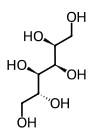
Names and identifiers
- IUPAC name
- (2R,3R,4R,5S)-hexane-1,2,3,4,5,6-hexol
- Synonyms
- glucitol, D-sorbitol, E420
+ 39 more
sugar alcohol, sorbol, D-Sorbitol, D-Glucitol, Glucarine, (-)-Sorbitol, Nivitin, Sorbit, D-(-)-Sorbitol, Diakarmon, Sorbilande, Sorbostyl, Esasorb, Multitol, Neosorb, Sorbo, Sorbol, Cholaxine, Sionit, Sionite, Sionon, Siosan, Karion instant, Sorbitol F, Sorbex Rp, Sorbitol FP, D-Sorbol, Sionit K, Sorbex M, Sorbex R, Sorbex S, Sorbex X, Sorbicolan, Sorvilande, Gulitol, D-Sorbite, Neosorb P 60, Foodol D 70, Neosorb 20/60DC
- Molecular formula
- C6H14O6
- Empirical formula
- C3H7O3
- Molecular weight
- 182.17 g/mol
- Exact mass
- 182.07904
- CAS number
- 50-70-4
- PubChem CID
- 5780
- Canonical SMILES
- C(C(C(C(C(CO)O)O)O)O)O
- Isomeric SMILES
- C([C@H]([C@H]([C@@H]([C@H](CO)O)O)O)O)O
- InChI
- InChI=1S/C6H14O6/c7-1-3(9)5(11)6(12)4(10)2-8/h3-12H,1-2H2/t3-,4+,5-,6-/m1/s1
- InChIKey
- FBPFZTCFMRRESA-JGWLITMVSA-N
- Molfile
Names, InChI and the identifiers from PubChem, retrieved 2026-10-14.
Physical properties
- Appearance
- White crystalline powder[4]
6 values
From Hazardous Substances Data Bank (HSDB), the most authoritative source here.
Value As written Source – Sorbitol is an odorless colorless solid. Sinks and mixes with water. (USCG, 1999) [1] CAMEO Chemicalscites U.S. Coast Guard. 1999. Chemical Hazard Response Information System (CHRIS) - Hazardous Chemical Data. Commandant Instruction 16465.12C. Washington, D.C.: U.S. Government Printing Office. – Large Crystals; Dry Powder; Dry Powder; Liquid; Liquid; Large Crystals; Wet Solid; Other Solid [2] EPA Chemical Data Reporting (CDR) – WHITE HYGROSCOPIC SOLID IN VARIOUS FORMS. [3] ILO-WHO International Chemical Safety Cards (ICSCs) – White powder, as granules, or as crystalline masses [4] Hazardous Substances Data Bank (HSDB)cites FCC; Food Chemicals Codex. Committee on Food Chemicals Codex, Food and Nutrition Board, Institute of Medicine. 5th. Washington, DC: National Academy Press p. 443 (2003) –shown White crystalline powder [4] Hazardous Substances Data Bank (HSDB)cites Lewis, R.J. Sr. (ed) Sax's Dangerous Properties of Industrial Materials. 11th Edition. Wiley-Interscience, Wiley & Sons, Inc. Hoboken, NJ. 2004., p. V3: 3292 – WHITE POWDER, GRANULES, OR FLAKES [4] Hazardous Substances Data Bank (HSDB)cites Osol, A. and J.E. Hoover, et al. (eds.). Remington's Pharmaceutical Sciences. 15th ed. Easton, Pennsylvania: Mack Publishing Co., 1975., p. 1235 - Odor
- Odorless[4]
- Melting point
- 110-112 °C[3]
2 values
2 of 2 sources agree on it (most common value).
Value As written Source 110 °C 230 °F (USCG, 1999) [1] CAMEO Chemicalscites U.S. Coast Guard. 1999. Chemical Hazard Response Information System (CHRIS) - Hazardous Chemical Data. Commandant Instruction 16465.12C. Washington, D.C.: U.S. Government Printing Office. 110 to 112 °Cshown 110-112 °C [3] ILO-WHO International Chemical Safety Cards (ICSCs) - Boiling point
- Reported, but no value passed the checks.
The value and why
- Very high (USCG, 1999) (could not be read; source [1])
- Density
- 1.49 at 15 °C (59 °F) (USCG, 1999) - Denser than water[1]
2 values
2 of 2 sources agree on it (most common value).
Value As written Source –shown 1.49 at 59 °F (USCG, 1999) - Denser than water [1] CAMEO Chemicalscites U.S. Coast Guard. 1999. Chemical Hazard Response Information System (CHRIS) - Hazardous Chemical Data. Commandant Instruction 16465.12C. Washington, D.C.: U.S. Government Printing Office. – 1.5 g/cm³ [3] ILO-WHO International Chemical Safety Cards (ICSCs) - Solubility in water
- Solubility in water, g/100ml at 20 °C: 220[3]
3 values
From ILO-WHO International Chemical Safety Cards (ICSCs), the most authoritative source here.
Value As written Source – In water, 6.9X10+5 mg/L at 20 °C [4] Hazardous Substances Data Bank (HSDB)cites Yalkowsky, S.H., He, Yan., Handbook of Aqueous Solubility Data: An Extensive Compilation of Aqueous Solubility Data for Organic Compounds Extracted from the AQUASOL dATAbASE. CRC Press LLC, Boca Raton, FL. 2003., p. 336 – In water, 2.75X10+6 mg/L at 25 °C [4] Hazardous Substances Data Bank (HSDB)cites Mullin JW; pp 425-426 in Crystallisation, Book A. Cleveland, OH: CRC Press (1972) –shown Solubility in water, g/100ml at 20 °C: 220 [3] ILO-WHO International Chemical Safety Cards (ICSCs) - log P
- log Kow = -2.20[4]
2 values
2 of 2 sources agree on it (most common value).
Value As written Source –shown log Kow = -2.20 [4] Hazardous Substances Data Bank (HSDB)cites Sangster J; LOGKOW Databank. Sangster Res Lab Montreal Quebec, Canada (1994) – -2.2 [3] ILO-WHO International Chemical Safety Cards (ICSCs) - pKa
- pKa = 13.57[4]
- Flash point
- 283 °C (542 °F, USCG 1999)[1]
Each value as its source reports it, with the source's number after it (listed under References). Where several sources report a property, the row shows the value most of them agree on, the rule the app uses; open the values to see every one.
Calculated
- Heavy atoms
- 12
- Rings
- 0
- Aromatic rings
- 0
- Fraction sp³ carbons (Fsp3)
- 1
- H-bond donors
- 6
- H-bond acceptors
- 6
- Rotatable bonds
- 5
- TPSA (Ų)
- 121.4 computed here · PubChem 121
- Formal charge
- 0
- XLogP3
- -3.1 PubChem
- Complexity
- 105 PubChem
- Stereocenters
- 4 definedCIP: C3: S · C5: R · C7: R · C9: R
- Double-bond geometry
- None specified
- Point group
- C1 of one 3D conformer with its hydrogens, by Athanor’s engine (as in the app)
Elemental analysis
- C39.56%
- H7.75%
- O52.69%
Isotope pattern
Each peak is a nominal mass with its abundance-weighted exact mass, as a percentage of the tallest, from IUPAC natural isotope abundances.
Computed from the structure with RDKit 2026.09 when this page was built, beside PubChem's own computed values from its record; where the two differ, both are shown.
Predicted
- log P
- -3.59 Crippen (Wildman and Crippen 1999)
- log S (water solubility)
- 1.62 ESOL (Delaney 2004), log mol/L
- Synthetic accessibility
- 3.56 SA score, 1 easy to 10 hard (Ertl and Schuffenhauer 2009)
Drug-likeness: Lipinski’s rule of five
- Molecular weight ≤ 500: 182.17
- log P ≤ 5 (Crippen): -3.59
- H-bond donors ≤ 5: 6
- H-bond acceptors ≤ 10: 6
Breaks 1 of the four rules.
¹³C NMR shifts, predicted
Predictions, not measurements; each names its method. A measured log P, where a source reports one, is under Physical properties.
Safety
This chemical does not meet GHS hazard criteria for 100% (1338 of 1338) of all reports.[5]
First aid
- Only for burns caused by hot liquid. (USCG, 1999)[1]
Storage
Incompatibilities
- Materials to avoid: Strong oxidizing agents.[4]
Safety data sheets on the supplier’s page: Alfa Chemistry, Chemenu Inc., Combi-Blocks.
Always read the supplier’s safety data sheet before working with it.
Spectra
- NMRHazardous Substances Data Bank (HSDB)
- 1H NMRHuman Metabolome Database (HMDB) (Varian · 500 MHz · Water) · Human Metabolome Database (HMDB) (Bruker · D2O) · SpectraBase
- 13C NMRHuman Metabolome Database (HMDB) (Bruker · 125 MHz · Water) · Human Metabolome Database (HMDB) (400 MHz · H2O) · SpectraBase
- 1H-13C NMRHuman Metabolome Database (HMDB) (Bruker · 600 MHz · Water)
- GC-MSHuman Metabolome Database (HMDB) (GC-EI-TOF · positive) · Human Metabolome Database (HMDB) (GC-MS) · Human Metabolome Database (HMDB) (GC-EI-TOF · positive) · Human Metabolome Database (HMDB) (GC-EI-TOF (Pegasus III TOF-MS system, Leco; GC 6890, Agilent Technologies) · Positive) · MassBank Europe (Pegasus III TOF-MS system, Leco; GC 6890, Agilent Technologies · GC-EI-TOF · POSITIVE) · MassBank of North America (MoNA) (Leco Pegasus IV · GC-EI-TOF · positive)
- MS-MSHuman Metabolome Database (HMDB) (Negative) · Human Metabolome Database (HMDB) (Positive) · Human Metabolome Database (HMDB) (Positive) · Human Metabolome Database (HMDB) (Quattro_QQQ · Positive) · Human Metabolome Database (HMDB) (Quattro_QQQ · Positive) · Human Metabolome Database (HMDB) (Quattro_QQQ · Positive)
- LC-MSMassBank Europe (Thermo Scientific Q-Exactive Focus · LC-ESI-ITFT · NEGATIVE) · MassBank Europe (Thermo Scientific Q-Exactive Focus · LC-ESI-ITFT · NEGATIVE) · MassBank Europe (Thermo Scientific Q-Exactive Focus · LC-ESI-ITFT · NEGATIVE) · MassBank Europe (Thermo Scientific Q-Exactive Focus · LC-ESI-ITFT · NEGATIVE) · MassBank Europe (Thermo Scientific Q-Exactive Focus · LC-ESI-ITFT · NEGATIVE) · MassBank Europe (Thermo Scientific Q-Exactive Focus · LC-ESI-ITFT · NEGATIVE)
- Other MSMassBank of North America (MoNA) (TQD, Waters · Flow-injection QqQ/MS · ESI) · MassBank of North America (MoNA) (TQD, Waters · Flow-injection QqQ/MS · ESI) · MassBank of North America (MoNA) (TQD, Waters · Flow-injection QqQ/MS · ESI)
- UVHazardous Substances Data Bank (HSDB)
- IRHazardous Substances Data Bank (HSDB)
- FTIRSpectraBase (KBr WAFER)
- ATR-IRSpectraBase (Bio-Rad FTS · ATR-Neat (DuraSamplIR II))
- RamanSpectraBase (Bruker MultiRAM Stand Alone FT-Raman Spectrometer · FT-Raman)
Experimental spectra held by these sources; each link opens the source's own record.
Literature
Reading PubChem, OpenAlex and GSRS…
Bioactivity
Reading ChEMBL…
References
- [1]CAMEO Chemicals · Public domain (NOAA) · via PubChem · retrieved 2026-10-14
- [2]EPA Chemical Data Reporting (CDR) · Public domain (US EPA) · via PubChem · retrieved 2026-10-14
- [3]ILO-WHO International Chemical Safety Cards (ICSCs) · CC BY 4.0 · via PubChem · retrieved 2026-10-14
- [4]Hazardous Substances Data Bank (HSDB) · Public domain (US NLM) · via PubChem · retrieved 2026-10-14
- [5]European Chemicals Agency (ECHA) · ECHA legal notice: reuse with acknowledgement · via PubChem · retrieved 2026-10-14
- [6]Human Metabolome Database (HMDB) · Linked only · via PubChem · retrieved 2026-10-14
- [7]SpectraBase · Linked only · via PubChem · retrieved 2026-10-14
- [8]MassBank Europe · Linked only · via PubChem · retrieved 2026-10-14
- [9]MassBank of North America (MoNA) · CC BY 4.0 · via PubChem · retrieved 2026-10-14
- ·Calculated values: computed by Athanor with RDKit 2026.09 from the structure.
- ·Literature on PubChem
Data last updated 2026-10-14.