
Pregnenolone
Athanor · official
C21H32O2 · 316.5 g/mol
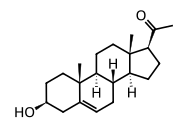
IUPAC name: 1-[(3S,8S,9S,10R,13S,14S,17S)-3-hydroxy-10,13-dimethyl-2,3,4,7,8,9,11,12,14,15,16,17-dodecahydro-1H-cyclopenta[a]phenanthren-17-yl]ethanone
Also called P5, steroid precursor, prohormone

 WarningHarmful if swallowed · Harmful in contact with skin · Harmful if inhaled · Suspected of causing cancer · Suspected of damaging fertility or the unborn child
Names and identifiers
- IUPAC name
- 1-[(3S,8S,9S,10R,13S,14S,17S)-3-hydroxy-10,13-dimethyl-2,3,4,7,8,9,11,12,14,15,16,17-dodecahydro-1H-cyclopenta[a]phenanthren-17-yl]ethanone
- Synonyms
- P5, steroid precursor, prohormone
+ 38 more
3beta-Hydroxypregn-5-en-20-one, Arthenolone, Regnosone, Skinostelon, Enelone, Natolone, Bina-Skin, 5-Pregnen-3beta-ol-20-one, delta5-Pregnenolone, 5-Pregnen-3-beta-ol-20-one, Pregnenolona, Pregnenolonum, DTXSID1036541, 3-beta-Hydroxypregn-5-en-20-one, Pregn-5-en-20-one, 3-hydroxy-, (3beta)-, 73R90F7MQ8, 1-[(3S,8S,9S,10R,13S,14S,17S)-3-hydroxy-10,13-dimethyl-2,3,4,7,8,9,11,12,14,15,16,17-dodecahydro-1H-cyclopenta[a]phenanthren-17-yl]ethanone, DTXCID9016541, CHEBI:16581, NSC1616, 5 Pregnen 3 beta ol 20 one, 1-((3S,8S,9S,10R,13S,14S,17S)-3-hydroxy-10,13-dimethyl-2,3,4,7,8,9,11,12,14,15,16,17-dodecahydro-1H-cyclopenta(a)phenanthren-17-yl)ethanone, RefChem:868471, 205-647-4, Prenolon, Pregnetan, Pregneton, Pregnolon, (3BETA)-3-HYDROXYPREGN-5-EN-20-ONE, 3beta-Hydroxy-5-pregnen-20-one, 5-Pregnenolone, NSC 1616, MFCD00003628, Prestwick_859, Pregnenolone (Standard), Prestwick3_000546, Pregnenolone (JAN/INN), Pregn-5-en-20-one, 3beta-hydroxy-
- Molecular formula
- C21H32O2
- Empirical formula
- C21H32O2
- Molecular weight
- 316.5 g/mol
- Exact mass
- 316.24023
- CAS number
- 145-13-1
- PubChem CID
- 8955
- Canonical SMILES
- CC(=O)C1CCC2C1(CCC3C2CC=C4C3(CCC(C4)O)C)C
- Isomeric SMILES
- CC(=O)[C@H]1CC[C@@H]2[C@@]1(CC[C@H]3[C@H]2CC=C4[C@@]3(CC[C@@H](C4)O)C)C
- InChI
- InChI=1S/C21H32O2/c1-13(22)17-6-7-18-16-5-4-14-12-15(23)8-10-20(14,2)19(16)9-11-21(17,18)3/h4,15-19,23H,5-12H2,1-3H3/t15-,16-,17+,18-,19-,20-,21+/m0/s1
- InChIKey
- ORNBQBCIOKFOEO-QGVNFLHTSA-N
- Molfile
Names, InChI and the identifiers from PubChem, retrieved 2026-10-14.
Calculated
- Heavy atoms
- 23
- Rings
- 4
- Aromatic rings
- 0
- Fraction sp³ carbons (Fsp3)
- 0.86
- H-bond donors
- 1
- H-bond acceptors
- 2
- Rotatable bonds
- 1
- TPSA (Ų)
- 37.3
- Formal charge
- 0
- XLogP3
- 4.2 PubChem
- Complexity
- 550 PubChem
- Stereocenters
- 7 definedCIP: C4: S · C7: S · C8: S · C13: S · C17: R · C19: S · C22: S
- Double-bond geometry
- None specified
- Point group
- C1 of one 3D conformer with its hydrogens, by Athanor’s engine (as in the app)
Elemental analysis
- C79.70%
- H10.19%
- O10.11%
Isotope pattern
Each peak is a nominal mass with its abundance-weighted exact mass, as a percentage of the tallest, from IUPAC natural isotope abundances.
Computed from the structure with RDKit 2026.09 when this page was built, beside PubChem's own computed values from its record; where the two differ, both are shown.
Predicted
- log P
- 4.52 Crippen (Wildman and Crippen 1999)
- log S (water solubility)
- -4.58 ESOL (Delaney 2004), log mol/L
- Synthetic accessibility
- 4.08 SA score, 1 easy to 10 hard (Ertl and Schuffenhauer 2009)
Drug-likeness: Lipinski’s rule of five
- Molecular weight ≤ 500: 316.49
- log P ≤ 5 (Crippen): 4.52
- H-bond donors ≤ 5: 1
- H-bond acceptors ≤ 10: 2
Passes all four rules.
¹³C NMR shifts, predicted
Predictions, not measurements; each names its method. A measured log P, where a source reports one, is under Physical properties.
Safety
Warning
Most widely reported: 23 company reports to ECHA. Source [1].
- Harmful or irritant
- Health hazard
- H302Harmful if swallowed (87% of reports)
- H312Harmful in contact with skin (87% of reports)
- H332Harmful if inhaled (87% of reports)
- H351Suspected of causing cancer (87% of reports)
- H361Suspected of damaging fertility or the unborn child (87% of reports)
Precautionary statements: P203, P261, P264, P270, P271, P280, P301+P317, P302+P352, P304+P340, P317, P318, P321, P330, P362+P364, P405, P501
View all classifications (2)
- [1] European Chemicals Agency (ECHA)This chemical does not meet GHS hazard criteria for 13% (3 of 23) of reports.
- [1] European Chemicals Agency (ECHA) · 23 reports · WarningH302, H312, H332, H351, H361
Safety data sheets on the supplier’s page: Aladdin Scientific, INTERBIOSCREEN, Alfa Chemistry.
Always read the supplier’s safety data sheet before working with it.
Spectra
- 1H NMRHuman Metabolome Database (HMDB) (JEOL · 400 MHz · CDCl3) · SpectraBase
- 13C NMRHuman Metabolome Database (HMDB) (50.18 MHz · CDCl3) · SpectraBase
- GC-MSHuman Metabolome Database (HMDB) (EI-B · positive) · MassBank of North America (MoNA) (HITACHI M-52 · EI-B · positive) · MassBank of North America (MoNA) (GC-MS) · NIST Mass Spectrometry Data Center · NIST Mass Spectrometry Data Center · NIST Mass Spectrometry Data Center
- MS-MSNIST Mass Spectrometry Data Center (IT/ion trap) · NIST Mass Spectrometry Data Center (IT/ion trap)
- Other MSMassBank Europe (HITACHI M-52 · EI-B · POSITIVE)
- FTIRSpectraBase (KBr WAFER)
- ATR-IRSpectraBase (Bio-Rad FTS · ATR-Neat (DuraSamplIR II) ground)
- Vapor Phase IRSpectraBase (DIGILAB FTS-14 · Vapor Phase)
- RamanSpectraBase (Bruker MultiRAM Stand Alone FT-Raman Spectrometer · FT-Raman)
Experimental spectra held by these sources; each link opens the source's own record.
Literature
Reading PubChem, OpenAlex and GSRS…
Bioactivity
Reading ChEMBL…
References
- [1]European Chemicals Agency (ECHA) · ECHA legal notice: reuse with acknowledgement · via PubChem · retrieved 2026-10-14
- [2]Human Metabolome Database (HMDB) · Linked only · via PubChem · retrieved 2026-10-14
- [3]SpectraBase · Linked only · via PubChem · retrieved 2026-10-14
- [4]MassBank of North America (MoNA) · CC BY 4.0 · via PubChem · retrieved 2026-10-14
- [5]NIST Mass Spectrometry Data Center · Linked only · via PubChem · retrieved 2026-10-14
- [6]MassBank Europe · Linked only · via PubChem · retrieved 2026-10-14
- ·Calculated values: computed by Athanor with RDKit 2026.09 from the structure.
- ·Literature on PubChem
Data last updated 2026-10-14.