
Gonadotropin-releasing hormone
Athanor · official
C55H75N17O13 · 1182.3 g/mol
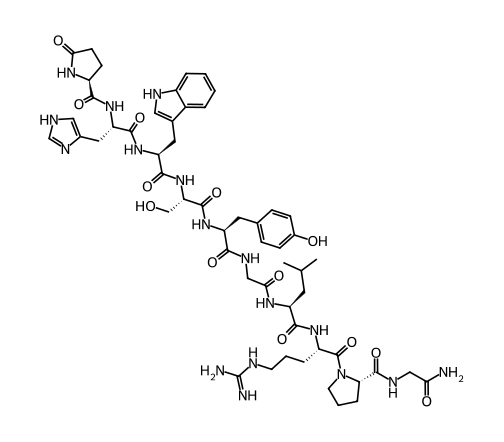
IUPAC name: (2S)-N-[(2S)-1-[[(2S)-1-[[(2S)-1-[[(2S)-1-[[2-[[(2S)-1-[[(2S)-1-[(2S)-2-[(2-amino-2-oxoethyl)carbamoyl]pyrrolidin-1-yl]-5-(diaminomethylideneamino)-1-oxopentan-2-yl]amino]-4-methyl-1-oxopentan-2-yl]amino]-2-oxoethyl]amino]-3-(4-hydroxyphenyl)-1-oxopropan-2-yl]amino]-3-hydroxy-1-oxopropan-2-yl]amino]-3-(1H-indol-3-yl)-1-oxopropan-2-yl]amino]-3-(1H-imidazol-5-yl)-1-oxopropan-2-yl]-5-oxopyrrolidine-2-carboxamide
Also called GnRH, LHRH, luteinizing hormone-releasing hormone, gonadorelin, 10-residue peptide
 DangerMay damage fertility or the unborn child
Names and identifiers
- IUPAC name
- (2S)-N-[(2S)-1-[[(2S)-1-[[(2S)-1-[[(2S)-1-[[2-[[(2S)-1-[[(2S)-1-[(2S)-2-[(2-amino-2-oxoethyl)carbamoyl]pyrrolidin-1-yl]-5-(diaminomethylideneamino)-1-oxopentan-2-yl]amino]-4-methyl-1-oxopentan-2-yl]amino]-2-oxoethyl]amino]-3-(4-hydroxyphenyl)-1-oxopropan-2-yl]amino]-3-hydroxy-1-oxopropan-2-yl]amino]-3-(1H-indol-3-yl)-1-oxopropan-2-yl]amino]-3-(1H-imidazol-5-yl)-1-oxopropan-2-yl]-5-oxopyrrolidine-2-carboxamide
- Synonyms
- GnRH, LHRH, luteinizing hormone-releasing hormone
+ 41 more
gonadorelin, 10-residue peptide, GONADORELIN, Gonadorelina, GnRH-I, Gonadorelinum, Fertagyl, LH-Releasing factor, Luforan, Lutrefact, Gonadoliberin I, Gonadotropin-releasing factor, Gonadoreline, p-Glu-His-Trp-Ser-Tyr-Gly-Leu-Arg-Pro-Gly-NH2, Gonadorelin decapeptide, CHEBI:5520, 5-oxo-L-prolyl-L-histidyl-L-tryptophyl-L-seryl-L-tyrosylglycyl-L-leucyl-L-arginyl-L-prolylglycinamide, DTXSID20873490, 9O7312W37G, pGlu-His-Trp-Ser-Tyr-Gly-Leu-Arg-Pro-Gly-NH2, Fertiral lh-rh, Relefact lh-rh, Fertelin, OvaCyst, RefChem:1086162, H01CA01, V04CM01, DTXCID001011737, 251-553-1, Hypocrine, Luteostimulin, Relefact, 5-oxo-PHWSYGLRPGNH2, Gonadorelin for NMR identification CRS, Dirigestran, Glycinamide, 5-oxo-L-prolyl-L-histidyl-L-tryptophyl-L-seryl-L-tyrosylglycyl-L-leucyl-L-arginyl-L-prolyl-, Nialutin, Lutal, Relisorm l, C55H75N17O13, Mammalian GnRH, Synthetic LRF
- Molecular formula
- C55H75N17O13
- Empirical formula
- C55H75N17O13
- Molecular weight
- 1182.3 g/mol
- Exact mass
- 1181.57303
- CAS number
- 33515-09-2
- PubChem CID
- 638793
- Canonical SMILES
- CC(C)CC(C(=O)NC(CCCN=C(N)N)C(=O)N1CCCC1C(=O)NCC(=O)N)NC(=O)CNC(=O)C(CC2=CC=C(C=C2)O)NC(=O)C(CO)NC(=O)C(CC3=CNC4=CC=CC=C43)NC(=O)C(CC5=CN=CN5)NC(=O)C6CCC(=O)N6
- Isomeric SMILES
- CC(C)C[C@@H](C(=O)N[C@@H](CCCN=C(N)N)C(=O)N1CCC[C@H]1C(=O)NCC(=O)N)NC(=O)CNC(=O)[C@H](CC2=CC=C(C=C2)O)NC(=O)[C@H](CO)NC(=O)[C@H](CC3=CNC4=CC=CC=C43)NC(=O)[C@H](CC5=CN=CN5)NC(=O)[C@@H]6CCC(=O)N6
- InChI
- InChI=1S/C55H75N17O13/c1-29(2)19-38(49(80)67-37(9-5-17-60-55(57)58)54(85)72-18-6-10-43(72)53(84)62-25-44(56)75)66-46(77)26-63-47(78)39(20-30-11-13-33(74)14-12-30)68-52(83)42(27-73)71-50(81)40(21-31-23-61-35-8-4-3-7-34(31)35)69-51(82)41(22-32-24-59-28-64-32)70-48(79)36-15-16-45(76)65-36/h3-4,7-8,11-14,23-24,28-29,36-43,61,73-74H,5-6,9-10,15-22,25-27H2,1-2H3,(H2,56,75)(H,59,64)(H,62,84)(H,63,78)(H,65,76)(H,66,77)(H,67,80)(H,68,83)(H,69,82)(H,70,79)(H,71,81)(H4,57,58,60)/t36-,37-,38-,39-,40-,41-,42-,43-/m0/s1
- InChIKey
- XLXSAKCOAKORKW-AQJXLSMYSA-N
- Molfile
Names, InChI and the identifiers from PubChem, retrieved 2026-10-14.
Calculated
- Heavy atoms
- 85
- Rings
- 6
- Aromatic rings
- 4
- Fraction sp³ carbons (Fsp3)
- 0.47
- H-bond donors
- 17 computed here · PubChem 16
- H-bond acceptors
- 15
- Rotatable bonds
- 31
- TPSA (Ų)
- 472.1 computed here · PubChem 475
- Formal charge
- 0
- XLogP3
- -2.4 PubChem
- Complexity
- 2390 PubChem
- Stereocenters
- 8 definedCIP: C5: S · C10: S · C20: S · C34: S · C40: S · C56: S · C64: S · C78: S
- Double-bond geometry
- None specified
- Point group
- C1 of one 3D conformer with its hydrogens, by Athanor’s engine (as in the app)
Elemental analysis
- C55.87%
- H6.39%
- N20.14%
- O17.59%
Isotope pattern
Each peak is a nominal mass with its abundance-weighted exact mass, as a percentage of the tallest, from IUPAC natural isotope abundances.
Computed from the structure with RDKit 2026.09 when this page was built, beside PubChem's own computed values from its record; where the two differ, both are shown.
Predicted
- log P
- -4.18 Crippen (Wildman and Crippen 1999)
- log S (water solubility)
- -2.67 ESOL (Delaney 2004), log mol/L
- Synthetic accessibility
- 5.78 SA score, 1 easy to 10 hard (Ertl and Schuffenhauer 2009)
Drug-likeness: Lipinski’s rule of five
- Molecular weight ≤ 500: 1182.31
- log P ≤ 5 (Crippen): -4.18
- H-bond donors ≤ 5: 17
- H-bond acceptors ≤ 10: 15
Breaks 3 of the four rules.
¹³C NMR shifts, predicted
Predictions, not measurements; each names its method. A measured log P, where a source reports one, is under Physical properties.
Safety
Danger
Most widely reported: 2 company reports to ECHA. Source [1].
- Health hazard
- H360May damage fertility or the unborn child
Precautionary statements: P203, P280, P318, P405, P501
Safety data sheets on the supplier’s page: Ambinter, Alfa Chemistry, AvaChem Scientific.
Always read the supplier’s safety data sheet before working with it.
Literature
Reading PubChem, OpenAlex and GSRS…
Bioactivity
Reading ChEMBL…
References
- [1]European Chemicals Agency (ECHA) · ECHA legal notice: reuse with acknowledgement · via PubChem · retrieved 2026-10-14
- ·Calculated values: computed by Athanor with RDKit 2026.09 from the structure.
- ·Literature on PubChem
Data last updated 2026-10-14.