
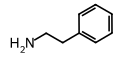
Phenethylamine
Athanor · official
C8H11N · 121.18 g/mol
IUPAC name: 2-phenylethanamine
Also called PEA, 2-phenylethylamine


 DangerToxic if swallowed · Harmful if swallowed · Harmful in contact with skin · Causes severe skin burns and eye damage · Harmful if inhaled
Names and identifiers
- IUPAC name
- 2-phenylethanamine
- Synonyms
- PEA, 2-phenylethylamine, 2-Phenylethanamine
+ 36 more
2-Phenethylamine, beta-Phenethylamine, 1-Amino-2-phenylethane, beta-Aminoethylbenzene, (2-Aminoethyl)benzene, 1-Phenyl-2-aminoethane, 2-Amino-1-phenylethane, Ethanamine, 2-phenyl-, Ethylamine, 2-phenyl-, 1-Phenyl-2-amino-athan, 2-Fenylethylamin, 2-Amino-fenylethan, PHENETHYLAMINE, BETA, beta-Phenylaethylamin, b-phenylethylamine, FEMA No. 3220, omega-Phenylethylamine, NSC 10811, HSDB 3526, EINECS 200-574-4, UNII-327C7L2BXQ, BRN 0507488, 327C7L2BXQ, AI3-03117, NSC-10811, DTXSID5058773, CHEBI:18397, EC 200-574-4, RefChem:6118, 1-Phenyl-2-amino-aethan, DTXCID3044172, 200-574-4, Benzeneethanamine, phenylethylamine, beta-phenylethylamine, 2-Phenylethan-1-Amine
- Molecular formula
- C8H11N
- Empirical formula
- C8H11N
- Molecular weight
- 121.18 g/mol
- Exact mass
- 121.08915
- CAS number
- 64-04-0
- PubChem CID
- 1001
- Canonical SMILES
- C1=CC=C(C=C1)CCN
- Isomeric SMILES
- C1=CC=C(C=C1)CCN
- InChI
- InChI=1S/C8H11N/c9-7-6-8-4-2-1-3-5-8/h1-5H,6-7,9H2
- InChIKey
- BHHGXPLMPWCGHP-UHFFFAOYSA-N
- Molfile
Names, InChI and the identifiers from PubChem, retrieved 2026-10-14.
Physical properties
- Appearance
- Liquid[1]
2 values
From Hazardous Substances Data Bank (HSDB), the most authoritative source here.
Value As written Source – Colorless to slightly yellow liquid [1] Hazardous Substances Data Bank (HSDB)cites Lewis, R.J. Sr. (ed) Sax's Dangerous Properties of Industrial Materials. 12th Edition. Wiley-Interscience, Wiley & Sons, Inc. Hoboken, NJ. 2012., p. V5: 3545 –shown Liquid [1] Hazardous Substances Data Bank (HSDB)cites Larranaga, M.D., Lewis, R.J. Sr., Lewis, R.A.; Hawley's Condensed Chemical Dictionary 16th Edition. John Wiley & Sons, Inc. Hoboken, NJ 2016., p. 1064 - Odor
- Fishy odor[1]
- Boiling point
- 197.5 °C[1]
2 values
Only one source reports it.
Value As written Source 197.5 °Cshown 197.5 °C [1] Hazardous Substances Data Bank (HSDB)cites Lewis, R.J. Sr. (ed) Sax's Dangerous Properties of Industrial Materials. 12th Edition. Wiley-Interscience, Wiley & Sons, Inc. Hoboken, NJ. 2012., p. V5: 3545 197.0 to 198.0 °C BP: 197-198 °C: Specific gravity: 0.96 at 15 °C/15 °C [1] Hazardous Substances Data Bank (HSDB)cites Lewis, R.J. Sr. (ed) Sax's Dangerous Properties of Industrial Materials. 12th Edition. Wiley-Interscience, Wiley & Sons, Inc. Hoboken, NJ. 2012., p. V5: 3545 - Solubility in water
- Soluble in water[1]
2 values
From Hazardous Substances Data Bank (HSDB), the most authoritative source here.
Value As written Source –shown Soluble in water [1] Hazardous Substances Data Bank (HSDB)cites Larranaga, M.D., Lewis, R.J. Sr., Lewis, R.A.; Hawley's Condensed Chemical Dictionary 16th Edition. John Wiley & Sons, Inc. Hoboken, NJ 2016., p. 1064 – Soluble in alcohol, ether [1] Hazardous Substances Data Bank (HSDB)cites Larranaga, M.D., Lewis, R.J. Sr., Lewis, R.A.; Hawley's Condensed Chemical Dictionary 16th Edition. John Wiley & Sons, Inc. Hoboken, NJ 2016., p. 1064 - log P
- log Kow = 1.41[1]
- Vapor pressure
- 31 Pa /0.23 mmHg/ at 20 °C[1]
- Flash point
- 81 °C (178 °F) - closed cup[1]
Each value as its source reports it, with the source's number after it (listed under References). Where several sources report a property, the row shows the value most of them agree on, the rule the app uses; open the values to see every one.
Calculated
- Heavy atoms
- 9
- Rings
- 1
- Aromatic rings
- 1
- Fraction sp³ carbons (Fsp3)
- 0.25
- H-bond donors
- 1
- H-bond acceptors
- 1
- Rotatable bonds
- 2
- TPSA (Ų)
- 26
- Formal charge
- 0
- XLogP3
- 1.4 PubChem
- Complexity
- 65 PubChem
- Stereocenters
- None
- Double-bond geometry
- None specified
- Point group
- Cs of one 3D conformer with its hydrogens, by Athanor’s engine (as in the app)
Elemental analysis
- C79.29%
- H9.15%
- N11.56%
Isotope pattern
Each peak is a nominal mass with its abundance-weighted exact mass, as a percentage of the tallest, from IUPAC natural isotope abundances.
Computed from the structure with RDKit 2026.09 when this page was built, beside PubChem's own computed values from its record; where the two differ, both are shown.
Predicted
- log P
- 1.19 Crippen (Wildman and Crippen 1999)
- log S (water solubility)
- -1.7 ESOL (Delaney 2004), log mol/L
- Synthetic accessibility
- 1.29 SA score, 1 easy to 10 hard (Ertl and Schuffenhauer 2009)
Drug-likeness: Lipinski’s rule of five
- Molecular weight ≤ 500: 121.18
- log P ≤ 5 (Crippen): 1.19
- H-bond donors ≤ 5: 1
- H-bond acceptors ≤ 10: 1
Passes all four rules.
¹³C NMR shifts, predicted
Predictions, not measurements; each names its method. A measured log P, where a source reports one, is under Physical properties.
Safety
Danger
Most widely reported: 1,549 company reports to ECHA. Source [2].
- Corrosive
- Acute toxicity
- Harmful or irritant
- H301Toxic if swallowed (12.8% of reports)
- H302Harmful if swallowed (87.2% of reports)
- H312Harmful in contact with skin (87.1% of reports)
- H314Causes severe skin burns and eye damage (98.4% of reports)
- H332Harmful if inhaled (86.7% of reports)
Precautionary statements: P260, P261, P264, P270, P271, P280, P301+P316, P301+P317, P301+P330+P331, P302+P352, P302+P361+P354, P304+P340, P305+P354+P338, P316, P317, P321, P330, P362+P364, P363, P405, P501
View all classifications (2)
- [2] European Chemicals Agency (ECHA) · 1,549 reports · DangerH301, H302, H312, H314, H332
- [1] Hazardous Substances Data Bank (HSDB) · DangerH227, H290, H301, H314, H318, H402
Storage
- Keep container tightly closed in a dry and well-ventilated place. Containers which are opened must be carefully resealed and kept upright to prevent leakage. Air sensitive. Store under inert gas. Storage class (TRGS 510): 6.1B: Non-combustible, acute toxic Cat. 1 and 2/very toxic hazardous materials[1]
Incompatibilities
- Incompatible materials: Strong oxidizing agents, copper, copper alloys, strong acids, brass.[1]
Safety data sheets on the supplier’s page: Mcule, Selleck Chemicals, Thermo Fisher Scientific.
Always read the supplier’s safety data sheet before working with it.
Spectra
- NMRHazardous Substances Data Bank (HSDB) · NMRShiftDB
- 1H NMRHuman Metabolome Database (HMDB) (JEOL · 90 MHz · CDCl3) · Human Metabolome Database (HMDB) (Bruker · D2O) · SpectraBase (BRUKER AC-300)
- 13C NMRHuman Metabolome Database (HMDB) (Varian · 25.16 MHz · CDCl3) · Human Metabolome Database (HMDB) (Bruker · D2O) · SpectraBase
- GC-MSHuman Metabolome Database (HMDB) (GC-MS) · Human Metabolome Database (HMDB) (GC-MS) · Human Metabolome Database (HMDB) (EI-B · positive) · Human Metabolome Database (HMDB) (EI-B · positive) · Human Metabolome Database (HMDB) (CI-B · positive) · Human Metabolome Database (HMDB) (EI-B · positive)
- MS-MSHuman Metabolome Database (HMDB) (Positive) · Human Metabolome Database (HMDB) (Positive) · Human Metabolome Database (HMDB) (Positive) · Human Metabolome Database (HMDB) (Positive) · Human Metabolome Database (HMDB) (Positive) · Human Metabolome Database (HMDB) (Positive)
- LC-MSMassBank Europe (Bruker maXis Impact · LC-ESI-QTOF · POSITIVE) · MassBank Europe (Bruker maXis Impact · LC-ESI-QTOF · POSITIVE) · MassBank Europe (Bruker maXis Impact · LC-ESI-QTOF · POSITIVE) · MassBank Europe (API3000, Applied Biosystems · LC-ESI-QQ · POSITIVE) · MassBank Europe (API3000, Applied Biosystems · LC-ESI-QQ · POSITIVE) · MassBank Europe (API3000, Applied Biosystems · LC-ESI-QQ · POSITIVE)
- Other MSHazardous Substances Data Bank (HSDB) · MassBank Europe (Unknown · EI-B · POSITIVE) · MassBank Europe (HITACHI RMU-6M · EI-B · POSITIVE) · MassBank Europe (HITACHI M-80 · CI-B · POSITIVE) · MassBank Europe (HITACHI M-60 · EI-B · POSITIVE) · MassBank Europe (HITACHI M-80A · EI-B · POSITIVE)
- UVHazardous Substances Data Bank (HSDB)
- IRHazardous Substances Data Bank (HSDB)
- FTIRSpectraBase (Bio-Rad FTS · Neat (KBr))
- ATR-IRSpectraBase (Bio-Rad FTS · ATR-Neat (DuraSamplIR II))
- Near IRSpectraBase (INSTRUMENT PARAMETERS=INST=BRUKER,RSN=11020,REO=2,CNM=HEI,ZFF=2 · NIR Spectrometer= BRUKER IFS 88)
- Vapor Phase IRSpectraBase (Bruker IFS 85 · Gas-GC)
- RamanSpectraBase (Benchtop RAM II FT-IR Raman module (Bruker Nederland BV., Leiderdorp, The Netherlands) coupled to a FT-IR VERTEX 70 spectrometer)
Experimental spectra held by these sources; each link opens the source's own record.
Literature
Reading PubChem, OpenAlex and GSRS…
Bioactivity
Reading ChEMBL…
References
- [1]Hazardous Substances Data Bank (HSDB) · Public domain (US NLM) · via PubChem · retrieved 2026-10-14
- [2]European Chemicals Agency (ECHA) · ECHA legal notice: reuse with acknowledgement · via PubChem · retrieved 2026-10-14
- [3]NMRShiftDB · Linked only · via PubChem · retrieved 2026-10-14
- [4]Human Metabolome Database (HMDB) · Linked only · via PubChem · retrieved 2026-10-14
- [5]SpectraBase · Linked only · via PubChem · retrieved 2026-10-14
- [6]MassBank of North America (MoNA) · CC BY 4.0 · via PubChem · retrieved 2026-10-14
- [7]NIST Mass Spectrometry Data Center · Linked only · via PubChem · retrieved 2026-10-14
- [8]MassBank Europe · Linked only · via PubChem · retrieved 2026-10-14
- ·Calculated values: computed by Athanor with RDKit 2026.09 from the structure.
- ·Literature on PubChem
Data last updated 2026-10-14.