
Sodium thiosulfate
Athanor · official
Na2O3S2 · 158.11 g/mol
IUPAC name: disodium;dioxido-oxo-sulfanylidene-lambda6-sulfane
Also called hypo, photographic fixer, E539
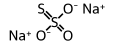
Names and identifiers
- IUPAC name
- disodium;dioxido-oxo-sulfanylidene-lambda6-sulfane
- Synonyms
- hypo, photographic fixer, E539
+ 38 more
Sodium thiosulphate, Disodium thiosulfate, Hypo, Chlorine Control, Chlorine Cure, Sodium thiosulfate, anhydrous, Thiosulfuric acid, disodium salt, Sodium thiosulfate (Na2S2O3), Sodium thiosulphate (Na2S2O3), Sodium oxide sulfide (Na2S2O3), L0IYT1O31N, Thiosulfuric acid (H2S2O3), disodium salt, Ins no.539, Ins-539, Sodium thiosulphate, anhydrous, DTXSID9042417, CHEBI:132112, E-539, sulfothiorine, RefChem:6498, Cyanide Antidote Package, DTXCID7022417, Thiosulfate, Sodium, Pentahydrate, Sodium Nitrite and Sodium Thiosulfate, 231-867-5, Ametox, Db-020, HX1032V43M, Natrii thiosulfas, NSC-45624, NSC45624, PEDMARK, S-Hydril, Sodium hyposulfite, Sodium Thiosulfate Anhydrous, Sodium thiosulphate anhydrous, Sodothiol, Thiosulfuric Acid Disodium Salt
- Molecular formula
- Na2O3S2
- Empirical formula
- Na2O3S2
- Molecular weight
- 158.11 g/mol
- Exact mass
- 157.90842
- CAS number
- 7772-98-7
- PubChem CID
- 24477
- Canonical SMILES
- [O-]S(=O)(=S)[O-].[Na+].[Na+]
- Isomeric SMILES
- [O-]S(=O)(=S)[O-].[Na+].[Na+]
- InChI
- InChI=1S/2Na.H2O3S2/c;;1-5(2,3)4/h;;(H2,1,2,3,4)/q2*+1;/p-2
- InChIKey
- AKHNMLFCWUSKQB-UHFFFAOYSA-L
- Molfile
Names, InChI and the identifiers from PubChem, retrieved 2026-10-14.
Physical properties
- Appearance
- CBI; Large Crystals; Wet Solid; Dry Powder; Liquid; Large Crystals; Liquid[1]
2 values
From EPA Chemical Data Reporting (CDR), the most authoritative source here.
Value As written Source –shown CBI; Large Crystals; Wet Solid; Dry Powder; Liquid; Large Crystals; Liquid [1] EPA Chemical Data Reporting (CDR) – COLOURLESS CRYSTALS. [2] ILO-WHO International Chemical Safety Cards (ICSCs) - Melting point
- 48.5 °C[2]
- Density
- 1.7 g/cm³[2]
- Solubility in water
- Solubility in water, g/100ml at 20 °C: 20.9[2]
- log P
- -4.35 (calculated)[2]
- Vapor pressure
- Reported, but no value passed the checks.
The value and why
- Vapor pressure at 20 °C: negligible (could not be read; source [2])
Each value as its source reports it, with the source's number after it (listed under References). Where several sources report a property, the row shows the value most of them agree on, the rule the app uses; open the values to see every one.
Calculated
- Heavy atoms
- 7
- Rings
- 0
- Aromatic rings
- 0
- Fraction sp³ carbons (Fsp3)
- 0
- H-bond donors
- 0
- H-bond acceptors
- 4
- Rotatable bonds
- 0
- TPSA (Ų)
- 63.2 computed here · PubChem 104
- Formal charge
- 0
- Complexity
- 82 PubChem
- Stereocenters
- None
- Double-bond geometry
- None specified
- Point group
- C3v of one 3D conformer with its hydrogens, by Athanor’s engine (as in the app)
Elemental analysis
- Na29.08%
- O30.36%
- S40.56%
Isotope pattern
Each peak is a nominal mass with its abundance-weighted exact mass, as a percentage of the tallest, from IUPAC natural isotope abundances.
Computed from the structure with RDKit 2026.09 when this page was built, beside PubChem's own computed values from its record; where the two differ, both are shown.
Predicted
- log P
- -7 Crippen (Wildman and Crippen 1999)
- log S (water solubility)
- 3.59 ESOL (Delaney 2004), log mol/L
- Synthetic accessibility
- 5.38 SA score, 1 easy to 10 hard (Ertl and Schuffenhauer 2009)
Drug-likeness: Lipinski’s rule of five
- Molecular weight ≤ 500: 158.11
- log P ≤ 5 (Crippen): -7
- H-bond donors ≤ 5: 0
- H-bond acceptors ≤ 10: 4
Passes all four rules.
Predictions, not measurements; each names its method. A measured log P, where a source reports one, is under Physical properties.
Safety
No GHS hazard classification was found in the sources.
First aid
Storage
- Separated from strong oxidants.[2]
Safety data sheets on the supplier’s page: TargetMol, Sigma-Aldrich, AstaTech, Inc..
Always read the supplier’s safety data sheet before working with it.
Spectra
- FTIRSpectraBase (KBr WAFER)
- ATR-IRSpectraBase
- RamanSpectraBase (Bio-Rad FTS 175C with Raman accessory · FT-Raman)
Experimental spectra held by these sources; each link opens the source's own record.
Literature
Reading PubChem, OpenAlex and GSRS…
Bioactivity
Reading ChEMBL…
References
- [1]EPA Chemical Data Reporting (CDR) · Public domain (US EPA) · via PubChem · retrieved 2026-10-14
- [2]ILO-WHO International Chemical Safety Cards (ICSCs) · CC BY 4.0 · via PubChem · retrieved 2026-10-14
- [3]Hazardous Substances Data Bank (HSDB) · Public domain (US NLM) · via PubChem · retrieved 2026-10-14
- [4]European Chemicals Agency (ECHA) · ECHA legal notice: reuse with acknowledgement · via PubChem · retrieved 2026-10-14
- [5]SpectraBase · Linked only · via PubChem · retrieved 2026-10-14
- ·Calculated values: computed by Athanor with RDKit 2026.09 from the structure.
- ·Literature on PubChem
Data last updated 2026-10-14.