
Sodium sulfate
Athanor · official
Na2O4S · 142.04 g/mol
IUPAC name: disodium;sulfate
Also called Glauber salt, salt cake, E514, disodium sulfate
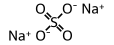
Names and identifiers
- IUPAC name
- disodium;sulfate
- Synonyms
- Glauber salt, salt cake, E514
+ 39 more
disodium sulfate, Disodium sulfate, Sodium sulfate anhydrous, Sodium sulfate, anhydrous, Salt cake, Sodium sulphate, Sulfuric acid disodium salt, Disodium sulphate, Sodium sulphate anhydrous, Sodium sulfate (2:1), Bisodium sulfate, Sodium sulfate, dried, Anhydrous sodium sulfate, Disodium monosulfate, Dibasic sodium sulfate, Sodium sulphate, anhydrous, Sodium sulfate (Na2SO4), Mirabilite, Natriumsulfat, DTXSID1021291, 36KCS0R750, NSC-403914, DTXCID601291, CHEBI:32149, Sulfuric acid disodium salt, anhydrous, natrii sulphas, Glaubers salt, Nat Sulph, Natrum Sulph 3X, Nat Sulph 3X, NATRUM SULPH, Natrum Sulphuricum 6X, RefChem:6690, Natrum sulphuricum 30C, NAT SULPH 6X, TONICPET 11, Natrum Sulphuricum 8011, BQCELL REVIRGIN GUNG, NATRIUM SULFURICUM 6X
- Molecular formula
- Na2O4S
- Empirical formula
- Na2O4S
- Molecular weight
- 142.04 g/mol
- Exact mass
- 141.93127
- CAS number
- 7757-82-6
- PubChem CID
- 24436
- Canonical SMILES
- [O-]S(=O)(=O)[O-].[Na+].[Na+]
- Isomeric SMILES
- [O-]S(=O)(=O)[O-].[Na+].[Na+]
- InChI
- InChI=1S/2Na.H2O4S/c;;1-5(2,3)4/h;;(H2,1,2,3,4)/q2*+1;/p-2
- InChIKey
- PMZURENOXWZQFD-UHFFFAOYSA-L
- Molfile
Names, InChI and the identifiers from PubChem, retrieved 2026-10-14.
Physical properties
- Appearance
- Large Crystals; CBI; Dry Powder; Wet Solid; Dry Powder; Gas Vapor; Wet Solid; Other Solid; Dry Powder; Large Crystals; Liquid; Liquid; Dry Powder; Liquid; Liquid; Other Solid; Dry Powder; Large Crystals[1]
2 values
From EPA Chemical Data Reporting (CDR), the most authoritative source here.
Value As written Source –shown Large Crystals; CBI; Dry Powder; Wet Solid; Dry Powder; Gas Vapor; Wet Solid; Other Solid; Dry Powder; Large Crystals; Liquid; Liquid; Dry Powder; Liquid; Liquid; Other Solid; Dry Powder; Large Crystals [1] EPA Chemical Data Reporting (CDR) – WHITE HYGROSCOPIC SOLID IN VARIOUS FORMS. [2] ILO-WHO International Chemical Safety Cards (ICSCs) - Odor
- Odorless[3]
- Melting point
- 884 °C[2]
2 values
Sources disagree; from ILO-WHO International Chemical Safety Cards (ICSCs), the most authoritative.
Value As written Source 884 °Cshown 884 °C [2] ILO-WHO International Chemical Safety Cards (ICSCs) 888 °C 888 °C [4] PAC Chemical Database, U.S. Department of Energy 1 more value was reported but failed the checks (unreadable or out of range), so it is not shown.
- Density
- 2.671[3]
3 values
3 of 3 sources agree on it (most common value).
Value As written Source –shown 2.671 [3] Hazardous Substances Data Bank (HSDB)cites Larranaga, M.D., Lewis, R.J. Sr., Lewis, R.A.; Hawley's Condensed Chemical Dictionary 16th Edition. John Wiley & Sons, Inc. Hoboken, NJ 2016., p. 1254 – Relative density (water = 1): 2.7 [2] ILO-WHO International Chemical Safety Cards (ICSCs) – 2.671 @25 °C [4] PAC Chemical Database, U.S. Department of Energy - Solubility in water
- Solubility in water: very good[2]
2 values
From ILO-WHO International Chemical Safety Cards (ICSCs), the most authoritative source here.
Value As written Source – In water, 445.47 g/L at 20 °C and pH 5.23 (shake flask method) [3] Hazardous Substances Data Bank (HSDB)cites ECHA; Search for Chemicals. Sodium Sulphate (7757-82-6) Registered Substances Dossier. European Chemical Agency. Available from, as of June 15, 2017: https://echa.europa.eu/ –shown Solubility in water: very good [2] ILO-WHO International Chemical Safety Cards (ICSCs) - pKa
- Reported, but no value passed the checks.
The value and why
- Sodium sulphate dissociates into Na+ and SO4- ions in water. (could not be read; source [3])
- Viscosity
- Reported, but no value passed the checks.
The value and why
- 2.48 (22% solution at 20 °C) (could not be read; source [3])
- Refractive index
- Index of refraction: 1.464[3]
Each value as its source reports it, with the source's number after it (listed under References). Where several sources report a property, the row shows the value most of them agree on, the rule the app uses; open the values to see every one.
Calculated
- Heavy atoms
- 7
- Rings
- 0
- Aromatic rings
- 0
- Fraction sp³ carbons (Fsp3)
- 0
- H-bond donors
- 0
- H-bond acceptors
- 4
- Rotatable bonds
- 0
- TPSA (Ų)
- 80.3 computed here · PubChem 88.6
- Formal charge
- 0
- Complexity
- 62 PubChem
- Stereocenters
- None
- Double-bond geometry
- None specified
- Point group
- Td of one 3D conformer with its hydrogens, by Athanor’s engine (as in the app)
Elemental analysis
- Na32.37%
- O45.05%
- S22.58%
Isotope pattern
Each peak is a nominal mass with its abundance-weighted exact mass, as a percentage of the tallest, from IUPAC natural isotope abundances.
Computed from the structure with RDKit 2026.09 when this page was built, beside PubChem's own computed values from its record; where the two differ, both are shown.
Predicted
- log P
- -7.33 Crippen (Wildman and Crippen 1999)
- log S (water solubility)
- 3.9 ESOL (Delaney 2004), log mol/L
- Synthetic accessibility
- 4.82 SA score, 1 easy to 10 hard (Ertl and Schuffenhauer 2009)
Drug-likeness: Lipinski’s rule of five
- Molecular weight ≤ 500: 142.04
- log P ≤ 5 (Crippen): -7.33
- H-bond donors ≤ 5: 0
- H-bond acceptors ≤ 10: 4
Passes all four rules.
Predictions, not measurements; each names its method. A measured log P, where a source reports one, is under Physical properties.
Safety
This chemical does not meet GHS hazard criteria for 96.5% (4127 of 4277) of all reports.[5]
First aid
Storage
- Keep container tightly closed in a dry and well-ventilated place. Hygroscopic. Storage class (TRGS 510): Non Combustible Solids.[3]
Incompatibilities
Safety data sheets on the supplier’s page: Thermo Fisher Scientific, Protheragen, Clearsynth.
Always read the supplier’s safety data sheet before working with it.
Spectra
- FTIRSpectraBase (KBr pellet)
- RamanRRUFF Project · RRUFF Project · RRUFF Project · RRUFF Project · RRUFF Project · RRUFF Project
Experimental spectra held by these sources; each link opens the source's own record.
Literature
Reading PubChem, OpenAlex and GSRS…
Bioactivity
Reading ChEMBL…
References
- [1]EPA Chemical Data Reporting (CDR) · Public domain (US EPA) · via PubChem · retrieved 2026-10-14
- [2]ILO-WHO International Chemical Safety Cards (ICSCs) · CC BY 4.0 · via PubChem · retrieved 2026-10-14
- [3]Hazardous Substances Data Bank (HSDB) · Public domain (US NLM) · via PubChem · retrieved 2026-10-14
- [4]PAC Chemical Database, U.S. Department of Energy · Public domain (US DOE) · via PubChem · retrieved 2026-10-14
- [5]European Chemicals Agency (ECHA) · ECHA legal notice: reuse with acknowledgement · via PubChem · retrieved 2026-10-14
- [6]SpectraBase · Linked only · via PubChem · retrieved 2026-10-14
- [7]RRUFF Project · Linked only · via PubChem · retrieved 2026-10-14
- ·Calculated values: computed by Athanor with RDKit 2026.09 from the structure.
- ·Literature on PubChem
Data last updated 2026-10-14.