
Malonic acid
Athanor · official
C3H4O4 · 104.06 g/mol
IUPAC name: propanedioic acid
Also called propanedioic acid

 DangerHarmful if swallowed · Causes skin irritation · Causes serious eye damage · Causes serious eye irritation · May cause respiratory irritation
Names and identifiers
- IUPAC name
- propanedioic acid
- Synonyms
- propanedioic acid, Dicarboxymethane, Carboxyacetic acid
+ 35 more
Methanedicarboxylic acid, malonate, Kyselina malonova, USAF EK-695, 1,3-Propanedioic acid, DTXSID7021659, 9KX7ZMG0MK, NSC-8124, DTXCID401659, CHEBI:30794, malonyl, disodium;malonate, RefChem:5980, 205-503-0, hydron;propanedioate, Dicarboxylic acid, Kyselina malonova [Czech], MFCD00002707, Propane-1,3-dioic acid, NSC 8124, Methanedicarbonic acid, AI3-15375, Malonicacid, alpha,omega-Dicarboxylic acid, NSC8124, 1,3-Propanoic acid, Thallium malonate, PROPANEDIOLIC ACID, METAHNEDICARBOXYLIC ACID, EINECS 205-503-0, UNII-9KX7ZMG0MK, BRN 1751370, H2malo, 2fah, Malonic acid-13C3
- Molecular formula
- C3H4O4
- Empirical formula
- C3H4O4
- Molecular weight
- 104.06 g/mol
- Exact mass
- 104.01096
- CAS number
- 141-82-2
- PubChem CID
- 867
- Canonical SMILES
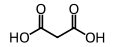
- C(C(=O)O)C(=O)O
- Isomeric SMILES
- C(C(=O)O)C(=O)O
- InChI
- InChI=1S/C3H4O4/c4-2(5)1-3(6)7/h1H2,(H,4,5)(H,6,7)
- InChIKey
- OFOBLEOULBTSOW-UHFFFAOYSA-N
- Molfile
Names, InChI and the identifiers from PubChem, retrieved 2026-10-14.
Physical properties
- Appearance
- White crystals[4]
6 values
From Hazardous Substances Data Bank (HSDB), the most authoritative source here.
Value As written Source – Malonic acid appears as white crystals or crystalline powder. Sublimes in vacuum. (NTP, 1992) [1] CAMEO Chemicalscites National Toxicology Program, Institute of Environmental Health Sciences, National Institutes of Health (NTP). 1992. National Toxicology Program Chemical Repository Database. Research Triangle Park, North Carolina. – Large Crystals; Liquid; Other Solid [2] EPA Chemical Data Reporting (CDR) – WHITE CRYSTALS. [3] ILO-WHO International Chemical Safety Cards (ICSCs) –shown White crystals [4] Hazardous Substances Data Bank (HSDB)cites Larranaga, M.D., Lewis, R.J. Sr., Lewis, R.A.; Hawley's Condensed Chemical Dictionary 16th Edition. John Wiley & Sons, Inc. Hoboken, NJ 2016., p. 859 – Crystalline powder [4] Hazardous Substances Data Bank (HSDB)cites NOAA; CAMEO Chemicals. Database of Hazardous Materials. Malonic Acid (141-82-2). Natl Ocean Atmos Admin, Off Resp Rest; NOAA Ocean Serv. Available from, as of July 16, 2018: https://cameochemicals.noaa.gov/ – Colorless hygroscopic solid which sublimes in vacuum [4] Hazardous Substances Data Bank (HSDB)cites Strittmatter H et al; Malonic Acid and Derivatives. Ullmann's Encyclopedia of Industrial Chemistry. 7th ed. (1999-2018). New York, NY: John Wiley & Sons. Online Posting Date: 15 April 2007 - Melting point
- 135.6 °C (276.1 °F, NTP 1992)[1]
2 values
2 of 2 sources agree on it (most common value).
Value As written Source 135.6 °Cshown 276.1 °F (NTP, 1992) [1] CAMEO Chemicalscites National Toxicology Program, Institute of Environmental Health Sciences, National Institutes of Health (NTP). 1992. National Toxicology Program Chemical Repository Database. Research Triangle Park, North Carolina. 135 to 137 °C 135-137 °C [4] Hazardous Substances Data Bank (HSDB)cites Sigma-Aldrich; Product Search Malonic acid (141-82-2). Available from, as of Oct 11, 2018: https://www.sigmaaldrich.com/united-states.html - Boiling point
- 140 °C (284 °F) at 760 mmHg (decomposes) (NTP, 1992)[1]
- Density
- 1.63 @ 10°C[5]
3 values
3 of 3 sources agree on it (most common value).
Value As written Source – 1.63 (NTP, 1992) - Denser than water [1] CAMEO Chemicalscites National Toxicology Program, Institute of Environmental Health Sciences, National Institutes of Health (NTP). 1992. National Toxicology Program Chemical Repository Database. Research Triangle Park, North Carolina. – 1.6 g/cm³ [3] ILO-WHO International Chemical Safety Cards (ICSCs) –shown 1.63 @ 10°C [5] PAC Chemical Database, U.S. Department of Energy - Solubility in water
- Solubility in water, g/100ml at 20 °C: 7.3[3]
4 values
From ILO-WHO International Chemical Safety Cards (ICSCs), the most authoritative source here.
Value As written Source – greater than or equal to 100 mg/mL at 72 °F (NTP, 1992) [1] CAMEO Chemicalscites National Toxicology Program, Institute of Environmental Health Sciences, National Institutes of Health (NTP). 1992. National Toxicology Program Chemical Repository Database. Research Triangle Park, North Carolina. – In water, 6.23X10+5 mg/L at 25 °C [4] Hazardous Substances Data Bank (HSDB)cites Yalkowsky, S.H., He, Yan, Jain, P. Handbook of Aqueous Solubility Data Second Edition. CRC Press, Boca Raton, FL 2010, p. 51 – In water, 7.66X10+5 mg/L at 20 °C (pH 1-10), EU Guideline Method A.6 (flask method) [4] Hazardous Substances Data Bank (HSDB)cites ECHA; Search for Chemicals. Malonic Acid (141-82-2) Registered Substances Dossier. European Chemical Agency. Available from, as of July 16, 2018: https://echa.europa.eu/ –shown Solubility in water, g/100ml at 20 °C: 7.3 [3] ILO-WHO International Chemical Safety Cards (ICSCs) - log P
- -0.91/-0.18 (calculated)[3]
2 values
Sources disagree; from ILO-WHO International Chemical Safety Cards (ICSCs), the most authoritative.
Value As written Source – log Kow = -0.81 [4] Hazardous Substances Data Bank (HSDB)cites Hansch, C., Leo, A., D. Hoekman. Exploring QSAR - Hydrophobic, Electronic, and Steric Constants. Washington, DC: American Chemical Society., 1995., p. 5 –shown -0.91/-0.18 (calculated) [3] ILO-WHO International Chemical Safety Cards (ICSCs) - pKa
- pKa1 = 2.8, pKa2 = 5.7 at 25 °C[4]
- Vapor pressure
- 2.7 × 10⁻⁶ mmHg at 23 °C[4]
Each value as its source reports it, with the source's number after it (listed under References). Where several sources report a property, the row shows the value most of them agree on, the rule the app uses; open the values to see every one.
Calculated
- Heavy atoms
- 7
- Rings
- 0
- Aromatic rings
- 0
- Fraction sp³ carbons (Fsp3)
- 0.33
- H-bond donors
- 2
- H-bond acceptors
- 2 computed here · PubChem 4
- Rotatable bonds
- 2
- TPSA (Ų)
- 74.6
- Formal charge
- 0
- XLogP3
- -0.8 PubChem
- Complexity
- 83 PubChem
- Stereocenters
- None
- Double-bond geometry
- None specified
- Point group
- C2 of one 3D conformer with its hydrogens, by Athanor’s engine (as in the app)
Elemental analysis
- C34.63%
- H3.87%
- O61.50%
Isotope pattern
Each peak is a nominal mass with its abundance-weighted exact mass, as a percentage of the tallest, from IUPAC natural isotope abundances.
Computed from the structure with RDKit 2026.09 when this page was built, beside PubChem's own computed values from its record; where the two differ, both are shown.
Predicted
- log P
- -0.45 Crippen (Wildman and Crippen 1999)
- log S (water solubility)
- -0.07 ESOL (Delaney 2004), log mol/L
- Synthetic accessibility
- 2.05 SA score, 1 easy to 10 hard (Ertl and Schuffenhauer 2009)
Drug-likeness: Lipinski’s rule of five
- Molecular weight ≤ 500: 104.06
- log P ≤ 5 (Crippen): -0.45
- H-bond donors ≤ 5: 2
- H-bond acceptors ≤ 10: 2
Passes all four rules.
¹³C NMR shifts, predicted
Predictions, not measurements; each names its method. A measured log P, where a source reports one, is under Physical properties.
Safety
Danger
Most widely reported: 443 company reports to ECHA. Source [6].
- Corrosive
- Harmful or irritant
- H302Harmful if swallowed (47.2% of reports)
- H315Causes skin irritation (28.2% of reports)
- H318Causes serious eye damage (49.7% of reports)
- H319Causes serious eye irritation (49% of reports)
- H335May cause respiratory irritation (11.5% of reports)
Precautionary statements: P261, P264, P264+P265, P270, P271, P280, P301+P317, P302+P352, P304+P340, P305+P351+P338, P305+P354+P338, P317, P319, P321, P330, P332+P317, P337+P317, P362+P364, P403+P233, P405, P501
View all classifications (3)
- [6] European Chemicals Agency (ECHA)This chemical does not meet GHS hazard criteria for 1.4% (6 of 443) of reports.
- [6] European Chemicals Agency (ECHA) · 443 reports · DangerH302, H315, H318, H319, H335
- [4] Hazardous Substances Data Bank (HSDB) · DangerH302, H318
First aid
- Eyes: First check the victim for contact lenses and remove if present. Flush victim's eyes with water or normal saline solution for 20 to 30 minutes while simultaneously calling a hospital or poison control center. Do not put any ointments, oils, or medication in the victim's eyes without specific instructions from a physician. Immediately transport the victim after flushing eyes to a hospital even if no symptoms (such as redness or irritation) develop. Skin: Immediately flood affected skin with water while removing and isolating all contaminated clothing.[1]
- Fresh air, rest. Refer for medical attention.[3]
- Remove contaminated clothes. Rinse skin with plenty of water or shower.[3]
- First rinse with plenty of water for several minutes (remove contact lenses if easily possible), then refer for medical attention.[3]
Storage
Incompatibilities
- Incompatible materials: Bases, Oxidizing agents, Reducing agents[4]
Safety data sheets on the supplier’s page: Cooke Chemical Co., Ltd, Sigma-Aldrich, BenchChem.
Always read the supplier’s safety data sheet before working with it.
Spectra
- NMRHazardous Substances Data Bank (HSDB) · NMRShiftDB
- 1H NMRHuman Metabolome Database (HMDB) (Varian · 500 MHz · Water) · Human Metabolome Database (HMDB) (500 MHz · H2O) · Human Metabolome Database (HMDB) (JEOL · 90 MHz · DMSO-d6) · SpectraBase
- 13C NMRHuman Metabolome Database (HMDB) (Bruker · 125 MHz · Water) · Human Metabolome Database (HMDB) (400 MHz · H2O) · SpectraBase
- 1H-13C NMRHuman Metabolome Database (HMDB) (Bruker · 600 MHz · Water)
- GC-MSHuman Metabolome Database (HMDB) (GC-MS) · Human Metabolome Database (HMDB) (EI-B · positive) · Human Metabolome Database (HMDB) (EI-B · positive) · Human Metabolome Database (HMDB) (EI-B · positive) · Human Metabolome Database (HMDB) (EI-B · positive) · Human Metabolome Database (HMDB) (GC-EI-TOF · positive)
- MS-MSHuman Metabolome Database (HMDB) (LC-ESI-QQ · negative) · Human Metabolome Database (HMDB) (Negative) · Human Metabolome Database (HMDB) (Negative) · Human Metabolome Database (HMDB) (Negative) · Human Metabolome Database (HMDB) (Negative) · Human Metabolome Database (HMDB) (Negative)
- LC-MSMassBank Europe (API3000, Applied Biosystems · LC-ESI-QQ · NEGATIVE) · MassBank Europe (API3000, Applied Biosystems · LC-ESI-QQ · NEGATIVE) · MassBank Europe (API3000, Applied Biosystems · LC-ESI-QQ · NEGATIVE) · MassBank Europe (API3000, Applied Biosystems · LC-ESI-QQ · NEGATIVE) · MassBank Europe (API3000, Applied Biosystems · LC-ESI-QQ · NEGATIVE) · MassBank Europe (impact II · LC-ESI-QTOF · NEGATIVE)
- Other MSHazardous Substances Data Bank (HSDB) · MassBank Europe (Unknown · EI-B · POSITIVE) · MassBank Europe (HITACHI RMU-7M · EI-B · POSITIVE) · MassBank Europe (SHIMADZU QP-1000EX · EI-B · POSITIVE) · MassBank Europe (GCMS-2010 Plus, Shimadzu · EI-B · POSITIVE) · MassBank of North America (MoNA) (TQD, Waters · Flow-injection QqQ/MS · ESI)
- UVHazardous Substances Data Bank (HSDB)
- IRHazardous Substances Data Bank (HSDB)
- FTIRSpectraBase (Bruker IFS 85 · KBr-Pellet)
- ATR-IRSpectraBase
- Vapor Phase IRSpectraBase (Bruker IFS 85 · Gas-GC)
- RamanSpectraBase
Experimental spectra held by these sources; each link opens the source's own record.
Literature
Reading PubChem, OpenAlex and GSRS…
Bioactivity
Reading ChEMBL…
References
- [1]CAMEO Chemicals · Public domain (NOAA) · via PubChem · retrieved 2026-10-14
- [2]EPA Chemical Data Reporting (CDR) · Public domain (US EPA) · via PubChem · retrieved 2026-10-14
- [3]ILO-WHO International Chemical Safety Cards (ICSCs) · CC BY 4.0 · via PubChem · retrieved 2026-10-14
- [4]Hazardous Substances Data Bank (HSDB) · Public domain (US NLM) · via PubChem · retrieved 2026-10-14
- [5]PAC Chemical Database, U.S. Department of Energy · Public domain (US DOE) · via PubChem · retrieved 2026-10-14
- [6]European Chemicals Agency (ECHA) · ECHA legal notice: reuse with acknowledgement · via PubChem · retrieved 2026-10-14
- [7]NMRShiftDB · Linked only · via PubChem · retrieved 2026-10-14
- [8]Human Metabolome Database (HMDB) · Linked only · via PubChem · retrieved 2026-10-14
- [9]SpectraBase · Linked only · via PubChem · retrieved 2026-10-14
- [10]MassBank Europe · Linked only · via PubChem · retrieved 2026-10-14
- [11]MassBank of North America (MoNA) · CC BY 4.0 · via PubChem · retrieved 2026-10-14
- [12]NIST Mass Spectrometry Data Center · Linked only · via PubChem · retrieved 2026-10-14
- ·Calculated values: computed by Athanor with RDKit 2026.09 from the structure.
- ·Literature on PubChem
Data last updated 2026-10-14.