
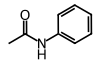
Acetanilide
Athanor · official
C8H9NO · 135.16 g/mol
IUPAC name: N-phenylacetamide
Also called antifebrin, N-phenylacetamide
 WarningHarmful if swallowed
Names and identifiers
- IUPAC name
- N-phenylacetamide
- Synonyms
- antifebrin, N-phenylacetamide, N-Phenylacetamide
+ 37 more
Antifebrin, N-Acetylaniline, Acetanilid, Acetamidobenzene, Acetanil, Acetylaniline, Phenalgene, Acetamide, N-phenyl-, Acetylaminobenzene, Acetic acid anilide, Acetoanilide, Phenalgin, Aniline, N-acetyl-, USAF EK-3, Benzenamine, N-acetyl-, Acetanilidum, Antifebrinum, NSC-7636, SP86R356CC, NSC-203231, CHEBI:28884, RefChem:6369, 203-150-7, 695-031-5, N-acetylarylamine, N-Acetylaminobenzene, AN [Analgesic], NSC 7636, MFCD00008674, Ethananilide, N-Phenyl-acetamide, DTXSID2022543, Acetanilide (Antifebrin), Acetanilide (Acetylaniline), NSC7636, N-Phenylacetamide;N-Phenylacetamide, NCGC00091326-01
- Molecular formula
- C8H9NO
- Empirical formula
- C8H9NO
- Molecular weight
- 135.16 g/mol
- Exact mass
- 135.06841
- CAS number
- 103-84-4
- PubChem CID
- 904
- Canonical SMILES
- CC(=O)NC1=CC=CC=C1
- Isomeric SMILES
- CC(=O)NC1=CC=CC=C1
- InChI
- InChI=1S/C8H9NO/c1-7(10)9-8-5-3-2-4-6-8/h2-6H,1H3,(H,9,10)
- InChIKey
- FZERHIULMFGESH-UHFFFAOYSA-N
- Molfile
Names, InChI and the identifiers from PubChem, retrieved 2026-10-14.
Physical properties
- Appearance
- Colorless, glossy, crystalline material.[2]
4 values
From Hazardous Substances Data Bank (HSDB), the most authoritative source here.
Value As written Source – Acetanilide is a white to gray solid. (NTP, 1992) [1] CAMEO Chemicalscites National Toxicology Program, Institute of Environmental Health Sciences, National Institutes of Health (NTP). 1992. National Toxicology Program Chemical Repository Database. Research Triangle Park, North Carolina. – WHITE SHINING CRYSTALLINE SCALES [2] Hazardous Substances Data Bank (HSDB)cites Sax, N.I. Dangerous Properties of Industrial Materials. 5th ed. New York: Van Nostrand Rheinhold, 1979., p. 332 – White, shining crystalline leaflets or white crystalline powder. [2] Hazardous Substances Data Bank (HSDB)cites Lewis, R.J., Sr (Ed.). Hawley's Condensed Chemical Dictionary. 12th ed. New York, NY: Van Nostrand Rheinhold Co., 1993, p. 6 –shown Colorless, glossy, crystalline material. [2] Hazardous Substances Data Bank (HSDB)cites Gerhartz, W. (exec ed.). Ullmann's Encyclopedia of Industrial Chemistry. 5th ed.Vol A1: Deerfield Beach, FL: VCH Publishers, 1985 to Present., p. VA2 310 - Odor
- ODORLESS[2]
- Melting point
- 114.3 °C[3]
2 values
2 of 2 sources agree on it (most common value).
Value As written Source 114.3 °C 237.7 °F (NTP, 1992) [1] CAMEO Chemicalscites National Toxicology Program, Institute of Environmental Health Sciences, National Institutes of Health (NTP). 1992. National Toxicology Program Chemical Repository Database. Research Triangle Park, North Carolina. 114.3 °Cshown 114.3 °C [3] PAC Chemical Database, U.S. Department of Energy - Boiling point
- 304 °C @760 [mmHg][3]
2 values
2 of 2 sources agree on it (most common value).
Value As written Source 304 °C 579 °F at 760 mmHg (NTP, 1992) [1] CAMEO Chemicalscites National Toxicology Program, Institute of Environmental Health Sciences, National Institutes of Health (NTP). 1992. National Toxicology Program Chemical Repository Database. Research Triangle Park, North Carolina. 304 °Cshown 304 °C @760 [mm Hg] [3] PAC Chemical Database, U.S. Department of Energy - Density
- 1.219 at 15 °C (59 °F) (NTP, 1992) - Denser than water[1]
2 values
2 of 2 sources agree on it (most common value).
Value As written Source –shown 1.219 at 59 °F (NTP, 1992) - Denser than water [1] CAMEO Chemicalscites National Toxicology Program, Institute of Environmental Health Sciences, National Institutes of Health (NTP). 1992. National Toxicology Program Chemical Repository Database. Research Triangle Park, North Carolina. – 1.21 @ 20°C [3] PAC Chemical Database, U.S. Department of Energy - Solubility in water
- Water solubility= 6.93 × 10³ mg/l at 25 °C[2]
2 values
From Hazardous Substances Data Bank (HSDB), the most authoritative source here.
Value As written Source – less than 1 mg/mL at 72 °F (NTP, 1992) [1] CAMEO Chemicalscites National Toxicology Program, Institute of Environmental Health Sciences, National Institutes of Health (NTP). 1992. National Toxicology Program Chemical Repository Database. Research Triangle Park, North Carolina. –shown Water solubility= 6.93X10+3 mg/l at 25 °C [2] Hazardous Substances Data Bank (HSDB)cites Yalkowsky SH, Dannenfelser RM; The Aquasol Database of Aqueous Solubility. Fifth ed, Tucson, AZ: Univ AZ, College of Pharmacy, PC Ver. (1992) - log P
- Log Kow= 1.16[2]
- pKa
- pKa = 0.50 at 25 °C (conjugate acid)[2]
- Vapor pressure
- 1.22 × 10⁻³ mmHg at 25 °C[2]
3 values
Sources disagree; from Hazardous Substances Data Bank (HSDB), the most authoritative.
Value As written Source 1 mmHg 1 mmHg at 237 °F (NTP, 1992) [1] CAMEO Chemicalscites National Toxicology Program, Institute of Environmental Health Sciences, National Institutes of Health (NTP). 1992. National Toxicology Program Chemical Repository Database. Research Triangle Park, North Carolina. 0.00122 mmHgshown 1.22X10⁻³ mm Hg at 25 °C [2] Hazardous Substances Data Bank (HSDB)cites Perry RH, Green D; Perry's Chemical Handbook, 6th ed. NY, NY: McGraw Hill p 3-50 (1984) 0.000003 mmHg 0.000003 [mm Hg] @20 °C [3] PAC Chemical Database, U.S. Department of Energy - Flash point
- 169 °C (337 °F)[2]
3 values
Sources disagree; from Hazardous Substances Data Bank (HSDB), the most authoritative.
Value As written Source 174 °C 345 °F (NTP, 1992) [1] CAMEO Chemicalscites National Toxicology Program, Institute of Environmental Health Sciences, National Institutes of Health (NTP). 1992. National Toxicology Program Chemical Repository Database. Research Triangle Park, North Carolina. 169 °Cshown 337 °F [2] Hazardous Substances Data Bank (HSDB)cites Fire Protection Guide to Hazardous Materials. 12 ed. Quincy, MA: National Fire Protection Association, 1997., p. 325-10 169 °C 169 °C (OPEN CUP) [2] Hazardous Substances Data Bank (HSDB)cites Fire Protection Guide to Hazardous Materials. 12 ed. Quincy, MA: National Fire Protection Association, 1997., p. 325-10 - Autoignition temperature
- 540 °C (1004 °F, NTP 1992)[1]
Each value as its source reports it, with the source's number after it (listed under References). Where several sources report a property, the row shows the value most of them agree on, the rule the app uses; open the values to see every one.
Calculated
- Heavy atoms
- 10
- Rings
- 1
- Aromatic rings
- 1
- Fraction sp³ carbons (Fsp3)
- 0.12
- H-bond donors
- 1
- H-bond acceptors
- 1
- Rotatable bonds
- 1
- TPSA (Ų)
- 29.1
- Formal charge
- 0
- XLogP3
- 1.2 PubChem
- Complexity
- 116 PubChem
- Stereocenters
- None
- Double-bond geometry
- None specified
- Point group
- C1 of one 3D conformer with its hydrogens, by Athanor’s engine (as in the app)
Elemental analysis
- C71.09%
- H6.71%
- N10.36%
- O11.84%
Isotope pattern
Each peak is a nominal mass with its abundance-weighted exact mass, as a percentage of the tallest, from IUPAC natural isotope abundances.
Computed from the structure with RDKit 2026.09 when this page was built, beside PubChem's own computed values from its record; where the two differ, both are shown.
Predicted
- log P
- 1.64 Crippen (Wildman and Crippen 1999)
- log S (water solubility)
- -2.09 ESOL (Delaney 2004), log mol/L
- Synthetic accessibility
- 1.11 SA score, 1 easy to 10 hard (Ertl and Schuffenhauer 2009)
Drug-likeness: Lipinski’s rule of five
- Molecular weight ≤ 500: 135.17
- log P ≤ 5 (Crippen): 1.64
- H-bond donors ≤ 5: 1
- H-bond acceptors ≤ 10: 1
Passes all four rules.
¹³C NMR shifts, predicted
Predictions, not measurements; each names its method. A measured log P, where a source reports one, is under Physical properties.
Safety
Warning
Most widely reported: 1,686 company reports to ECHA. Source [4].
- Harmful or irritant
- H302Harmful if swallowed (99.9% of reports)
Precautionary statements: P264, P270, P301+P317, P330, P501
View all classifications (3)
- [4] European Chemicals Agency (ECHA)This chemical does not meet GHS hazard criteria for 0.1% (2 of 1686) of reports.
- [4] European Chemicals Agency (ECHA) · 1,686 reports · WarningH302
- [4] European Chemicals Agency (ECHA) · WarningH302, H315, H319, H335
First aid
- Eyes: First check the victim for contact lenses and remove if present. Flush victim's eyes with water or normal saline solution for 20 to 30 minutes while simultaneously calling a hospital or poison control center. Do not put any ointments, oils, or medication in the victim's eyes without specific instructions from a physician. Immediately transport the victim after flushing eyes to a hospital even if no symptoms (such as redness or irritation) develop. Skin: Immediately flood affected skin with water while removing and isolating all contaminated clothing.[1]
Incompatibilities
- SEE aniline...CAN react vigorously WITH oxidizing materials.[2]
Safety data sheets on the supplier’s page: Biorbyt, Synthonix, Inc., Sigma-Aldrich.
Always read the supplier’s safety data sheet before working with it.
Spectra
- NMRHazardous Substances Data Bank (HSDB) · NMRShiftDB
- 1H NMRSpectraBase (BRUKER AC-300)
- 13C NMRSpectraBase
- 15N NMRSpectraBase
- 17O NMRSpectraBase
- GC-MSHuman Metabolome Database (HMDB) (EI-B · positive) · Human Metabolome Database (HMDB) (GC-EI-TOF · positive) · Human Metabolome Database (HMDB) (GC-EI-TOF · positive) · Human Metabolome Database (HMDB) (GC-EI-TOF · positive) · Human Metabolome Database (HMDB) (GC-EI-TOF · positive) · Human Metabolome Database (HMDB) (EI-B · positive)
- MS-MSHuman Metabolome Database (HMDB) (LC-ESI-QQ · negative) · Human Metabolome Database (HMDB) (LC-ESI-QQ · negative) · Human Metabolome Database (HMDB) (LC-ESI-QQ · negative) · Human Metabolome Database (HMDB) (LC-ESI-QQ · negative) · Human Metabolome Database (HMDB) (LC-ESI-QQ · negative) · Human Metabolome Database (HMDB) (Positive)
- LC-MSMassBank Europe (TripleTOF 5600 SCIEX · LC-ESI-QTOF · POSITIVE) · MassBank Europe (TripleTOF 5600 SCIEX · LC-ESI-QTOF · POSITIVE) · MassBank Europe (TripleTOF 5600 SCIEX · LC-ESI-QTOF · POSITIVE) · MassBank Europe (TripleTOF 5600 SCIEX · LC-ESI-QTOF · POSITIVE) · MassBank Europe (TripleTOF 5600 SCIEX · LC-ESI-QTOF · POSITIVE) · MassBank Europe (TripleTOF 5600 SCIEX · LC-ESI-QTOF · POSITIVE)
- Other MSHazardous Substances Data Bank (HSDB) · MassBank Europe (HITACHI M-80 · EI-B · POSITIVE)
- UVHazardous Substances Data Bank (HSDB)
- IRHazardous Substances Data Bank (HSDB)
- FTIRSpectraBase (Bruker IFS 85 · KBr-Pellet)
- ATR-IRSpectraBase
- Vapor Phase IRSpectraBase (Bruker IFS 85 · Gas-GC)
Experimental spectra held by these sources; each link opens the source's own record.
Literature
Reading PubChem, OpenAlex and GSRS…
Bioactivity
Reading ChEMBL…
References
- [1]CAMEO Chemicals · Public domain (NOAA) · via PubChem · retrieved 2026-10-14
- [2]Hazardous Substances Data Bank (HSDB) · Public domain (US NLM) · via PubChem · retrieved 2026-10-14
- [3]PAC Chemical Database, U.S. Department of Energy · Public domain (US DOE) · via PubChem · retrieved 2026-10-14
- [4]European Chemicals Agency (ECHA) · ECHA legal notice: reuse with acknowledgement · via PubChem · retrieved 2026-10-14
- [5]NMRShiftDB · Linked only · via PubChem · retrieved 2026-10-14
- [6]SpectraBase · Linked only · via PubChem · retrieved 2026-10-14
- [7]Human Metabolome Database (HMDB) · Linked only · via PubChem · retrieved 2026-10-14
- [8]MassBank of North America (MoNA) · CC BY 4.0 · via PubChem · retrieved 2026-10-14
- [9]NIST Mass Spectrometry Data Center · Linked only · via PubChem · retrieved 2026-10-14
- [10]MassBank Europe · Linked only · via PubChem · retrieved 2026-10-14
- ·Calculated values: computed by Athanor with RDKit 2026.09 from the structure.
- ·Literature on PubChem
Data last updated 2026-10-14.