
Ammonium persulfate
Athanor · official
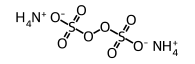
H8N2O8S2 · 228.21 g/mol
IUPAC name: diazanium;sulfonatooxy sulfate
Also called APS, persulfate, radical initiator, gel polymerisation


 DangerMay intensify fire; oxidizer · Harmful if swallowed · Causes skin irritation · May cause an allergic skin reaction · Causes serious eye irritation · May cause allergy or asthma symptoms or breathing difficulties if inhaled · May cause respiratory irritation
Names and identifiers
- IUPAC name
- diazanium;sulfonatooxy sulfate
- Synonyms
- APS, persulfate, radical initiator
+ 39 more
gel polymerisation, Ammonium peroxydisulfate, Diammonium peroxydisulfate, Diammonium peroxydisulphate, Ammonium persulphate, DTXSID9029691, 22QF6L357F, DTXCID209691, CHEBI:156543, Peroxydisulfuric acid (((HO)S(O)2)2O2), ammonium salt (1:2), RefChem:5551, Bis(Ammonium) Peroxodisulfate, 231-786-5, Ammonium Peroxysulfate, Diammonium Persulfate, Peroxydisulfuric Acid, Diammonium Salt, Persulfate d'ammonium, Ammonium peroxodisulfate, Ammonium peroxydisulphate, APS Solution, ammonium persuiphate, ammonium per sulphate, ammonium peroxidisulfate, ammonium persulphate-d8, Epitope ID:1309331, diazanium;sulfonatooxy sulfate, orb2941050, AMMONIUM PERSULFATE, ACS, AMMONIUM PERSULFATE [VANDF], AMMONIUM PERSULFATE [MART.], Tox21_201161, AMMONIUM PEROXYDISULFATE [MI], TXB-00065, AKOS025243328, Ammonium persulfate pound APS pound(c), FA40911, NCGC00258713-01, CAS-7727-54-0, DB-056201
- Molecular formula
- H8N2O8S2
- Empirical formula
- H4NO4S
- Molecular weight
- 228.21 g/mol
- Exact mass
- 227.97221
- CAS number
- 7727-54-0
- PubChem CID
- 62648
- Canonical SMILES
- [NH4+].[NH4+].[O-]S(=O)(=O)OOS(=O)(=O)[O-]
- Isomeric SMILES
- [NH4+].[NH4+].[O-]S(=O)(=O)OOS(=O)(=O)[O-]
- InChI
- InChI=1S/2H3N.H2O8S2/c;;1-9(2,3)7-8-10(4,5)6/h2*1H3;(H,1,2,3)(H,4,5,6)
- InChIKey
- ROOXNKNUYICQNP-UHFFFAOYSA-N
- Molfile
Names, InChI and the identifiers from PubChem, retrieved 2026-10-14.
Physical properties
- Appearance
- Colorless, white monoclinic crystals[4]
4 values
From Hazardous Substances Data Bank (HSDB), the most authoritative source here.
Value As written Source – Ammonium persulfate appears as a white crystalline solid. A strong oxidizing agent. Does not burn readily, but may cause spontaneous ignition of organic materials. Used as a bleaching agent and as a food preservative. [1] CAMEO Chemicals – Liquid; Large Crystals; Dry Powder [2] EPA Chemical Data Reporting (CDR) – COLOURLESS CRYSTALS OR WHITE POWDER. [3] ILO-WHO International Chemical Safety Cards (ICSCs) –shown Colorless, white monoclinic crystals [4] Hazardous Substances Data Bank (HSDB)cites Lewis, R.J. Sr. (ed) Sax's Dangerous Properties of Industrial Materials. 11th Edition. Wiley-Interscience, Wiley & Sons, Inc. Hoboken, NJ. 2004., p. V2: 240 - Melting point
- Reported, but no value passed the checks.
The value and why
- Decomposes at 120 °C (could not be read; source [4])
- Density
- 1.982 @25 °C[5]
3 values
2 of 3 sources agree on it (most common value).
Value As written Source – 1.98 at 68 °F (USCG, 1999) - Denser than water [1] CAMEO Chemicalscites U.S. Coast Guard. 1999. Chemical Hazard Response Information System (CHRIS) - Hazardous Chemical Data. Commandant Instruction 16465.12C. Washington, D.C.: U.S. Government Printing Office. – 1.9 g/cm³ [3] ILO-WHO International Chemical Safety Cards (ICSCs) –shown 1.982 @25 °C [5] PAC Chemical Database, U.S. Department of Energy - Solubility in water
- Solubility in water, g/100ml at 20 °C: 58.2[3]
Each value as its source reports it, with the source's number after it (listed under References). Where several sources report a property, the row shows the value most of them agree on, the rule the app uses; open the values to see every one.
Calculated
- Heavy atoms
- 12
- Rings
- 0
- Aromatic rings
- 0
- Fraction sp³ carbons (Fsp3)
- 0
- H-bond donors
- 2
- H-bond acceptors
- 8
- Rotatable bonds
- 3 computed here · PubChem 1
- TPSA (Ų)
- 205.9 computed here · PubChem 152
- Formal charge
- 0
- Complexity
- 206 PubChem
- Stereocenters
- None
- Double-bond geometry
- None specified
- Point group
- C1 of one 3D conformer with its hydrogens, by Athanor’s engine (as in the app)
Elemental analysis
- H3.53%
- N12.28%
- O56.09%
- S28.10%
Isotope pattern
Each peak is a nominal mass with its abundance-weighted exact mass, as a percentage of the tallest, from IUPAC natural isotope abundances.
Computed from the structure with RDKit 2026.09 when this page was built, beside PubChem's own computed values from its record; where the two differ, both are shown.
Predicted
- log P
- -1.39 Crippen (Wildman and Crippen 1999)
- log S (water solubility)
- -0.18 ESOL (Delaney 2004), log mol/L
- Synthetic accessibility
- 4.94 SA score, 1 easy to 10 hard (Ertl and Schuffenhauer 2009)
Drug-likeness: Lipinski’s rule of five
- Molecular weight ≤ 500: 228.2
- log P ≤ 5 (Crippen): -1.39
- H-bond donors ≤ 5: 2
- H-bond acceptors ≤ 10: 8
Passes all four rules.
Predictions, not measurements; each names its method. A measured log P, where a source reports one, is under Physical properties.
Safety
Danger
Harmonized EU classification (CLP Annex VI). Source [6].
- Oxidizer
- Harmful or irritant
- Health hazard
- H272May intensify fire; oxidizer
- H302Harmful if swallowed
- H315Causes skin irritation
- H317May cause an allergic skin reaction
- H319Causes serious eye irritation
- H334May cause allergy or asthma symptoms or breathing difficulties if inhaled
- H335May cause respiratory irritation
Precautionary statements: P210, P220, P233, P260, P261, P264, P264+P265, P270, P271, P272, P280, P284, P301+P317, P302+P352, P304+P340, P305+P351+P338, P319, P321, P330, P332+P317, P333+P317, P337+P317, P342+P316, P362+P364, P370+P378, P403, P403+P233, P405, P501
Exposure limits
First aid
- Inhalation: Remove to fresh air. Eyes: Wash with water for 20 min.; call a physician. Skin: Wash with water. (USCG, 1999)[1]
- General First Aid: · Call 911 or emergency medical service. · Ensure that medical personnel are aware of the material(s) involved, take precautions to protect themselves and avoid contamination. · Move victim to fresh air if it can be done safely. · Administer oxygen if breathing is difficult. · If victim is not breathing: -- DO NOT perform mouth-to-mouth resuscitation; the victim may have ingested or inhaled the substance. -- If equipped and pulse detected, wash face and mouth, then give artificial respiration using a proper respiratory medical device (bag-valve mask, pocket mask equipped…[7]
- Fresh air, rest. Artificial respiration may be needed. Refer for medical attention.[3]
- First rinse with plenty of water for at least 15 minutes, then remove contaminated clothes and rinse again.[3]
Storage
- Dry. Well closed. Separated from combustible substances, reducing agents, powdered metals and strong bases.[3]
Incompatibilities
Safety data sheets on the supplier’s page: CymitQuimica, Thermo Fisher Scientific, LGC Standards.
Always read the supplier’s safety data sheet before working with it.
Spectra
- FTIRSpectraBase (Bio-Rad FTS · KBr0)
- ATR-IRSpectraBase (PerkinElmer SpectrumTwo · ATR-IR)
- RamanSpectraBase (FT-Raman)
Experimental spectra held by these sources; each link opens the source's own record.
Literature
Reading PubChem, OpenAlex and GSRS…
Bioactivity
Reading ChEMBL…
References
- [1]CAMEO Chemicals · Public domain (NOAA) · via PubChem · retrieved 2026-10-14
- [2]EPA Chemical Data Reporting (CDR) · Public domain (US EPA) · via PubChem · retrieved 2026-10-14
- [3]ILO-WHO International Chemical Safety Cards (ICSCs) · CC BY 4.0 · via PubChem · retrieved 2026-10-14
- [4]Hazardous Substances Data Bank (HSDB) · Public domain (US NLM) · via PubChem · retrieved 2026-10-14
- [5]PAC Chemical Database, U.S. Department of Energy · Public domain (US DOE) · via PubChem · retrieved 2026-10-14
- [6]Regulation (EC) No 1272/2008 of the European Parliament and of the Council · EU reuse policy, CC BY 4.0 · via PubChem · retrieved 2026-10-14
- [7]Emergency Response Guidebook (ERG) · Public domain (US DOT) · via PubChem · retrieved 2026-10-14
- [8]SpectraBase · Linked only · via PubChem · retrieved 2026-10-14
- ·Calculated values: computed by Athanor with RDKit 2026.09 from the structure.
- ·Literature on PubChem
Data last updated 2026-10-14.