
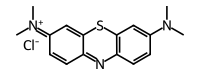
Methylene blue
Athanor · official
C16H18ClN3S · 319.9 g/mol
IUPAC name: [7-(dimethylamino)phenothiazin-3-ylidene]-dimethylazanium chloride
Also called methylthioninium chloride, basic blue 9, Swiss blue, ProvayBlue

 DangerHarmful if swallowed · Causes serious eye damage · Harmful to aquatic life with long lasting effects
Names and identifiers
- IUPAC name
- [7-(dimethylamino)phenothiazin-3-ylidene]-dimethylazanium chloride
- Synonyms
- methylthioninium chloride, basic blue 9, Swiss blue
+ 39 more
ProvayBlue, Basic blue 9, Methylthioninium chloride, Solvent blue 8, Swiss Blue, C.I. Basic Blue 9, Chromosmon, Methylene Blue anhydrous, Methylene Blue N, Methylene Blue BB, Urolene blue, Methylenium ceruleum, Methylene Blue chloride, Bleu de methylene, Methylene Blue A, Methylene Blue B, Methylene Blue D, Methylene Blue G, External Blue 1, Tetramethylene Blue, Calcozine Blue ZF, Methylene Blue BD, Methylene Blue BP, Methylene Blue BX, Methylene Blue BZ, Methylene Blue FZ, Methylene Blue GZ, Methylene Blue NZ, Methylene Blue SG, Methylene Blue SP, Methylene Blue ZF, Methylene Blue ZX, Methylthionine chloride, Methylenblau, Methylene Blue 2B, Methylene Blue BBA, Methylene Blue BPC, Methylene Blue HGG, Methylene Blue IAD
- Molecular formula
- C16H18ClN3S
- Empirical formula
- C16H18ClN3S
- Molecular weight
- 319.9 g/mol
- Exact mass
- 319.09100
- CAS number
- 61-73-4
- PubChem CID
- 6099
- Canonical SMILES
- CN(C)C1=CC2=C(C=C1)N=C3C=CC(=[N+](C)C)C=C3S2.[Cl-]
- Isomeric SMILES
- CN(C)C1=CC2=C(C=C1)N=C3C=CC(=[N+](C)C)C=C3S2.[Cl-]
- InChI
- InChI=1S/C16H18N3S.ClH/c1-18(2)11-5-7-13-15(9-11)20-16-10-12(19(3)4)6-8-14(16)17-13;/h5-10H,1-4H3;1H/q+1;/p-1
- InChIKey
- CXKWCBBOMKCUKX-UHFFFAOYSA-M
- Molfile
Names, InChI and the identifiers from PubChem, retrieved 2026-10-14.
Physical properties
- Appearance
- Solutions have a deep blue color (methylene blue zinc-free dye)[1]
- Odor
- Slight odor[1]
- Melting point
- 100-110 °C (decomposes)[1]
- Solubility in water
- In water, 43,600 mg/L at 25 °C.[1]
2 values
From Hazardous Substances Data Bank (HSDB), the most authoritative source here.
Value As written Source –shown In water, 43,600 mg/L at 25 °C. [1] Hazardous Substances Data Bank (HSDB)cites Baughman GL et al; Dye Solubilities. In: Advances in Color Chemistry. Freeman M, Peters MT, eds., Elsevier (1993) – Soluble in glacial acetic acid and glycerol; insoluble in xylene and oleic acid, in ethanol 2%, and in acetone 0.5%. [1] Hazardous Substances Data Bank (HSDB)cites Kirk-Othmer Encyclopedia of Chemical Technology. 3rd ed., Volumes 1-26. New York, NY: John Wiley and Sons, 1978-1984., p. V3: 379 (1978)
Each value as its source reports it, with the source's number after it (listed under References). Where several sources report a property, the row shows the value most of them agree on, the rule the app uses; open the values to see every one.
Calculated
- Heavy atoms
- 21
- Rings
- 3
- Aromatic rings
- 1
- Fraction sp³ carbons (Fsp3)
- 0.25
- H-bond donors
- 0
- H-bond acceptors
- 3 computed here · PubChem 4
- Rotatable bonds
- 1
- TPSA (Ų)
- 19.1 computed here · PubChem 43.9
- Formal charge
- 0
- Complexity
- 483 PubChem
- Stereocenters
- None
- Double-bond geometry
- None specified
- Point group
- C1 of one 3D conformer with its hydrogens, by Athanor’s engine (as in the app)
Elemental analysis
- C60.08%
- H5.67%
- Cl11.08%
- N13.14%
- S10.03%
Isotope pattern
Each peak is a nominal mass with its abundance-weighted exact mass, as a percentage of the tallest, from IUPAC natural isotope abundances.
Computed from the structure with RDKit 2026.09 when this page was built, beside PubChem's own computed values from its record; where the two differ, both are shown.
Predicted
- log P
- -0.5 Crippen (Wildman and Crippen 1999)
- log S (water solubility)
- -1.94 ESOL (Delaney 2004), log mol/L
- Synthetic accessibility
- 2.89 SA score, 1 easy to 10 hard (Ertl and Schuffenhauer 2009)
Drug-likeness: Lipinski’s rule of five
- Molecular weight ≤ 500: 319.86
- log P ≤ 5 (Crippen): -0.5
- H-bond donors ≤ 5: 0
- H-bond acceptors ≤ 10: 3
Passes all four rules.
¹³C NMR shifts, predicted
Predictions, not measurements; each names its method. A measured log P, where a source reports one, is under Physical properties.
Safety
Danger
Most widely reported: 273 company reports to ECHA. Source [2].
- Corrosive
- Harmful or irritant
- H302Harmful if swallowed (91.6% of reports)
- H318Causes serious eye damage (25.6% of reports)
- H412Harmful to aquatic life with long lasting effects (10.3% of reports)
Precautionary statements: P264, P264+P265, P270, P273, P280, P301+P317, P305+P354+P338, P317, P330, P501
View all classifications (3)
- [2] European Chemicals Agency (ECHA)This chemical does not meet GHS hazard criteria for 8.1% (22 of 273) of reports.
- [2] European Chemicals Agency (ECHA) · 273 reports · DangerH302, H318, H412
- [2] European Chemicals Agency (ECHA) · 2 reports · DangerH302, H318
Storage
Safety data sheets on the supplier’s page: TCI (Tokyo Chemical Industry), A2B Chem, LGC Standards.
Always read the supplier’s safety data sheet before working with it.
Spectra
- GC-MSSpectraBase
- UVHazardous Substances Data Bank (HSDB)
- UV-VISSpectraBase
- IRHazardous Substances Data Bank (HSDB)
- FTIRSpectraBase (Bruker IFS 85 · KBr-Pellet)
- ATR-IRSpectraBase (Bio-Rad FTS · ATR-Film (CHCl3) (DuraSamplIR II))
Experimental spectra held by these sources; each link opens the source's own record.
Literature
Reading PubChem, OpenAlex and GSRS…
Bioactivity
Reading ChEMBL…
References
- [1]Hazardous Substances Data Bank (HSDB) · Public domain (US NLM) · via PubChem · retrieved 2026-10-14
- [2]European Chemicals Agency (ECHA) · ECHA legal notice: reuse with acknowledgement · via PubChem · retrieved 2026-10-14
- [3]SpectraBase · Linked only · via PubChem · retrieved 2026-10-14
- ·Calculated values: computed by Athanor with RDKit 2026.09 from the structure.
- ·Literature on PubChem
Data last updated 2026-10-14.