
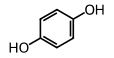
Hydroquinone
Athanor · official
C6H6O2 · 110.11 g/mol
IUPAC name: benzene-1,4-diol
Also called benzene-1,4-diol, quinol


 DangerHarmful if swallowed · May cause an allergic skin reaction · Causes serious eye damage · Suspected of causing genetic defects · Suspected of causing cancer · Very toxic to aquatic life
Names and identifiers
- IUPAC name
- benzene-1,4-diol
- Synonyms
- benzene-1,4-diol, quinol, Benzene-1,4-diol
+ 37 more
1,4-benzenediol, 1,4-Dihydroxybenzene, Quinol, p-Hydroquinone, p-Hydroxyphenol, p-Benzenediol, p-Dihydroxybenzene, 4-Hydroxyphenol, hydroquinol, Benzoquinol, Eldopaque, Eldoquin, Hydroquinole, Phiaquin, Tecquinol, p-Dioxybenzene, Solaquin forte, Idrochinone, Benzohydroquinone, Hidroquinone, Arctuvin, Tequinol, Dihydroxybenzene, Tenox HQ, Eldopaque Forte, Eldoquin Forte, Hydrochinon, Usaf ek-356, Diak 5, Benzene, p-dihydroxy-, 1,4-Dihydroxy-benzol, 1,4-Diidrobenzene, p-Dioxobenzene, 1,4-Dihydroxybenzen, para-Dioxybenzene, para-Hydroquinone, NCI-C55834
- Molecular formula
- C6H6O2
- Empirical formula
- C3H3O
- Molecular weight
- 110.11 g/mol
- Exact mass
- 110.03678
- CAS number
- 123-31-9
- PubChem CID
- 785
- Canonical SMILES
- C1=CC(=CC=C1O)O
- Isomeric SMILES
- C1=CC(=CC=C1O)O
- InChI
- InChI=1S/C6H6O2/c7-5-1-2-6(8)4-3-5/h1-4,7-8H
- InChIKey
- QIGBRXMKCJKVMJ-UHFFFAOYSA-N
- Molfile
Names, InChI and the identifiers from PubChem, retrieved 2026-10-14.
Physical properties
- Appearance
- White crystals[6]
7 values
From Hazardous Substances Data Bank (HSDB), the most authoritative source here.
Value As written Source – Hydroquinone appears as light colored crystals or solutions. May irritate the skin, eyes and mucous membranes. Mildly toxic by ingestion or skin absorption. [1] CAMEO Chemicals – Large Crystals; Other Solid; Dry Powder; Liquid [2] EPA Chemical Data Reporting (CDR) – COLOURLESS CRYSTALS. [3] ILO-WHO International Chemical Safety Cards (ICSCs) – Light-tan, light-gray, or colorless crystals. [4] Occupational Safety and Health Administration (OSHA) – Light-tan, light-gray, or colorless crystals. [5] The National Institute for Occupational Safety and Health (NIOSH) –shown White crystals [6] Hazardous Substances Data Bank (HSDB)cites Lewis, R.J. Sr.; Hawley's Condensed Chemical Dictionary 15th Edition. John Wiley & Sons, Inc. New York, NY 2007., p. 669 – Light-tan, light-gray, or colorless crystals [6] Hazardous Substances Data Bank (HSDB)cites NIOSH. NIOSH Pocket Guide to Chemical Hazards. Department of Health & Human Services, Centers for Disease Control & Prevention. National Institute for Occupational Safety & Health. DHHS (NIOSH) Publication No. 2010-168 (2010). Available from: https://www.cdc.gov/niosh/npg - Odor
- Odorless[6]
- Melting point
- 170 to 171 °C (338 to 340 °F, EPA 1998)[1]
5 values
3 of 5 sources agree on it (most common value).
Value As written Source 170 to 171 °Cshown 338 to 340 °F (EPA, 1998) [1] CAMEO Chemicalscites U.S. Environmental Protection Agency. 1998. Extremely Hazardous Substances (EHS) Chemical Profiles and Emergency First Aid Guides. Washington, D.C.: U.S. Government Printing Office. 172 °C 172 °C [3] ILO-WHO International Chemical Safety Cards (ICSCs) 170 °C 338 °F [4] Occupational Safety and Health Administration (OSHA) 172 °C 172 °C [7] PAC Chemical Database, U.S. Department of Energy 170 °C 338 °F [5] The National Institute for Occupational Safety and Health (NIOSH) 1 more value was reported but failed the checks (unreadable or out of range), so it is not shown.
- Boiling point
- 285 °C @760 [mmHg][7]
5 values
4 of 5 sources agree on it (most common value).
Value As written Source 285 to 287 °C 545 to 549 °F at 760 mmHg (EPA, 1998) [1] CAMEO Chemicalscites U.S. Environmental Protection Agency. 1998. Extremely Hazardous Substances (EHS) Chemical Profiles and Emergency First Aid Guides. Washington, D.C.: U.S. Government Printing Office. 287 °C 287 °C [3] ILO-WHO International Chemical Safety Cards (ICSCs) 285 °C 545 °F [4] Occupational Safety and Health Administration (OSHA) 285 °Cshown 285 °C @760 [mm Hg] [7] PAC Chemical Database, U.S. Department of Energy 285 °C 545 °F [5] The National Institute for Occupational Safety and Health (NIOSH) - Density
- 1.332 at 15 °C (59 °F) (EPA, 1998) - Denser than water[1]
5 values
5 of 5 sources agree on it (most common value).
Value As written Source –shown 1.332 at 59 °F (EPA, 1998) - Denser than water [1] CAMEO Chemicalscites U.S. Environmental Protection Agency. 1998. Extremely Hazardous Substances (EHS) Chemical Profiles and Emergency First Aid Guides. Washington, D.C.: U.S. Government Printing Office. – Relative density (water = 1): 1.3 [3] ILO-WHO International Chemical Safety Cards (ICSCs) – 1.332 at 59 °F [4] Occupational Safety and Health Administration (OSHA) – 1.358 @ 20°C [7] PAC Chemical Database, U.S. Department of Energy – 1.33 [5] The National Institute for Occupational Safety and Health (NIOSH) 1 more value was reported but failed the checks (unreadable or out of range), so it is not shown.
- Solubility in water
- Solubility in water, g/100ml at 15 °C: 5.9[3]
8 values
From ILO-WHO International Chemical Safety Cards (ICSCs), the most authoritative source here.
Value As written Source – 10 to 50 mg/mL at 68 °F (NTP, 1992) [1] CAMEO Chemicalscites National Toxicology Program, Institute of Environmental Health Sciences, National Institutes of Health (NTP). 1992. National Toxicology Program Chemical Repository Database. Research Triangle Park, North Carolina. – In water, 72,000 mg/L at 25 °C [6] Hazardous Substances Data Bank (HSDB)cites Granger FS, Nelson JM; J Am Chem Soc 43: 1403-7 (1921) – In water, 6.72 g/L at 20 °C. Also water solubility = 3.85 g/L at 0 °C; 5.12 g/L at 10 °C; 5.40 g/L at 15 °C; 8.76 g/L at 30 °C; 11.5 g/L at 40 °C; 25/9 g/L at 60 °C; 46.8 g/L at 80 °C; 66.4 g/L at 100 °C [6] Hazardous Substances Data Bank (HSDB)cites Yalkowsky, S.H., He, Yan, Jain, P. Handbook of Aqueous Solubility Data Second Edition. CRC Press, Boca Raton, FL 2010, p. 254 – 7% soluble in water at 25 °C [6] Hazardous Substances Data Bank (HSDB)cites Cavender FL, O'Donohue J; Phenol and Phenolics. Patty's Toxicology. 6th ed. (1999-2014). New York, NY: John Wiley & Sons, Inc. On-line posting date: 17 Aug 2012 – Grams of hydroquinone per 100 g solvent (30 °C); ethanol 46.4; acetone 28.4; water 8.3; benzene 0.06; tetrachloromethane 0.01 [6] Hazardous Substances Data Bank (HSDB)cites Hudnall PM; Hydroquinone. Ullmann's Encyclopedia of Industrial Chemistry. 7th ed. (1999-2014). New York, NY: John Wiley & Sons. Online Posting Date: 15 Jun 2000 – For more Solubility (Complete) data for HYDROQUINONE (6 total), please visit the HSDB record page. [6] Hazardous Substances Data Bank (HSDB) –shown Solubility in water, g/100ml at 15 °C: 5.9 [3] ILO-WHO International Chemical Safety Cards (ICSCs) – 7% [5] The National Institute for Occupational Safety and Health (NIOSH) - log P
- 0.59[3]
2 values
2 of 2 sources agree on it (most common value).
Value As written Source – log Kow = 0.59 [6] Hazardous Substances Data Bank (HSDB)cites Hansch, C., Leo, A., D. Hoekman. Exploring QSAR - Hydrophobic, Electronic, and Steric Constants. Washington, DC: American Chemical Society., 1995., p. 20 –shown 0.59 [3] ILO-WHO International Chemical Safety Cards (ICSCs) - pKa
- pKa = 10.85 at 25 °C[6]
2 values
Only one source reports it.
Value As written Source –shown pKa = 10.85 at 25 °C [6] Hazardous Substances Data Bank (HSDB)cites Pearce PJ, Simkins RJJ; Can J Chem 46: 241-8 (1968) – pKa = 9.96 [6] Hazardous Substances Data Bank (HSDB)cites McEvoy, G.K. (ed.). AHFS Drug Information 90. Bethesda, MD: American Society of Hospital Pharmacists, Inc., 1990 (Plus Supplements 1990)., p. 2081 - Vapor pressure
- 4 mmHg at 150 °C (302 °F, EPA 1998)[1]
4 values
2 of 4 sources agree on it (most common value).
Value As written Source 4 mmHgshown 4 mmHg at 302 °F (EPA, 1998) [1] CAMEO Chemicalscites U.S. Environmental Protection Agency. 1998. Extremely Hazardous Substances (EHS) Chemical Profiles and Emergency First Aid Guides. Washington, D.C.: U.S. Government Printing Office. 0.000019 mmHg 1.9X10⁻⁵ mm Hg at 25 °C [6] Hazardous Substances Data Bank (HSDB)cites Jones AH; J Chem Eng Data 5: 196-200 (1960) 0.0009 mmHg Vapor pressure, Pa at 20 °C: 0.12 [3] ILO-WHO International Chemical Safety Cards (ICSCs) 4 mmHg 4 mmHg at 302 °F [4] Occupational Safety and Health Administration (OSHA) 1 more value was reported but failed the checks (unreadable or out of range), so it is not shown.
- Flash point
- 165 °C[3]
7 values
5 of 5 sources agree on it (most common value).
Value As written Source 165 °C 329 °F (EPA, 1998) [1] CAMEO Chemicalscites U.S. Environmental Protection Agency. 1998. Extremely Hazardous Substances (EHS) Chemical Profiles and Emergency First Aid Guides. Washington, D.C.: U.S. Government Printing Office. 165 °C 329 °F (CLOSED CUP) [6] Hazardous Substances Data Bank (HSDB)cites Lewis, R.J. Sr. (ed) Sax's Dangerous Properties of Industrial Materials. 11th Edition. Wiley-Interscience, Wiley & Sons, Inc. Hoboken, NJ. 2004., p. 1992 165 °C 165 °C (329 °F) (Closed cup) [6] Hazardous Substances Data Bank (HSDB)cites Sigma-Aldrich; Material Safety Data Sheet for Hydroquinone. Product Number: H17902, Version 4.7 (Revision Date 06/13/2014). Available from, as of October 8, 2014: https://www.sigmaaldrich.com/safety-center.html 165 °C 329 °F (165 °C) (Closed cup) [6] Hazardous Substances Data Bank (HSDB)cites National Fire Protection Association; Fire Protection Guide to Hazardous Materials. 14TH Edition, Quincy, MA 2010, p. 325-72 165 °Cshown 165 °C [3] ILO-WHO International Chemical Safety Cards (ICSCs) 165 °C 329 °F [4] Occupational Safety and Health Administration (OSHA) 165 °C 329 °F (Molten) [5] The National Institute for Occupational Safety and Health (NIOSH) - Autoignition temperature
- 515 °C[3]
3 values
3 of 3 sources agree on it (most common value).
Value As written Source 516 °C 960 °F (USCG, 1999) [1] CAMEO Chemicalscites U.S. Coast Guard. 1999. Chemical Hazard Response Information System (CHRIS) - Hazardous Chemical Data. Commandant Instruction 16465.12C. Washington, D.C.: U.S. Government Printing Office. 516 °C 960 °F (516 °C) [6] Hazardous Substances Data Bank (HSDB)cites National Fire Protection Association; Fire Protection Guide to Hazardous Materials. 14TH Edition, Quincy, MA 2010, p. 325-72 515 °Cshown 515 °C [3] ILO-WHO International Chemical Safety Cards (ICSCs)
Each value as its source reports it, with the source's number after it (listed under References). Where several sources report a property, the row shows the value most of them agree on, the rule the app uses; open the values to see every one.
Calculated
- Heavy atoms
- 8
- Rings
- 1
- Aromatic rings
- 1
- Fraction sp³ carbons (Fsp3)
- 0
- H-bond donors
- 2
- H-bond acceptors
- 2
- Rotatable bonds
- 0
- TPSA (Ų)
- 40.5
- Formal charge
- 0
- XLogP3
- 0.6 PubChem
- Complexity
- 54 PubChem
- Stereocenters
- None
- Double-bond geometry
- None specified
- Point group
- C2v of one 3D conformer with its hydrogens, by Athanor’s engine (as in the app)
Elemental analysis
- C65.45%
- H5.49%
- O29.06%
Isotope pattern
Each peak is a nominal mass with its abundance-weighted exact mass, as a percentage of the tallest, from IUPAC natural isotope abundances.
Computed from the structure with RDKit 2026.09 when this page was built, beside PubChem's own computed values from its record; where the two differ, both are shown.
Predicted
- log P
- 1.1 Crippen (Wildman and Crippen 1999)
- log S (water solubility)
- -1.77 ESOL (Delaney 2004), log mol/L
- Synthetic accessibility
- 1.53 SA score, 1 easy to 10 hard (Ertl and Schuffenhauer 2009)
Drug-likeness: Lipinski’s rule of five
- Molecular weight ≤ 500: 110.11
- log P ≤ 5 (Crippen): 1.1
- H-bond donors ≤ 5: 2
- H-bond acceptors ≤ 10: 2
Passes all four rules.
¹³C NMR shifts, predicted
Predictions, not measurements; each names its method. A measured log P, where a source reports one, is under Physical properties.
Safety
Danger
Harmonized EU classification (CLP Annex VI). Source [8].
- Corrosive
- Harmful or irritant
- Health hazard
- Environmental hazard
- H302Harmful if swallowed
- H317May cause an allergic skin reaction
- H318Causes serious eye damage
- H341Suspected of causing genetic defects
- H351Suspected of causing cancer
- H400Very toxic to aquatic life
Precautionary statements: P203, P261, P264, P264+P265, P270, P272, P273, P280, P301+P317, P302+P352, P305+P354+P338, P317, P318, P321, P330, P333+P317, P362+P364, P391, P405, P501
View all classifications (4)
- [8] Regulation (EC) No 1272/2008 of the European Parliament and of the Council · DangerH302, H317, H318, H341, H351, H400
- [9] European Chemicals Agency (ECHA)This chemical does not meet GHS hazard criteria for < 0.1% (1 of 2485) of reports.
- [9] European Chemicals Agency (ECHA) · 2,485 reports · DangerH302+H312, H302, H312, H318, H341, H410
- [6] Hazardous Substances Data Bank (HSDB) · DangerH302, H317, H318, H341, H351, H400, H410
Exposure limits
First aid
- Signs and Symptoms of Acute Hydroquinone Exposure: Signs and symptoms of acute exposure to hydroquinone may be severe and include dyspnea (shortness of breath), a sense of suffocation, increased respiratory rate, and respiratory failure. Pallor (paleness of the skin), cyanosis (blue tint to skin and mucous membranes), and cardiovascular collapse may occur. Neurologic effects include headache, tinnitus (ringing in the ears), dizziness, delirium, muscle twitching, tremor, and convulsions. Nausea, vomiting, and the production of green to brown-green urine may also occur.[1]
- (General first aid procedures) Eye: Irrigate immediately - If this chemical contacts the eyes, immediately wash (irrigate) the eyes with large amounts of water, occasionally lifting the lower and upper lids. Get medical attention immediately. Skin: Water flush - If this chemical contacts the skin, flush the contaminated skin with water. Where there is evidence of skin irritation, get medical attention. Breathing: Respiratory support Swallow: Medical attention immediately - If this chemical has been swallowed, get medical attention immediately.[5]
- Fresh air, rest. Artificial respiration may be needed. Refer for medical attention.[3]
- Remove contaminated clothes. Rinse and then wash skin with water and soap.[3]
Storage
Incompatibilities
Safety data sheets on the supplier’s page: Debye Scientific Co., Ltd, Sigma-Aldrich, Achemtek.
Always read the supplier’s safety data sheet before working with it.
Spectra
- NMRHazardous Substances Data Bank (HSDB) · NMRShiftDB
- 1H NMRHuman Metabolome Database (HMDB) (Bruker · 600 MHz · Water) · Human Metabolome Database (HMDB) (JEOL · 300 MHz · DMSO-d6) · SpectraBase (BRUKER AC-300)
- 13C NMRHuman Metabolome Database (HMDB) (NEVA · 15.08 MHz · DMSO-d6) · SpectraBase
- 1H-13C NMRHuman Metabolome Database (HMDB) (Bruker · 600 MHz · Water)
- GC-MSHuman Metabolome Database (HMDB) (EI-B · positive) · Human Metabolome Database (HMDB) (EI-B · positive) · Human Metabolome Database (HMDB) (GC-MS) · Human Metabolome Database (HMDB) (GC-EI-TOF · positive) · MassBank of North America (MoNA) (Unknown · EI-B · positive) · MassBank of North America (MoNA) (HITACHI M-80A · EI-B · positive)
- MS-MSHuman Metabolome Database (HMDB) (Negative) · Human Metabolome Database (HMDB) (Positive) · Human Metabolome Database (HMDB) (Negative) · Human Metabolome Database (HMDB) (Quattro_QQQ · Positive) · Human Metabolome Database (HMDB) (Quattro_QQQ · Positive) · Human Metabolome Database (HMDB) (Quattro_QQQ · Positive)
- LC-MSMassBank Europe (TripleTOF 5600 SCIEX · LC-ESI-QTOF · POSITIVE) · MassBank Europe (TripleTOF 5600 SCIEX · LC-ESI-QTOF · POSITIVE) · MassBank Europe (TripleTOF 5600 SCIEX · LC-ESI-QTOF · POSITIVE) · MassBank Europe (TripleTOF 5600 SCIEX · LC-ESI-QTOF · POSITIVE) · MassBank Europe (TripleTOF 5600 SCIEX · LC-ESI-QTOF · POSITIVE) · MassBank of North America (MoNA) (Thermo Q Exactive HF · ESI-QFT · positive)
- Other MSHazardous Substances Data Bank (HSDB) · MassBank Europe (Unknown · EI-B · POSITIVE) · MassBank Europe (HITACHI M-80A · EI-B · POSITIVE)
- UVHazardous Substances Data Bank (HSDB)
- UV-VISSpectraBase
- IRHazardous Substances Data Bank (HSDB)
- FTIRSpectraBase (KBr WAFER)
- ATR-IRSpectraBase
- Vapor Phase IRSpectraBase (DIGILAB FTS-14 · Vapor Phase)
- RamanSpectraBase (Bio-Rad FTS 175C with Raman accessory · FT-Raman)
Experimental spectra held by these sources; each link opens the source's own record.
Literature
Reading PubChem, OpenAlex and GSRS…
Bioactivity
Reading ChEMBL…
References
- [1]CAMEO Chemicals · Public domain (NOAA) · via PubChem · retrieved 2026-10-14
- [2]EPA Chemical Data Reporting (CDR) · Public domain (US EPA) · via PubChem · retrieved 2026-10-14
- [3]ILO-WHO International Chemical Safety Cards (ICSCs) · CC BY 4.0 · via PubChem · retrieved 2026-10-14
- [4]Occupational Safety and Health Administration (OSHA) · Public domain (US DOL) · via PubChem · retrieved 2026-10-14
- [5]The National Institute for Occupational Safety and Health (NIOSH) · Public domain (US CDC) · via PubChem · retrieved 2026-10-14
- [6]Hazardous Substances Data Bank (HSDB) · Public domain (US NLM) · via PubChem · retrieved 2026-10-14
- [7]PAC Chemical Database, U.S. Department of Energy · Public domain (US DOE) · via PubChem · retrieved 2026-10-14
- [8]Regulation (EC) No 1272/2008 of the European Parliament and of the Council · EU reuse policy, CC BY 4.0 · via PubChem · retrieved 2026-10-14
- [9]European Chemicals Agency (ECHA) · ECHA legal notice: reuse with acknowledgement · via PubChem · retrieved 2026-10-14
- [10]NMRShiftDB · Linked only · via PubChem · retrieved 2026-10-14
- [11]Human Metabolome Database (HMDB) · Linked only · via PubChem · retrieved 2026-10-14
- [12]SpectraBase · Linked only · via PubChem · retrieved 2026-10-14
- [13]MassBank of North America (MoNA) · CC BY 4.0 · via PubChem · retrieved 2026-10-14
- [14]NIST Mass Spectrometry Data Center · Linked only · via PubChem · retrieved 2026-10-14
- [15]MassBank Europe · Linked only · via PubChem · retrieved 2026-10-14
- ·Calculated values: computed by Athanor with RDKit 2026.09 from the structure.
- ·Literature on PubChem
Data last updated 2026-10-14.