
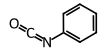
Phenyl isocyanate
Athanor · official
C7H5NO · 119.12 g/mol
IUPAC name: isocyanatobenzene
Also called isocyanatobenzene


 DangerFlammable liquid and vapor · Harmful if swallowed · Causes severe skin burns and eye damage · May cause an allergic skin reaction · Causes serious eye damage · Fatal if inhaled · May cause allergy or asthma symptoms or breathing difficulties if inhaled · May cause respiratory irritation · Very toxic to aquatic life · Very toxic to aquatic life with long lasting effects · Toxic to aquatic life with long lasting effects
Names and identifiers
- IUPAC name
- isocyanatobenzene
- Synonyms
- isocyanatobenzene, Isocyanatobenzene, Benzene, isocyanato-
+ 36 more
Phenylcarbimide, Carbanil, phenylisocyanate, Phenyl carbonimide, Fenylisokyanat, Isocyanic acid, phenyl ester, Mondur P, PhNCO, Karbanil, 196GO6BSOH, DTXSID5051521, CHEBI:53806, NSC-74454, RefChem:172961, DTXCID1030070, 203-137-6, isocyanato-benzene, NSC 74454, Karbanil [Czech], Fenylisokyanat [Czech], Isocyanic Acid Phenyl Ester, HSDB 5356, EINECS 203-137-6, UNII-196GO6BSOH, phenyl isocynate, AI3-28250, phenyl-isocyanate, isocyanato benzene, Carba0, 1-isocyanatobenzene, 4-isocyanatobenzene, phenyl isocyanate, 14C-labeled cpd, Isocyanate, phenyl ester, BENZENE,ISOCYANATE, WLN: OCNR, Epitope ID:117716
- Molecular formula
- C7H5NO
- Empirical formula
- C7H5NO
- Molecular weight
- 119.12 g/mol
- Exact mass
- 119.03711
- CAS number
- 103-71-9
- PubChem CID
- 7672
- Canonical SMILES
- C1=CC=C(C=C1)N=C=O
- Isomeric SMILES
- C1=CC=C(C=C1)N=C=O
- InChI
- InChI=1S/C7H5NO/c9-6-8-7-4-2-1-3-5-7/h1-5H
- InChIKey
- DGTNSSLYPYDJGL-UHFFFAOYSA-N
- Molfile
Names, InChI and the identifiers from PubChem, retrieved 2026-10-14.
Physical properties
- Appearance
- Phenyl isocyanate appears as a colorless liquid. About the same density as water. Very toxic by ingestion, inhalation or skin absorption. Very irritating to skin, eyes and mucous membranes.[1]
4 values
From CAMEO Chemicals, the most authoritative source here.
Value As written Source –shown Phenyl isocyanate appears as a colorless liquid. About the same density as water. Very toxic by ingestion, inhalation or skin absorption. Very irritating to skin, eyes and mucous membranes. [1] CAMEO Chemicals – Liquid [2] EPA Chemical Data Reporting (CDR) – COLOURLESS-TO-YELLOW LIQUID WITH PUNGENT ODOUR. [3] ILO-WHO International Chemical Safety Cards (ICSCs) – Colorless to yellow liquid with a pungent odor. [4] Occupational Safety and Health Administration (OSHA) - Melting point
- -30 °C[3]
3 values
3 of 3 sources agree on it (most common value).
Value As written Source −30 °C Freezing point: -30 °C [5] Hazardous Substances Data Bank (HSDB)cites Lewis, R.J. Sr.; Hawley's Condensed Chemical Dictionary 15th Edition. John Wiley & Sons, Inc. New York, NY 2007., p. 976 −30 °Cshown -30 °C [3] ILO-WHO International Chemical Safety Cards (ICSCs) −30 °C -22 °F [4] Occupational Safety and Health Administration (OSHA) - Boiling point
- 163.0 °C (325.4 °F)[4]
3 values
Sources disagree; from Occupational Safety and Health Administration (OSHA), the most authoritative.
Value As written Source 55 °C BP: 55 °C at 13 mm Hg [5] Hazardous Substances Data Bank (HSDB)cites Lide, D.R., G.W.A. Milne (eds.). Handbook of Data on Organic Compounds. Volume I. 3rd ed. CRC Press, Inc. Boca Raton ,FL. 1994., p. V1: 1005 158 to 168 °C 158-168 °C [3] ILO-WHO International Chemical Safety Cards (ICSCs) 163.0 °Cshown 325.4 °F [4] Occupational Safety and Health Administration (OSHA) - Density
- Density: 1.0956 g/cu cm at 20 °C[5]
3 values
Only one source reports it.
Value As written Source 1.0956 g/mLshown Density: 1.0956 g/cu cm at 20 °C [5] Hazardous Substances Data Bank (HSDB)cites Lide, D.R., G.W.A. Milne (eds.). Handbook of Data on Organic Compounds. Volume I. 3rd ed. CRC Press, Inc. Boca Raton ,FL. 1994., p. V1: 1004 – Relative density (water = 1): 1.095 [3] ILO-WHO International Chemical Safety Cards (ICSCs) – 1.0956 @ 19.6°C [6] PAC Chemical Database, U.S. Department of Energy - Solubility in water
- Solubility in water: reaction[3]
2 values
From ILO-WHO International Chemical Safety Cards (ICSCs), the most authoritative source here.
Value As written Source – Decomposes in water, alcohol; very soluble in ether [5] Hazardous Substances Data Bank (HSDB)cites Lewis, R.J. Sr. (ed) Sax's Dangerous Properties of Industrial Materials. 11th Edition. Wiley-Interscience, Wiley & Sons, Inc. Hoboken, NJ. 2004., p. V3: 2920 –shown Solubility in water: reaction [3] ILO-WHO International Chemical Safety Cards (ICSCs) - Vapor pressure
- 2.57 mmHg at 25 °C[5]
3 values
Sources disagree; from Hazardous Substances Data Bank (HSDB), the most authoritative.
Value As written Source 2.57 mmHgshown 2.57 mm Hg at 25 °C [5] Hazardous Substances Data Bank (HSDB)cites Daubert, T.E., R.P. Danner. Physical and Thermodynamic Properties of Pure Chemicals Data Compilation. Washington, D.C.: Taylor and Francis, 1989. 1.5 mmHg Vapor pressure, kPa at 20 °C: 0.2 [3] ILO-WHO International Chemical Safety Cards (ICSCs) 1 mmHg 1 [mm Hg] @10.6 °C [6] PAC Chemical Database, U.S. Department of Energy 1 more value was reported but failed the checks (unreadable or out of range), so it is not shown.
- Flash point
- 55.5 °C (132 °F) (Open Cup)[5]
3 values
2 of 3 sources agree on it (most common value).
Value As written Source 55.6 °Cshown 132 °F (55.5 °C) (Open Cup) [5] Hazardous Substances Data Bank (HSDB)cites Lewis, R.J. Sr.; Hawley's Condensed Chemical Dictionary 15th Edition. John Wiley & Sons, Inc. New York, NY 2007., p. 976 51 °C 51 °C c.c. [3] ILO-WHO International Chemical Safety Cards (ICSCs) 56 °C 132 °F (open cup) [4] Occupational Safety and Health Administration (OSHA) - Autoignition temperature
- 300 °C[3]
Each value as its source reports it, with the source's number after it (listed under References). Where several sources report a property, the row shows the value most of them agree on, the rule the app uses; open the values to see every one.
Calculated
- Heavy atoms
- 9
- Rings
- 1
- Aromatic rings
- 1
- Fraction sp³ carbons (Fsp3)
- 0
- H-bond donors
- 0
- H-bond acceptors
- 2
- Rotatable bonds
- 1
- TPSA (Ų)
- 29.4
- Formal charge
- 0
- XLogP3
- 2.7 PubChem
- Complexity
- 121 PubChem
- Stereocenters
- None
- Double-bond geometry
- None specified
- Point group
- Cs of one 3D conformer with its hydrogens, by Athanor’s engine (as in the app)
Elemental analysis
- C70.58%
- H4.23%
- N11.76%
- O13.43%
Isotope pattern
Each peak is a nominal mass with its abundance-weighted exact mass, as a percentage of the tallest, from IUPAC natural isotope abundances.
Computed from the structure with RDKit 2026.09 when this page was built, beside PubChem's own computed values from its record; where the two differ, both are shown.
Predicted
- log P
- 1.65 Crippen (Wildman and Crippen 1999)
- log S (water solubility)
- -2.05 ESOL (Delaney 2004), log mol/L
- Synthetic accessibility
- 2.2 SA score, 1 easy to 10 hard (Ertl and Schuffenhauer 2009)
Drug-likeness: Lipinski’s rule of five
- Molecular weight ≤ 500: 119.12
- log P ≤ 5 (Crippen): 1.65
- H-bond donors ≤ 5: 0
- H-bond acceptors ≤ 10: 2
Passes all four rules.
¹³C NMR shifts, predicted
Predictions, not measurements; each names its method. A measured log P, where a source reports one, is under Physical properties.
Safety
Danger
Most widely reported: 391 company reports to ECHA. Source [7].
- Flammable
- Corrosive
- Acute toxicity
- Harmful or irritant
 Health hazard
 Environmental hazard
- H226Flammable liquid and vapor (85.2% of reports)
- H302Harmful if swallowed (90.5% of reports)
- H314Causes severe skin burns and eye damage (89% of reports)
- H317May cause an allergic skin reaction (93.1% of reports)
- H318Causes serious eye damage (62.1% of reports)
- H330Fatal if inhaled (90.5% of reports)
- H334May cause allergy or asthma symptoms or breathing difficulties if inhaled (97.4% of reports)
- H335May cause respiratory irritation (67% of reports)
- H400Very toxic to aquatic life (62.9% of reports)
- H410Very toxic to aquatic life with long lasting effects (46% of reports)
- H411Toxic to aquatic life with long lasting effects (18.2% of reports)
Precautionary statements: P210, P233, P240, P241, P242, P243, P260, P261, P264, P264+P265, P270, P271, P272, P273, P280, P284, P301+P317, P301+P330+P331, P302+P352, P302+P361+P354, P303+P361+P353, P304+P340, P305+P354+P338, P316, P317, P319, P320, P321, P330, P333+P317, P342+P316, P362+P364, P363, P370+P378, P391, P403, P403+P233, P403+P235, P405, P501
Exposure limits
First aid
- Excerpt from ERG Guide 155 [Substances - Toxic and/or Corrosive (Flammable / Water-Sensitive)]: Refer to the "General First Aid" section. Specific First Aid: For corrosives, in case of contact, immediately flush skin or eyes with running water for at least 30 minutes. Additional flushing may be required. (ERG, 2024)[1]
- General First Aid: · Call 911 or emergency medical service. · Ensure that medical personnel are aware of the material(s) involved, take precautions to protect themselves and avoid contamination. · Move victim to fresh air if it can be done safely. · Administer oxygen if breathing is difficult. · If victim is not breathing: -- DO NOT perform mouth-to-mouth resuscitation; the victim may have ingested or inhaled the substance. -- If equipped and pulse detected, wash face and mouth, then give artificial respiration using a proper respiratory medical device (bag-valve mask, pocket mask equipped…[8]
- Fresh air, rest. Half-upright position. Artificial respiration may be needed. Refer for medical attention.[3]
- Remove contaminated clothes. Rinse and then wash skin with water and soap. Refer for medical attention .[3]
Storage
- Fireproof. Keep in a well-ventilated room. Dry.[3]
- Isocyanates are transported in railroad tank cars, tank trucks, tanks in ships, containers, and drums. They are stored in steel tanks and processed in steel equipment. For long-term storage stainless steel is recommended. To avoid contamination by atmospheric moisture, a dry air or inert gas blanket is essential. (isocyanates)[5]
Incompatibilities
- Has exploded when stirred with (cobalt pentammine triazoperchlorate + nitrosyl perchlorate).[5]
Safety data sheets on the supplier’s page: Sigma-Aldrich, Ambinter, 001Chemical.
Always read the supplier’s safety data sheet before working with it.
Spectra
- NMRHazardous Substances Data Bank (HSDB) · NMRShiftDB
- 1H NMRSpectraBase (Varian A-60)
- 13C NMRHazardous Substances Data Bank (HSDB) · Human Metabolome Database (HMDB) (JEOL · 100.54 MHz · CDCl3) · SpectraBase
- 15N NMRSpectraBase
- GC-MSHuman Metabolome Database (HMDB) (EI-B · positive) · MassBank of North America (MoNA) (JEOL JMS-D-3000 · EI-B · positive) · MassBank of North America (MoNA) (JEOL JMS-D-3000 · EI-B · positive) · NIST Mass Spectrometry Data Center · NIST Mass Spectrometry Data Center · NIST Mass Spectrometry Data Center
- MS-MSNIST Mass Spectrometry Data Center (IT/ion trap)
- Other MSHazardous Substances Data Bank (HSDB) · MassBank Europe (JEOL JMS-D-3000 · EI-B · POSITIVE)
- UVHazardous Substances Data Bank (HSDB)
- IRHazardous Substances Data Bank (HSDB)
- FTIRSpectraBase (Bruker IFS 85 · Cell)
- ATR-IRSpectraBase (Bruker Tensor 27 FT-IR · ATR-Neat (DuraSamplIR II))
- Near IRSpectraBase (BRUKER IFS 88 · NIR)
- Vapor Phase IRSpectraBase (Vapor Phase)
- RamanSpectraBase (Bruker MultiRAM Stand Alone FT-Raman Spectrometer · FT-Raman)
Experimental spectra held by these sources; each link opens the source's own record.
Literature
Reading PubChem, OpenAlex and GSRS…
Bioactivity
Reading ChEMBL…
References
- [1]CAMEO Chemicals · Public domain (NOAA) · via PubChem · retrieved 2026-10-14
- [2]EPA Chemical Data Reporting (CDR) · Public domain (US EPA) · via PubChem · retrieved 2026-10-14
- [3]ILO-WHO International Chemical Safety Cards (ICSCs) · CC BY 4.0 · via PubChem · retrieved 2026-10-14
- [4]Occupational Safety and Health Administration (OSHA) · Public domain (US DOL) · via PubChem · retrieved 2026-10-14
- [5]Hazardous Substances Data Bank (HSDB) · Public domain (US NLM) · via PubChem · retrieved 2026-10-14
- [6]PAC Chemical Database, U.S. Department of Energy · Public domain (US DOE) · via PubChem · retrieved 2026-10-14
- [7]European Chemicals Agency (ECHA) · ECHA legal notice: reuse with acknowledgement · via PubChem · retrieved 2026-10-14
- [8]Emergency Response Guidebook (ERG) · Public domain (US DOT) · via PubChem · retrieved 2026-10-14
- [9]NMRShiftDB · Linked only · via PubChem · retrieved 2026-10-14
- [10]SpectraBase · Linked only · via PubChem · retrieved 2026-10-14
- [11]Human Metabolome Database (HMDB) · Linked only · via PubChem · retrieved 2026-10-14
- [12]MassBank of North America (MoNA) · CC BY 4.0 · via PubChem · retrieved 2026-10-14
- [13]NIST Mass Spectrometry Data Center · Linked only · via PubChem · retrieved 2026-10-14
- [14]MassBank Europe · Linked only · via PubChem · retrieved 2026-10-14
- ·Calculated values: computed by Athanor with RDKit 2026.09 from the structure.
- ·Literature on PubChem
Data last updated 2026-10-14.