
EDTA
Athanor · official
C10H16N2O8 · 292.24 g/mol
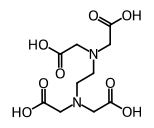
IUPAC name: 2-[2-[bis(carboxymethyl)amino]ethyl-(carboxymethyl)amino]acetic acid
Also called ethylenediaminetetraacetic acid, chelator, versene, E385
 WarningCauses serious eye irritation
Names and identifiers
- IUPAC name
- 2-[2-[bis(carboxymethyl)amino]ethyl-(carboxymethyl)amino]acetic acid
- Synonyms
- ethylenediaminetetraacetic acid, chelator, versene
+ 39 more
E385, Ethylenediaminetetraacetic acid, Edetic acid, Edathamil, Sequestrol, Havidote, Titriplex, Cheelox, EDTA acid, Sequestrene aa, Versene acid, Trilon BS, Gluma cleanser, Sequestric acid, Warkeelate acid, Komplexon ii, Tetrine acid, Quastal Special, Metaquest A, Trilon bw, (Ethylenedinitrilo)tetraacetic acid, Titriplex II, Cheelox BF acid, Celon A, Celon ATH, Chelest 3A, Questex 4H, Chemcolox 340, Acide edetique, Acido edetico, Universne acid, EDTA (chelating agent), Dissolvine E, Vinkeil 100, Nullapon B acid, Nullapon bf acid, Nervanaid B acid, Perma kleer 50 acid, Clewat TAA
- Molecular formula
- C10H16N2O8
- Empirical formula
- C5H8NO4
- Molecular weight
- 292.24 g/mol
- Exact mass
- 292.09067
- CAS number
- 60-00-4
- PubChem CID
- 6049
- Canonical SMILES
- C(CN(CC(=O)O)CC(=O)O)N(CC(=O)O)CC(=O)O
- Isomeric SMILES
- C(CN(CC(=O)O)CC(=O)O)N(CC(=O)O)CC(=O)O
- InChI
- InChI=1S/C10H16N2O8/c13-7(14)3-11(4-8(15)16)1-2-12(5-9(17)18)6-10(19)20/h1-6H2,(H,13,14)(H,15,16)(H,17,18)(H,19,20)
- InChIKey
- KCXVZYZYPLLWCC-UHFFFAOYSA-N
- Molfile
Names, InChI and the identifiers from PubChem, retrieved 2026-10-14.
Physical properties
- Appearance
- Colorless crystals[4]
6 values
From Hazardous Substances Data Bank (HSDB), the most authoritative source here.
Value As written Source – Ethylenediamine tetraacetic acid is a colorless crystalline solid. It is slightly soluble in water. The primary hazard is the threat to the environment. Immediate steps should be taken to limit its spread to the environment. It is used in chemical analysis, to make detergents and cleaning compounds, and for many other uses. [1] CAMEO Chemicals – CBI; Other Solid; Dry Powder [2] EPA Chemical Data Reporting (CDR) – Liquid; Dry Powder; Liquid; Dry Powder; CBI; Large Crystals [2] EPA Chemical Data Reporting (CDR) – COLOURLESS CRYSTALS OR WHITE POWDER. [3] ILO-WHO International Chemical Safety Cards (ICSCs) –shown Colorless crystals [4] Hazardous Substances Data Bank (HSDB)cites Lewis, R.J. Sr.; Hawley's Condensed Chemical Dictionary 15th Edition. John Wiley & Sons, Inc. New York, NY 2007., p. 527 – White crystalline powder [4] Hazardous Substances Data Bank (HSDB)cites Lewis, R.J. Sr. (ed) Sax's Dangerous Properties of Industrial Materials. 11th Edition. Wiley-Interscience, Wiley & Sons, Inc. Hoboken, NJ. 2004., p. V2: 1660 - Density
- Relative density (water = 1): 0.86[3]
2 values
2 of 2 sources agree on it (most common value).
Value As written Source – 0.86 at 68 °F (USCG, 1999) - Less dense than water [1] CAMEO Chemicalscites U.S. Coast Guard. 1999. Chemical Hazard Response Information System (CHRIS) - Hazardous Chemical Data. Commandant Instruction 16465.12C. Washington, D.C.: U.S. Government Printing Office. –shown Relative density (water = 1): 0.86 [3] ILO-WHO International Chemical Safety Cards (ICSCs) - Solubility in water
- Solubility in water, g/100ml at 20 °C: 0.05 (very poor)[3]
4 values
From ILO-WHO International Chemical Safety Cards (ICSCs), the most authoritative source here.
Value As written Source – SOL IN SOLN OF ALKALI HYDROXIDES [4] Hazardous Substances Data Bank (HSDB)cites Osol, A. (ed.). Remington's Pharmaceutical Sciences. 16th ed. Easton, Pennsylvania: Mack Publishing Co., 1980., p. 1260 – Insoluble in common organic solvents [4] Hazardous Substances Data Bank (HSDB)cites Lewis, R.J. Sr.; Hawley's Condensed Chemical Dictionary 15th Edition. John Wiley & Sons, Inc. New York, NY 2007., p. 527 – In water, 1,000 mg/L at 25 °C [4] Hazardous Substances Data Bank (HSDB)cites Wolf K, Gilbert PA; in The Handbook of Environmental Chemistry. Hutzinger O, ed. Berlin, Germany: Spring-Verlag 3F: 243-259 (1992) –shown Solubility in water, g/100ml at 20 °C: 0.05 (very poor) [3] ILO-WHO International Chemical Safety Cards (ICSCs) - log P
- -3.34 (calculated)[3]
- pKa
- pKa = 0.26[4]
- Vapor pressure
- 1.50 × 10⁻¹² mmHg at 25 °C (extrapolated)[4]
- Flash point
- Reported, but no value passed the checks.
The value and why
- Flash point is> 100 °C, (could not be read; source [4])
Each value as its source reports it, with the source's number after it (listed under References). Where several sources report a property, the row shows the value most of them agree on, the rule the app uses; open the values to see every one.
Calculated
- Heavy atoms
- 20
- Rings
- 0
- Aromatic rings
- 0
- Fraction sp³ carbons (Fsp3)
- 0.6
- H-bond donors
- 4
- H-bond acceptors
- 6 computed here · PubChem 10
- Rotatable bonds
- 11
- TPSA (Ų)
- 155.7 computed here · PubChem 156
- Formal charge
- 0
- XLogP3
- -5.9 PubChem
- Complexity
- 315 PubChem
- Stereocenters
- None
- Double-bond geometry
- None specified
- Point group
- C1 of one 3D conformer with its hydrogens, by Athanor’s engine (as in the app)
Elemental analysis
- C41.10%
- H5.52%
- N9.59%
- O43.80%
Isotope pattern
Each peak is a nominal mass with its abundance-weighted exact mass, as a percentage of the tallest, from IUPAC natural isotope abundances.
Computed from the structure with RDKit 2026.09 when this page was built, beside PubChem's own computed values from its record; where the two differ, both are shown.
Predicted
- log P
- -2.07 Crippen (Wildman and Crippen 1999)
- log S (water solubility)
- 0.38 ESOL (Delaney 2004), log mol/L
- Synthetic accessibility
- 2.17 SA score, 1 easy to 10 hard (Ertl and Schuffenhauer 2009)
Drug-likeness: Lipinski’s rule of five
- Molecular weight ≤ 500: 292.24
- log P ≤ 5 (Crippen): -2.07
- H-bond donors ≤ 5: 4
- H-bond acceptors ≤ 10: 6
Passes all four rules.
¹³C NMR shifts, predicted
Predictions, not measurements; each names its method. A measured log P, where a source reports one, is under Physical properties.
Safety
Warning
Harmonized EU classification (CLP Annex VI). Source [5].
- Harmful or irritant
- H319Causes serious eye irritation
Precautionary statements: P264+P265, P280, P305+P351+P338, P337+P317
View all classifications (5)
- [5] Regulation (EC) No 1272/2008 of the European Parliament and of the Council · WarningH319
- [6] European Chemicals Agency (ECHA)This chemical does not meet GHS hazard criteria for 0.4% (6 of 1452) of reports.
- [6] European Chemicals Agency (ECHA) · 1,452 reports · WarningH319, H332, H373
- [6] European Chemicals Agency (ECHA)This chemical does not meet GHS hazard criteria for 19.4% (86 of 443) of reports.
- [6] European Chemicals Agency (ECHA) · 443 reports · WarningH302, H312, H315, H319, H332, H335, H373, H412
First aid
Storage
- Separated from strong oxidants, metals and food and feedstuffs.[3]
- Chelating agents, by their very nature, tend to be corrosive to metals such as copper, zinc, and iron. The alkaline salts corrode aluminum severely, and contact with these salts should be avoided. Stainless steel and most polymers or coatings that are able to withstand dilute alkali are acceptable as construction materials. Solid chelating agents should be stored in a cool, dry place to avoid caking. (chelating agents)[4]
- Store at 25 °C (77 °F) with excursions permitted between 15 to 30 °C (59 to 86 °F).[4]
- Store in tight container as defined in the usp-nf. This material should be handled and stored per label instructions to ensure product integrity. Store in a refrigerator.[4]
Incompatibilities
- Reacts with strong oxidants, strong bases, copper, copper alloys and nickel.[4]
- Reacts violently with lead dioxide.[4]
- Disodium edentate behaves as a weak acid, displacing carbon dioxide from carbonates and reacting with metals to form hydrogen. It is incompatible with strong oxidizing agents, strong bases, metal ions, and metal alloys.[4]
- Additives may be incompatible with the reconstituted (diluted) solution required for intravenous infusion. Consult with pharmacist, if available. When introducing additives, use aseptic technique, mix thoroughly and do not store.[4]
Safety data sheets on the supplier’s page: Thermo Fisher Scientific, Biorbyt, LGC Standards.
Always read the supplier’s safety data sheet before working with it.
Spectra
- NMRNMRShiftDB
- 1H NMRSpectraBase (Varian CFT-20)
- 13C NMRSpectraBase
- GC-MSHuman Metabolome Database (HMDB) (GC-MS) · MassBank of North America (MoNA) (GC-MS) · NIST Mass Spectrometry Data Center · NIST Mass Spectrometry Data Center · SpectraBase
- LC-MSMassBank Europe (Orbitrap Exploris 240 Thermo Scientific · LC-ESI-QFT · POSITIVE) · MassBank Europe (Orbitrap Exploris 240 Thermo Scientific · LC-ESI-QFT · POSITIVE) · MassBank Europe (Orbitrap Exploris 240 Thermo Scientific · LC-ESI-QFT · POSITIVE) · MassBank Europe (Orbitrap Exploris 240 Thermo Scientific · LC-ESI-QFT · POSITIVE) · MassBank Europe (Orbitrap Exploris 240 Thermo Scientific · LC-ESI-QFT · POSITIVE) · MassBank Europe (Orbitrap Exploris 240 Thermo Scientific · LC-ESI-QFT · POSITIVE)
- IRHazardous Substances Data Bank (HSDB)
- FTIRSpectraBase (Bruker IFS 85 · KBr-Pellet)
- ATR-IRSpectraBase
Experimental spectra held by these sources; each link opens the source's own record.
Literature
Reading PubChem, OpenAlex and GSRS…
Bioactivity
Reading ChEMBL…
References
- [1]CAMEO Chemicals · Public domain (NOAA) · via PubChem · retrieved 2026-10-14
- [2]EPA Chemical Data Reporting (CDR) · Public domain (US EPA) · via PubChem · retrieved 2026-10-14
- [3]ILO-WHO International Chemical Safety Cards (ICSCs) · CC BY 4.0 · via PubChem · retrieved 2026-10-14
- [4]Hazardous Substances Data Bank (HSDB) · Public domain (US NLM) · via PubChem · retrieved 2026-10-14
- [5]Regulation (EC) No 1272/2008 of the European Parliament and of the Council · EU reuse policy, CC BY 4.0 · via PubChem · retrieved 2026-10-14
- [6]European Chemicals Agency (ECHA) · ECHA legal notice: reuse with acknowledgement · via PubChem · retrieved 2026-10-14
- [7]NMRShiftDB · Linked only · via PubChem · retrieved 2026-10-14
- [8]SpectraBase · Linked only · via PubChem · retrieved 2026-10-14
- [9]Human Metabolome Database (HMDB) · Linked only · via PubChem · retrieved 2026-10-14
- [10]MassBank of North America (MoNA) · CC BY 4.0 · via PubChem · retrieved 2026-10-14
- [11]NIST Mass Spectrometry Data Center · Linked only · via PubChem · retrieved 2026-10-14
- [12]MassBank Europe · Linked only · via PubChem · retrieved 2026-10-14
- ·Calculated values: computed by Athanor with RDKit 2026.09 from the structure.
- ·Literature on PubChem
Data last updated 2026-10-14.