
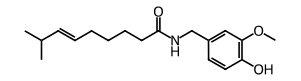
Capsaicin
Athanor · official
C18H27NO3 · 305.4 g/mol
IUPAC name: (E)-N-[(4-hydroxy-3-methoxyphenyl)methyl]-8-methylnon-6-enamide
Also called chilli, Capzasin, vanilloid


 DangerToxic if swallowed · Harmful if swallowed · Causes skin irritation · Causes serious eye damage
Names and identifiers
- IUPAC name
- (E)-N-[(4-hydroxy-3-methoxyphenyl)methyl]-8-methylnon-6-enamide
- Synonyms
- chilli, Capzasin, vanilloid
+ 38 more
Zostrix, CAPSAICINE, trans-Capsaicin, Qutenza, Styptysat, Axsain, Ausanil, Isodecenoic acid vanillylamide, trans-8-Methyl-N-vanillyl-6-nonenamide, Mioton, NGX-4010, Dolenon, Ovocap, (E)-8-Methyl-N-vanillyl-6-nonenamide, FEMA No. 3404, Capzasin-hp, 8-Methyl-N-Vanillyl-6-Nonenamide, Togarashi orenji, ALGRX 4975, DTXSID9020241, Ratden pe 40, NCI-C56564, NGX 4010, Capsaicina, (E)-N-[(4-HYDROXY-3-METHOXYPHENYL)METHYL]-8-METHYL-6-NONENAMIDE, Zostrix HP, Cntx-4975, NGX-1998, (6E)-N-[(4-hydroxy-3-methoxyphenyl)methyl]-8-methylnon-6-enamide, (E)-N-[(4-hydroxy-3-methoxyphenyl)methyl]-8-methylnon-6-enamide, 6-Nonenamide, 8-methyl-N-vanillyl-, (E)-, NSC-56353, N-(4-Hydroxy-3-methoxybenzyl)-8-methylnon-trans-6-enamide, ALGRX-4975, CHEBI:3374, S07O44R1ZM, NSC56353, 6-Nonenamide, N-[(4-hydroxy-3-methoxyphenyl)methyl]-8-methyl-, (6E)-
- Molecular formula
- C18H27NO3
- Empirical formula
- C18H27NO3
- Molecular weight
- 305.4 g/mol
- Exact mass
- 305.19909
- CAS number
- 404-86-4
- PubChem CID
- 1548943
- Canonical SMILES
- CC(C)C=CCCCCC(=O)NCC1=CC(=C(C=C1)O)OC
- Isomeric SMILES
- CC(C)/C=C/CCCCC(=O)NCC1=CC(=C(C=C1)O)OC
- InChI
- InChI=1S/C18H27NO3/c1-14(2)8-6-4-5-7-9-18(21)19-13-15-10-11-16(20)17(12-15)22-3/h6,8,10-12,14,20H,4-5,7,9,13H2,1-3H3,(H,19,21)/b8-6+
- InChIKey
- YKPUWZUDDOIDPM-SOFGYWHQSA-N
- Molfile
Names, InChI and the identifiers from PubChem, retrieved 2026-10-14.
Physical properties
- Appearance
- Pure dark red solid[2]
3 values
From Hazardous Substances Data Bank (HSDB), the most authoritative source here.
Value As written Source – White crystalline powder. [1] Occupational Safety and Health Administration (OSHA) –shown Pure dark red solid [2] Hazardous Substances Data Bank (HSDB)cites Crop Protection Handbook Volume 100, Meister Media Worldwide, Willoughby, OH 2014, p. 156 – Monoclinic, rectangular plates, crystals and scales [2] Hazardous Substances Data Bank (HSDB)cites Lewis, R.J. Sr. (ed) Sax's Dangerous Properties of Industrial Materials. 12th Edition. Wiley-Interscience, Wiley & Sons, Inc. Hoboken, NJ. 2012., p. 349 - Odor
- Highly volatile with a pungent odor[2]
- Melting point
- 65 °C (149 °F)[1]
- Boiling point
- 210-220 °C (410-428 °F)[1]
- log P
- log Kow = 3.04[2]
- Flash point
- 113 °C (235 °F) - closed cup[2]
Each value as its source reports it, with the source's number after it (listed under References). Where several sources report a property, the row shows the value most of them agree on, the rule the app uses; open the values to see every one.
Calculated
- Heavy atoms
- 22
- Rings
- 1
- Aromatic rings
- 1
- Fraction sp³ carbons (Fsp3)
- 0.5
- H-bond donors
- 2
- H-bond acceptors
- 3
- Rotatable bonds
- 9
- TPSA (Ų)
- 58.6
- Formal charge
- 0
- XLogP3
- 3.6 PubChem
- Complexity
- 341 PubChem
- Stereocenters
- None
- Double-bond geometry
- C14=C15: E
- Point group
- C1 of one 3D conformer with its hydrogens, by Athanor’s engine (as in the app)
Elemental analysis
- C70.79%
- H8.91%
- N4.59%
- O15.72%
Isotope pattern
Each peak is a nominal mass with its abundance-weighted exact mass, as a percentage of the tallest, from IUPAC natural isotope abundances.
Computed from the structure with RDKit 2026.09 when this page was built, beside PubChem's own computed values from its record; where the two differ, both are shown.
Predicted
- log P
- 3.79 Crippen (Wildman and Crippen 1999)
- log S (water solubility)
- -3.73 ESOL (Delaney 2004), log mol/L
- Synthetic accessibility
- 2.19 SA score, 1 easy to 10 hard (Ertl and Schuffenhauer 2009)
Drug-likeness: Lipinski’s rule of five
- Molecular weight ≤ 500: 305.42
- log P ≤ 5 (Crippen): 3.79
- H-bond donors ≤ 5: 2
- H-bond acceptors ≤ 10: 3
Passes all four rules.
¹³C NMR shifts, predicted
Predictions, not measurements; each names its method. A measured log P, where a source reports one, is under Physical properties.
Safety
Danger
Most widely reported: 1,697 company reports to ECHA. Source [3].
- Corrosive
- Acute toxicity
- Harmful or irritant
- H301Toxic if swallowed (21.9% of reports)
- H302Harmful if swallowed (78% of reports)
- H315Causes skin irritation (99.7% of reports)
- H318Causes serious eye damage (97.2% of reports)
Precautionary statements: P264, P264+P265, P270, P280, P301+P316, P301+P317, P302+P352, P305+P354+P338, P317, P321, P330, P332+P317, P362+P364, P405, P501
View all classifications (2)
- [3] European Chemicals Agency (ECHA) · 1,697 reports · DangerH301, H302, H315, H318
- [2] Hazardous Substances Data Bank (HSDB) · DangerH301, H315, H317, H319, H334, H335
Storage
- Keep container tightly closed in a dry and well-ventilated place. Recommended storage temperature: 2 - 8 °C.[2]
- Store at 15 to 30 °C (59 to 86 °F) (over the counter capsaicin)[2]
- Safe Storage of Pesticides. Always store pesticides in their original containers, complete with labels that list ingredients, directions for use, and first aid steps in case of accidental poisoning. Never store pesticides in cabinets with or near food, animal feed, or medical supplies. Do not store pesticides in places where flooding is possible or in places where they might spill or leak into wells, drains, ground water, or surface water.[2]
- Store carton between 20 and 25 °C (68 and 77 °F). Excursions between 15 and 30 °C (59 and 86 °F) are allowed. Keep the patch in the sealed pouch until immediately before use. (prescription capsaicin patch)[2]
Incompatibilities
- Incompatible materials: Strong oxidizing agents.[2]
Safety data sheets on the supplier’s page: Aladdin Scientific, INTERBIOSCREEN, Sinfoo Biotech.
Always read the supplier’s safety data sheet before working with it.
Spectra
- 1H NMRSpectraBase (Bruker WM-250)
- 13C NMRSpectraBase
- GC-MSNIST Mass Spectrometry Data Center · NIST Mass Spectrometry Data Center · SpectraBase (GC)
- MS-MSHuman Metabolome Database (HMDB) (Negative) · Human Metabolome Database (HMDB) (Negative) · Human Metabolome Database (HMDB) (Negative) · Human Metabolome Database (HMDB) (Negative) · Human Metabolome Database (HMDB) (Positive) · Human Metabolome Database (HMDB) (Positive)
- LC-MSMassBank Europe (UPLC Q-Tof Premier, Waters · LC-ESI-QTOF · POSITIVE) · MassBank Europe (UPLC Q-Tof Premier, Waters · LC-ESI-QTOF · NEGATIVE) · MassBank Europe (Shimadzu LC20A-IT-TOFMS · LC-ESI-ITTOF · POSITIVE) · MassBank Europe (LCMS-IT-TOF · LC-ESI-ITTOF · NEGATIVE) · MassBank Europe (Agilent 1200 RRLC; Agilent 6520 QTOF · LC-ESI-QTOF · POSITIVE) · MassBank Europe (Agilent 1200 RRLC; Agilent 6520 QTOF · LC-ESI-QTOF · POSITIVE)
- Other MSMassBank of North America (MoNA) (positive) · MassBank of North America (MoNA) (positive) · MassBank of North America (MoNA) (negative) · MassBank of North America (MoNA) (ESI-Orbitrap · positive) · MassBank of North America (MoNA) (ESI-Orbitrap · positive) · MassBank of North America (MoNA) (ESI-Orbitrap · positive)
- UVHazardous Substances Data Bank (HSDB)
- IRHazardous Substances Data Bank (HSDB)
- FTIRSpectraBase (CAPILLARY CELL: MELT)
- ATR-IRSpectraBase
- Vapor Phase IRSpectraBase (DIGILAB FTS-14 · Vapor Phase)
Experimental spectra held by these sources; each link opens the source's own record.
Literature
Reading PubChem, OpenAlex and GSRS…
Bioactivity
Reading ChEMBL…
References
- [1]Occupational Safety and Health Administration (OSHA) · Public domain (US DOL) · via PubChem · retrieved 2026-10-14
- [2]Hazardous Substances Data Bank (HSDB) · Public domain (US NLM) · via PubChem · retrieved 2026-10-14
- [3]European Chemicals Agency (ECHA) · ECHA legal notice: reuse with acknowledgement · via PubChem · retrieved 2026-10-14
- [4]SpectraBase · Linked only · via PubChem · retrieved 2026-10-14
- [5]NIST Mass Spectrometry Data Center · Linked only · via PubChem · retrieved 2026-10-14
- [6]Human Metabolome Database (HMDB) · Linked only · via PubChem · retrieved 2026-10-14
- [7]MassBank Europe · Linked only · via PubChem · retrieved 2026-10-14
- [8]MassBank of North America (MoNA) · CC BY 4.0 · via PubChem · retrieved 2026-10-14
- ·Calculated values: computed by Athanor with RDKit 2026.09 from the structure.
- ·Literature on PubChem
Data last updated 2026-10-14.