
Adrenaline
Athanor · official
C9H13NO3 · 183.2 g/mol
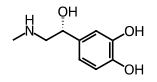
IUPAC name: 4-[(1R)-1-hydroxy-2-(methylamino)ethyl]benzene-1,2-diol
Also called epinephrine, EpiPen, catecholamine
 DangerToxic if swallowed · Fatal in contact with skin · Toxic if inhaled
Names and identifiers
- IUPAC name
- 4-[(1R)-1-hydroxy-2-(methylamino)ethyl]benzene-1,2-diol
- Synonyms
- epinephrine, EpiPen, catecholamine
+ 38 more
l-Adrenaline, Adrenalin, Levoepinephrine, Nephridine, Epinefrina, Epipen, (-)-Adrenaline, Adnephrine, Chelafrin, Epinephran, Epirenan, Renoform, (R)-Adrenaline, Hypernephrin, Renostypticin, Adrenine, Hemisine, Hemostasin, Levorenin, Levorenine, Mucidrina, Nieraline, Paranephrin, Renaglandin, Renaleptine, Renalina, Bosmin, Exadrin, Adrin, Vasoconstrictine, Bronkaid Mist, Primatene Mist, Methylarterenol, Adrenalinum, Glauposine, Hemostatin, Scurenaline, Styptirenal
- Molecular formula
- C9H13NO3
- Empirical formula
- C9H13NO3
- Molecular weight
- 183.2 g/mol
- Exact mass
- 183.08954
- CAS number
- 51-43-4
- PubChem CID
- 5816
- Canonical SMILES
- CNCC(C1=CC(=C(C=C1)O)O)O
- Isomeric SMILES
- CNC[C@@H](C1=CC(=C(C=C1)O)O)O
- InChI
- InChI=1S/C9H13NO3/c1-10-5-9(13)6-2-3-7(11)8(12)4-6/h2-4,9-13H,5H2,1H3/t9-/m0/s1
- InChIKey
- UCTWMZQNUQWSLP-VIFPVBQESA-N
- Molfile
Names, InChI and the identifiers from PubChem, retrieved 2026-10-14.
Physical properties
- Appearance
- Colorless microcrystals[2]
4 values
From Hazardous Substances Data Bank (HSDB), the most authoritative source here.
Value As written Source – Epinephrine appears as white to nearly-white microcrystalline powder or granules. Odorless. Melting point 211-212 °C. Aqueous solutions are slightly alkaline. Slightly bitter, numbing taste. [1] CAMEO Chemicals – Light brown or nearly white crystalline powder [2] Hazardous Substances Data Bank (HSDB)cites Lewis, R.J. Sr.; Hawley's Condensed Chemical Dictionary 15th Edition. John Wiley & Sons, Inc. New York, NY 2007., p. 505 –shown Colorless microcrystals [2] Hazardous Substances Data Bank (HSDB)cites Pugsley TA; Kirk-Othmer Encyclopedia of Chemical Technology. (2001). NY, NY: John Wiley & Sons; Epinephrine and Norepinephrine. Online Posting Date: Dec 4, 2000. – White to nearly white, microcrystalline powder or granules. [2] Hazardous Substances Data Bank (HSDB)cites McEvoy, G.K. (ed.). AHFS Drug Information 90. Bethesda, MD: American Society of Hospital Pharmacists, Inc., 1990 (Plus Supplements 1990)., p. 625 - Odor
- Odorless[2]
- Melting point
- 211 to 212 °C (412 to 414 °F, NTP 1992)[1]
- Solubility in water
- In water, 180 mg/L at 20 °C[2]
4 values
From Hazardous Substances Data Bank (HSDB), the most authoritative source here.
Value As written Source – less than 0.1 mg/mL at 64 °F (NTP, 1992) [1] CAMEO Chemicalscites National Toxicology Program, Institute of Environmental Health Sciences, National Institutes of Health (NTP). 1992. National Toxicology Program Chemical Repository Database. Research Triangle Park, North Carolina. – Very slightly soluble in alcohol. [2] Hazardous Substances Data Bank (HSDB)cites McEvoy, G.K. (ed.). AHFS Drug Information 90. Bethesda, MD: American Society of Hospital Pharmacists, Inc., 1990 (Plus Supplements 1990)., p. 625 – Insoluble in ethanol; soluble in acetic acid [2] Hazardous Substances Data Bank (HSDB)cites Lide, D.R., G.W.A. Milne (eds.). Handbook of Data on Organic Compounds. Volume I. 3rd ed. CRC Press, Inc. Boca Raton ,FL. 1994., p. V1: 907 –shown In water, 180 mg/L at 20 °C [2] Hazardous Substances Data Bank (HSDB)cites Yalkowsky, S.H., He, Yan., Handbook of Aqueous Solubility Data: An Extensive Compilation of Aqueous Solubility Data for Organic Compounds Extracted from the AQUASOL dATAbASE. CRC Press LLC, Boca Raton, FL. 2003., p. 597 - log P
- log Kow = -2.59[2]
- pKa
- pKa = 8.28[2]
Each value as its source reports it, with the source's number after it (listed under References). Where several sources report a property, the row shows the value most of them agree on, the rule the app uses; open the values to see every one.
Calculated
- Heavy atoms
- 13
- Rings
- 1
- Aromatic rings
- 1
- Fraction sp³ carbons (Fsp3)
- 0.33
- H-bond donors
- 4
- H-bond acceptors
- 4
- Rotatable bonds
- 3
- TPSA (Ų)
- 72.7
- Formal charge
- 0
- XLogP3
- -1.4 PubChem
- Complexity
- 154 PubChem
- Stereocenters
- 1 definedCIP: C4: R
- Double-bond geometry
- None specified
- Point group
- C1 of one 3D conformer with its hydrogens, by Athanor’s engine (as in the app)
Elemental analysis
- C59.00%
- H7.15%
- N7.65%
- O26.20%
Isotope pattern
Each peak is a nominal mass with its abundance-weighted exact mass, as a percentage of the tallest, from IUPAC natural isotope abundances.
Computed from the structure with RDKit 2026.09 when this page was built, beside PubChem's own computed values from its record; where the two differ, both are shown.
Predicted
- log P
- 0.35 Crippen (Wildman and Crippen 1999)
- log S (water solubility)
- -1.34 ESOL (Delaney 2004), log mol/L
- Synthetic accessibility
- 2.65 SA score, 1 easy to 10 hard (Ertl and Schuffenhauer 2009)
Drug-likeness: Lipinski’s rule of five
- Molecular weight ≤ 500: 183.21
- log P ≤ 5 (Crippen): 0.35
- H-bond donors ≤ 5: 4
- H-bond acceptors ≤ 10: 4
Passes all four rules.
¹³C NMR shifts, predicted
Predictions, not measurements; each names its method. A measured log P, where a source reports one, is under Physical properties.
Safety
Danger
Most widely reported: 103 company reports to ECHA. Source [3].
- Acute toxicity
- H301Toxic if swallowed (96.1% of reports)
- H310Fatal in contact with skin (95.1% of reports)
- H331Toxic if inhaled (93.2% of reports)
Precautionary statements: P261, P262, P264, P270, P271, P280, P301+P316, P302+P352, P304+P340, P316, P321, P330, P361+P364, P403+P233, P405, P501
First aid
- Eyes: First check the victim for contact lenses and remove if present. Flush victim's eyes with water or normal saline solution for 20 to 30 minutes while simultaneously calling a hospital or poison control center. Do not put any ointments, oils, or medication in the victim's eyes without specific instructions from a physician. Immediately transport the victim after flushing eyes to a hospital even if no symptoms (such as redness or irritation) develop. Skin: Immediately flood affected skin with water while removing and isolating all contaminated clothing.[1]
Storage
Safety data sheets on the supplier’s page: Alfa Chemistry, Smolecule, TCI (Tokyo Chemical Industry).
Always read the supplier’s safety data sheet before working with it.
Spectra
- 1H NMRHuman Metabolome Database (HMDB) (Varian · 600 MHz · Water) · SpectraBase
- 13C NMRSpectraBase
- 1H-13C NMRHuman Metabolome Database (HMDB) (Bruker · 600 MHz · Water)
- GC-MSHuman Metabolome Database (HMDB) (GC-EI-TOF · positive) · Human Metabolome Database (HMDB) (GC-EI-TOF (Pegasus III TOF-MS system, Leco; GC 6890, Agilent Technologies) · Positive) · MassBank Europe (Pegasus III TOF-MS system, Leco; GC 6890, Agilent Technologies · GC-EI-TOF · POSITIVE) · MassBank of North America (MoNA) (Pegasus III TOF-MS system, Leco; GC 6890, Agilent Technologies · GC-EI-TOF · positive) · NIST Mass Spectrometry Data Center · NIST Mass Spectrometry Data Center
- MS-MSHuman Metabolome Database (HMDB) (Quattro_QQQ · Positive) · Human Metabolome Database (HMDB) (Quattro_QQQ · Positive) · Human Metabolome Database (HMDB) (Quattro_QQQ · Positive) · Human Metabolome Database (HMDB) (Positive) · Human Metabolome Database (HMDB) (Positive) · Human Metabolome Database (HMDB) (Positive)
- LC-MSMassBank Europe (Q Exactive Orbitrap Thermo Scientific · LC-ESI-QFT · POSITIVE) · MassBank Europe (Q Exactive Orbitrap Thermo Scientific · LC-ESI-QFT · POSITIVE) · MassBank Europe (Q Exactive Orbitrap Thermo Scientific · LC-ESI-QFT · POSITIVE) · MassBank Europe (Q Exactive Orbitrap Thermo Scientific · LC-ESI-QFT · POSITIVE) · MassBank Europe (Q Exactive Orbitrap Thermo Scientific · LC-ESI-QFT · POSITIVE) · MassBank Europe (Q Exactive Orbitrap Thermo Scientific · LC-ESI-QFT · POSITIVE)
- Other MSHazardous Substances Data Bank (HSDB) · MassBank of North America (MoNA) (Agilent 6550 iFunnel · Q-TOF · ESI) · MassBank of North America (MoNA) (Agilent 6550 iFunnel · Q-TOF · ESI) · MassBank of North America (MoNA) (Agilent 6550 iFunnel · Q-TOF · ESI)
- UVHazardous Substances Data Bank (HSDB)
- IRHazardous Substances Data Bank (HSDB)
- FTIRSpectraBase (KBr WAFER)
- ATR-IRSpectraBase (Bruker Tensor 27 FT-IR · ATR-Neat (DuraSamplIR II))
- RamanSpectraBase (Bruker MultiRAM Stand Alone FT-Raman Spectrometer · FT-Raman)
Experimental spectra held by these sources; each link opens the source's own record.
Literature
Reading PubChem, OpenAlex and GSRS…
Bioactivity
Reading ChEMBL…
References
- [1]CAMEO Chemicals · Public domain (NOAA) · via PubChem · retrieved 2026-10-14
- [2]Hazardous Substances Data Bank (HSDB) · Public domain (US NLM) · via PubChem · retrieved 2026-10-14
- [3]European Chemicals Agency (ECHA) · ECHA legal notice: reuse with acknowledgement · via PubChem · retrieved 2026-10-14
- [4]Human Metabolome Database (HMDB) · Linked only · via PubChem · retrieved 2026-10-14
- [5]SpectraBase · Linked only · via PubChem · retrieved 2026-10-14
- [6]MassBank Europe · Linked only · via PubChem · retrieved 2026-10-14
- [7]MassBank of North America (MoNA) · CC BY 4.0 · via PubChem · retrieved 2026-10-14
- [8]NIST Mass Spectrometry Data Center · Linked only · via PubChem · retrieved 2026-10-14
- ·Calculated values: computed by Athanor with RDKit 2026.09 from the structure.
- ·Literature on PubChem
Data last updated 2026-10-14.