
Oxytocin
Athanor · official
C43H66N12O12S2 · 1007.2 g/mol
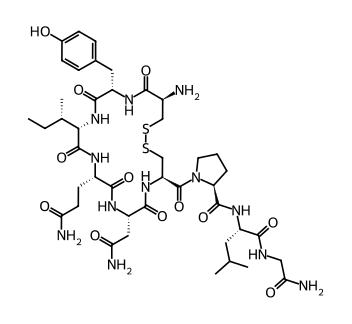
IUPAC name: (2S)-1-[(4R,7S,10S,13S,16S,19R)-19-amino-7-(2-amino-2-oxoethyl)-10-(3-amino-3-oxopropyl)-13-[(2S)-butan-2-yl]-16-[(4-hydroxyphenyl)methyl]-6,9,12,15,18-pentaoxo-1,2-dithia-5,8,11,14,17-pentazacycloicosane-4-carbonyl]-N-[(2S)-1-[(2-amino-2-oxoethyl)amino]-4-methyl-1-oxopentan-2-yl]pyrrolidine-2-carboxamide
Also called Pitocin, OT, love hormone, posterior pituitary hormone, uterotonic, 9-residue peptide

 WarningHarmful if swallowed · Suspected of damaging fertility or the unborn child
Names and identifiers
- IUPAC name
- (2S)-1-[(4R,7S,10S,13S,16S,19R)-19-amino-7-(2-amino-2-oxoethyl)-10-(3-amino-3-oxopropyl)-13-[(2S)-butan-2-yl]-16-[(4-hydroxyphenyl)methyl]-6,9,12,15,18-pentaoxo-1,2-dithia-5,8,11,14,17-pentazacycloicosane-4-carbonyl]-N-[(2S)-1-[(2-amino-2-oxoethyl)amino]-4-methyl-1-oxopentan-2-yl]pyrrolidine-2-carboxamide
- Synonyms
- Pitocin, OT, love hormone
+ 40 more
posterior pituitary hormone, uterotonic, 9-residue peptide, Endopituitrina, Ocytocin, Syntocinon, Oxytocinum, Orasthin, Oxitocina, Oxystin, Oxytocine, Synthetic oxytocin, Piton S, (1-Hemicystine)oxytocin, Syntocinone, Presoxin, Syntocin, Uteracon, Di-sipidin, Nobitocin S, 3-Isoleucine-8-leucine vasopressin, Atonin O, alpha-Hypophamine, Intertocine S, DTXSID8048361, (2S)-1-[(4R,7S,10S,13S,16S,19R)-19-amino-7-(2-amino-2-oxoethyl)-10-(3-amino-3-oxopropyl)-13-[(2S)-butan-2-yl]-16-[(4-hydroxyphenyl)methyl]-6,9,12,15,18-pentaoxo-1,2-dithia-5,8,11,14,17-pentazacycloicosane-4-carbonyl]-N-[(2S)-1-[(2-amino-2-oxoethyl)amino]-4-methyl-1-oxopentan-2-yl]pyrrolidine-2-carboxamide, 1JQS135EYN, Vasopressin, 3-L-isoleucine-8-L-leucine-, CHEBI:7872, OXYTOCIN 5 USP UNITS IN DEXTROSE 5%, OXYTOCIN 10 USP UNITS IN DEXTROSE 5%, OXYTOCIN 20 USP UNITS IN DEXTROSE 5%, TNX1900, TTA-121, TNX-1900, Cys-Tyr-Ile-Gln-Asn-Cys-Pro-Leu-Gly-NH2, cyclic 1-6 disulfide, L-Cysteinyl-L-tyrosyl-L-isoleucyl-L-glutaminyl-L-asparaginyl-L-cysteinyl-L-prolyl-L-leucylglycinamide cyclic (1-6)-disulfide, 1-({(4R,7S,10S,13S,16S,19R)-19-amino-7-(2-amino-2-oxoethyl)-10-(3-amino-3-oxopropyl)-16-(4-hydroxybenzyl)-13-[(1S)-1-methylpropyl]-6,9,12,15,18-pentaoxo-1,2-dithia-5,8,11,14,17-pentaazacycloicosan-4-yl}carbonyl)-L-prolyl-L-leucylglycinamide, Oxytocin Injectable, (2S)-1-((4R,7S,10S,13S,16S,19R)-19-amino-7-(2-amino-2-oxoethyl)-10-(3-amino-3-oxopropyl)-13-((2S)-butan-2-yl)-16-((4-hydroxyphenyl)methyl)-6,9,12,15,18-pentaoxo-1,2-dithia-5,8,11,14,17-pentazacycloicosane-4-carbonyl)-N-((2S)-1-((2-amino-2-oxoethyl)amino)-4-methyl-1-oxopentan-2-yl)pyrrolidine-2-carboxamide
- Molecular formula
- C43H66N12O12S2
- Empirical formula
- C43H66N12O12S2
- Molecular weight
- 1007.2 g/mol
- Exact mass
- 1006.43646
- CAS number
- 50-56-6
- PubChem CID
- 439302
- Canonical SMILES
- CCC(C)C1C(=O)NC(C(=O)NC(C(=O)NC(CSSCC(C(=O)NC(C(=O)N1)CC2=CC=C(C=C2)O)N)C(=O)N3CCCC3C(=O)NC(CC(C)C)C(=O)NCC(=O)N)CC(=O)N)CCC(=O)N
- Isomeric SMILES
- CC[C@H](C)[C@H]1C(=O)N[C@H](C(=O)N[C@H](C(=O)N[C@@H](CSSC[C@@H](C(=O)N[C@H](C(=O)N1)CC2=CC=C(C=C2)O)N)C(=O)N3CCC[C@H]3C(=O)N[C@@H](CC(C)C)C(=O)NCC(=O)N)CC(=O)N)CCC(=O)N
- InChI
- InChI=1S/C43H66N12O12S2/c1-5-22(4)35-42(66)49-26(12-13-32(45)57)38(62)51-29(17-33(46)58)39(63)53-30(20-69-68-19-25(44)36(60)50-28(40(64)54-35)16-23-8-10-24(56)11-9-23)43(67)55-14-6-7-31(55)41(65)52-27(15-21(2)3)37(61)48-18-34(47)59/h8-11,21-22,25-31,35,56H,5-7,12-20,44H2,1-4H3,(H2,45,57)(H2,46,58)(H2,47,59)(H,48,61)(H,49,66)(H,50,60)(H,51,62)(H,52,65)(H,53,63)(H,54,64)/t22-,25-,26-,27-,28-,29-,30-,31-,35-/m0/s1
- InChIKey
- XNOPRXBHLZRZKH-DSZYJQQASA-N
- Molfile
Names, InChI and the identifiers from PubChem, retrieved 2026-10-14.
Calculated
- Heavy atoms
- 69
- Rings
- 3
- Aromatic rings
- 1
- Fraction sp³ carbons (Fsp3)
- 0.6
- H-bond donors
- 12
- H-bond acceptors
- 15
- Rotatable bonds
- 17
- TPSA (Ų)
- 399.5 computed here · PubChem 450
- Formal charge
- 0
- XLogP3
- -2.6 PubChem
- Complexity
- 1870 PubChem
- Stereocenters
- 9 definedCIP: C2: R · C8: S · C20: S · C21: S · C28: S · C37: S · C45: R · C54: S · C58: S
- Double-bond geometry
- None specified
- Point group
- C1 of one 3D conformer with its hydrogens, by Athanor’s engine (as in the app)
Elemental analysis
- C51.28%
- H6.61%
- N16.69%
- O19.06%
- S6.37%
Isotope pattern
Each peak is a nominal mass with its abundance-weighted exact mass, as a percentage of the tallest, from IUPAC natural isotope abundances.
Computed from the structure with RDKit 2026.09 when this page was built, beside PubChem's own computed values from its record; where the two differ, both are shown.
Predicted
- log P
- -3.61 Crippen (Wildman and Crippen 1999)
- log S (water solubility)
- -2.75 ESOL (Delaney 2004), log mol/L
- Synthetic accessibility
- 5.97 SA score, 1 easy to 10 hard (Ertl and Schuffenhauer 2009)
Drug-likeness: Lipinski’s rule of five
- Molecular weight ≤ 500: 1007.21
- log P ≤ 5 (Crippen): -3.61
- H-bond donors ≤ 5: 12
- H-bond acceptors ≤ 10: 15
Breaks 3 of the four rules.
¹³C NMR shifts, predicted
Predictions, not measurements; each names its method. A measured log P, where a source reports one, is under Physical properties.
Safety
Warning
Most widely reported: 49 company reports to ECHA. Source [2].
- Harmful or irritant
- Health hazard
- H302Harmful if swallowed (10.2% of reports)
- H361Suspected of damaging fertility or the unborn child (14.3% of reports)
Precautionary statements: P203, P264, P270, P280, P301+P317, P318, P330, P405, P501
View all classifications (2)
- [2] European Chemicals Agency (ECHA)This chemical does not meet GHS hazard criteria for 79.6% (39 of 49) of all reports.
- [2] European Chemicals Agency (ECHA) · 49 reports · WarningH302, H361
Storage
- Store in tight container as defined in the usp-nf. This material should be handled and stored per label instructions to ensure product integrity.[1]
- Oxytocin injection should be stored at temperatures less than 15-25 °C but should not be frozen. Pitocin should be refrigerated at 2-8 °C but may be exposed to temperatures ranging from 15-25 °C for up to 30 days; Pitocin exposed to this latter temperature range for longer periods should be discarded.[1]
Incompatibilities
- Oxytocin injection appears to be compatible with most iv infusion fluids but is reported to be physically incompatible with fibrinolysin, norepinephrine bitartrate, prochlorperazine edisylate, and warfarin sodium. Oxytocin injection has also been reported to be incompatible with various other drugs, but the compatibility depends on several factors (eg, the concentration of the drugs, resulting pH, temperature). Specialized references should be consulted for more specific compatibility information.[1]
Safety data sheets on the supplier’s page: AppChem, Combi-Blocks, Alfa Chemistry.
Always read the supplier’s safety data sheet before working with it.
Literature
Reading PubChem, OpenAlex and GSRS…
Bioactivity
Reading ChEMBL…
References
- [1]Hazardous Substances Data Bank (HSDB) · Public domain (US NLM) · via PubChem · retrieved 2026-10-14
- [2]European Chemicals Agency (ECHA) · ECHA legal notice: reuse with acknowledgement · via PubChem · retrieved 2026-10-14
- ·Calculated values: computed by Athanor with RDKit 2026.09 from the structure.
- ·Literature on PubChem
Data last updated 2026-10-14.