
Maleic acid
Athanor · official
C4H4O4 · 116.07 g/mol
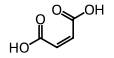
IUPAC name: (Z)-but-2-enedioic acid
Also called cis-butenedioic acid, toxilic acid
 WarningHarmful if swallowed · Causes skin irritation · May cause an allergic skin reaction · Causes serious eye irritation · May cause respiratory irritation
Names and identifiers
- IUPAC name
- (Z)-but-2-enedioic acid
- Synonyms
- cis-butenedioic acid, toxilic acid, Toxilic acid
+ 36 more
Maleinic acid, Malenic acid, (2Z)-but-2-enedioic acid, (Z)-Butenedioic acid, cis-1,2-Ethylenedicarboxylic acid, 2-Butenedioic acid (Z)-, 2-Butenedioic acid (2Z)-, (Z)-2-Butenedioic acid, Kyselina maleinova, Butenedioic acid, (Z)-, (Z)-but-2-enedioic acid, cis-2-Butenedioic acid, 1,2-Ethylenedicarboxylic acid, (Z), H2male, (2Z)-2-Butenedioic acid, DTXSID8021517, cis-but-2-enedioic acid, Scotchbond Multipurpose Etchant, 91XW058U2C, NSC-25940, DTXCID201517, CHEBI:18300, NSC25940, But-2-enedioic acid, RefChem:5977, 203-742-5, maleate, 2-Butenedioic acid, (Z)-, CCRIS 1115, HSDB 666, Malezid CM, MFCD00063177, AI3-01002, (2Z)but-2-enedioic acid, (Z)-2-Butenedioate, MAE
- Molecular formula
- C4H4O4
- Empirical formula
- CHO
- Molecular weight
- 116.07 g/mol
- Exact mass
- 116.01096
- CAS number
- 110-16-7
- PubChem CID
- 444266
- Canonical SMILES
- C(=CC(=O)O)C(=O)O
- Isomeric SMILES
- C(=C\C(=O)O)\C(=O)O
- InChI
- InChI=1S/C4H4O4/c5-3(6)1-2-4(7)8/h1-2H,(H,5,6)(H,7,8)/b2-1-
- InChIKey
- VZCYOOQTPOCHFL-UPHRSURJSA-N
- Molfile
Names, InChI and the identifiers from PubChem, retrieved 2026-10-14.
Physical properties
- Appearance
- Colorless crystals[4]
4 values
From Hazardous Substances Data Bank (HSDB), the most authoritative source here.
Value As written Source – Maleic acid is a colorless crystalline solid having a faint odor. It is combustible though it may take some effort to ignite. It is soluble in water. It is used to make other chemicals and for dyeing and finishing naturally occurring fibers. [1] CAMEO Chemicals – Dry Powder; Dry Powder; Large Crystals; Liquid [2] EPA Chemical Data Reporting (CDR) – WHITE CRYSTALS. [3] ILO-WHO International Chemical Safety Cards (ICSCs) –shown Colorless crystals [4] Hazardous Substances Data Bank (HSDB)cites Lewis, R.J. Sr.; Hawley's Condensed Chemical Dictionary 15th Edition. John Wiley & Sons, Inc. New York, NY 2007., p. 782 - Melting point
- 131 °C[3]
3 values
3 of 3 sources agree on it (most common value).
Value As written Source 130 to 131 °C 266 to 268 °F (NTP, 1992) [1] CAMEO Chemicalscites National Toxicology Program, Institute of Environmental Health Sciences, National Institutes of Health (NTP). 1992. National Toxicology Program Chemical Repository Database. Research Triangle Park, North Carolina. 132.5 °C 132.5 °C (OECD Guideline 102 (Melting point / Melting Range)) [4] Hazardous Substances Data Bank (HSDB)cites ECHA; Search for Chemicals. Maleic Acid (CAS 110-16-7) Registered Substances Dossier. European Chemical Agency. Available from, as of Mar 12, 2015: https://echa.europa.eu/ 131 °Cshown 131 °C [3] ILO-WHO International Chemical Safety Cards (ICSCs) - Boiling point
- 135 °C (275 °F) at 760 mmHg (decomposes) (NTP, 1992)[1]
- Density
- 1.59 @ 20°C[5]
3 values
3 of 3 sources agree on it (most common value).
Value As written Source – 1.59 at 68 °F (USCG, 1999) - Denser than water [1] CAMEO Chemicalscites U.S. Coast Guard. 1999. Chemical Hazard Response Information System (CHRIS) - Hazardous Chemical Data. Commandant Instruction 16465.12C. Washington, D.C.: U.S. Government Printing Office. – Relative density (water = 1): 1.59 [3] ILO-WHO International Chemical Safety Cards (ICSCs) –shown 1.59 @ 20°C [5] PAC Chemical Database, U.S. Department of Energy - Solubility in water
- Solubility in water, g/100ml at 25 °C: 78 (soluble)[3]
6 values
From ILO-WHO International Chemical Safety Cards (ICSCs), the most authoritative source here.
Value As written Source – greater than or equal to 100 mg/mL at 66 °F (NTP, 1992) [1] CAMEO Chemicalscites National Toxicology Program, Institute of Environmental Health Sciences, National Institutes of Health (NTP). 1992. National Toxicology Program Chemical Repository Database. Research Triangle Park, North Carolina. – In water, 788 g/L at 25 °C, 3926 g/L at 97.5 °C [4] Hazardous Substances Data Bank (HSDB)cites Verschueren, K. Handbook of Environmental Data on Organic Chemicals. Volumes 1-2. 4th ed. John Wiley & Sons. New York, NY. 2001, p. 1396 – 79.000 lb/100 lb water at 77 °F [4] Hazardous Substances Data Bank (HSDB)cites U.S. Coast Guard, Department of Transportation. CHRIS - Hazardous Chemical Data. Volume II. Washington, D.C.: U.S. Government Printing Office, 1984-5. – In water, 441,000 mg/L at 25 °C [4] Hazardous Substances Data Bank (HSDB)cites Yalkowsky, S.H., He, Yan, Jain, P. Handbook of Aqueous Solubility Data Second Edition. CRC Press, Boca Raton, FL 2010, p. 86 – For more Solubility (Complete) data for MALEIC ACID (7 total), please visit the HSDB record page. [4] Hazardous Substances Data Bank (HSDB) –shown Solubility in water, g/100ml at 25 °C: 78 (soluble) [3] ILO-WHO International Chemical Safety Cards (ICSCs) - log P
- -0.5[3]
2 values
Sources disagree; from ILO-WHO International Chemical Safety Cards (ICSCs), the most authoritative.
Value As written Source – log Kow = -0.48 [4] Hazardous Substances Data Bank (HSDB)cites Sangster J; LOGKOW Databank. Sangster Res Lab Montreal Quebec, Canada (1994) –shown -0.5 [3] ILO-WHO International Chemical Safety Cards (ICSCs) - pKa
- pKa1 = 1.94, pKa2 = 6.22 at 25 °C (OECD Guideline 105)[4]
- Vapor pressure
- 0.0000359 [mmHg] @25 °C[5]
3 values
2 of 3 sources agree on it (most common value).
Value As written Source 0.0000134 mmHg 1.34X10⁻⁵ mm Hg at 25 °C (OECD Guideline 104 (Vapor Pressure Curve)) [4] Hazardous Substances Data Bank (HSDB)cites ECHA; Search for Chemicals. Maleic Acid (CAS 110-16-7) Registered Substances Dossier. European Chemical Agency. Available from, as of Mar 12, 2015: https://echa.europa.eu/ 0.000036 mmHg Vapor pressure, Pa at 25 °C: 0.0048 [3] ILO-WHO International Chemical Safety Cards (ICSCs) 0.0000359 mmHgshown 0.0000359 [mm Hg] @25 °C [5] PAC Chemical Database, U.S. Department of Energy 1 more value was reported but failed the checks (unreadable or out of range), so it is not shown.
- Flash point
- 127 °C[3]
Each value as its source reports it, with the source's number after it (listed under References). Where several sources report a property, the row shows the value most of them agree on, the rule the app uses; open the values to see every one.
Calculated
- Heavy atoms
- 8
- Rings
- 0
- Aromatic rings
- 0
- Fraction sp³ carbons (Fsp3)
- 0
- H-bond donors
- 2
- H-bond acceptors
- 2 computed here · PubChem 4
- Rotatable bonds
- 2
- TPSA (Ų)
- 74.6
- Formal charge
- 0
- XLogP3
- -0.3 PubChem
- Complexity
- 119 PubChem
- Stereocenters
- None
- Double-bond geometry
- C4=C5: Z
- Point group
- C2 of one 3D conformer with its hydrogens, by Athanor’s engine (as in the app)
Elemental analysis
- C41.39%
- H3.47%
- O55.13%
Isotope pattern
Each peak is a nominal mass with its abundance-weighted exact mass, as a percentage of the tallest, from IUPAC natural isotope abundances.
Computed from the structure with RDKit 2026.09 when this page was built, beside PubChem's own computed values from its record; where the two differ, both are shown.
Predicted
- log P
- -0.29 Crippen (Wildman and Crippen 1999)
- log S (water solubility)
- -0.25 ESOL (Delaney 2004), log mol/L
- Synthetic accessibility
- 2.11 SA score, 1 easy to 10 hard (Ertl and Schuffenhauer 2009)
Drug-likeness: Lipinski’s rule of five
- Molecular weight ≤ 500: 116.07
- log P ≤ 5 (Crippen): -0.29
- H-bond donors ≤ 5: 2
- H-bond acceptors ≤ 10: 2
Passes all four rules.
¹³C NMR shifts, predicted
Predictions, not measurements; each names its method. A measured log P, where a source reports one, is under Physical properties.
Safety
Warning
Harmonized EU classification (CLP Annex VI). Source [6].
- Harmful or irritant
- H302Harmful if swallowed
- H315Causes skin irritation
- H317May cause an allergic skin reaction
- H319Causes serious eye irritation
- H335May cause respiratory irritation
Precautionary statements: P261, P264, P264+P265, P270, P271, P272, P280, P301+P317, P302+P352, P304+P340, P305+P351+P338, P319, P321, P330, P332+P317, P333+P317, P337+P317, P362+P364, P403+P233, P405, P501
View all classifications (5)
- [6] Regulation (EC) No 1272/2008 of the European Parliament and of the Council · WarningH302, H315, H317, H319, H335
- [7] European Chemicals Agency (ECHA)This chemical does not meet GHS hazard criteria for 0.2% (3 of 1974) of reports.
- [7] European Chemicals Agency (ECHA) · 1,974 reports · WarningH302, H312, H315, H317, H319, H335
- [7] European Chemicals Agency (ECHA) · 18 reports · DangerH315, H317, H318, H319, H335
- [4] Hazardous Substances Data Bank (HSDB) · WarningH302, H315, H317, H319, H335, H402
First aid
- Eyes: First check the victim for contact lenses and remove if present. Flush victim's eyes with water or normal saline solution for 20 to 30 minutes while simultaneously calling a hospital or poison control center. Do not put any ointments, oils, or medication in the victim's eyes without specific instructions from a physician. Immediately transport the victim after flushing eyes to a hospital even if no symptoms (such as redness or irritation) develop. Skin: Immediately flood affected skin with water while removing and isolating all contaminated clothing.[1]
- Fresh air, rest. Refer for medical attention.[3]
- Wear protective gloves when administering first aid. Remove contaminated clothes. Rinse skin with plenty of water or shower.[3]
- First rinse with plenty of water for several minutes (remove contact lenses if easily possible), then refer for medical attention.[3]
Storage
Incompatibilities
- Oxidizing agents[4]
Safety data sheets on the supplier’s page: Chemenu Inc., Accel Scientific, LGC Standards.
Always read the supplier’s safety data sheet before working with it.
Spectra
- NMRHazardous Substances Data Bank (HSDB) · NMRShiftDB
- 1H NMRHuman Metabolome Database (HMDB) (Varian · 500 MHz · Water) · SpectraBase
- 13C NMRSpectraBase
- 1H-1H NMRHuman Metabolome Database (HMDB)
- 1H-13C NMRHuman Metabolome Database (HMDB) (Bruker · 600 MHz · Water)
- GC-MSHuman Metabolome Database (HMDB) (GC-MS) · Human Metabolome Database (HMDB) (EI-B · positive) · Human Metabolome Database (HMDB) (EI-B · positive) · Human Metabolome Database (HMDB) (EI-B · positive) · Human Metabolome Database (HMDB) (GC-EI-TOF · positive) · Human Metabolome Database (HMDB) (GC-MS)
- MS-MSHuman Metabolome Database (HMDB) (Quattro_QQQ · Negative) · Human Metabolome Database (HMDB) (Negative) · Human Metabolome Database (HMDB) (Negative) · Human Metabolome Database (HMDB) (Negative) · Human Metabolome Database (HMDB) (Quattro_QQQ · Negative) · Human Metabolome Database (HMDB) (Quattro_QQQ · Negative)
- LC-MSMassBank Europe (API3000, Applied Biosystems · LC-ESI-QQ · NEGATIVE) · MassBank Europe (API3000, Applied Biosystems · LC-ESI-QQ · NEGATIVE) · MassBank Europe (API3000, Applied Biosystems · LC-ESI-QQ · NEGATIVE) · MassBank Europe (API3000, Applied Biosystems · LC-ESI-QQ · NEGATIVE) · MassBank Europe (API3000, Applied Biosystems · LC-ESI-QQ · NEGATIVE) · MassBank Europe (Q-Exactive Orbitrap, Thermo Scientfic; Ultimate 3000 HPLC, Thermo Scientfic · LC-ESI-QFT · POSITIVE)
- Other MSHazardous Substances Data Bank (HSDB) · MassBank Europe (HITACHI RMU-6L · EI-B · POSITIVE) · MassBank Europe (HITACHI M-80A · EI-B · POSITIVE) · MassBank Europe (GCMS-2010 Plus, Shimadzu · EI-B · POSITIVE) · MassBank of North America (MoNA) (TQD, Waters · Flow-injection QqQ/MS · ESI) · MassBank of North America (MoNA) (TQD, Waters · Flow-injection QqQ/MS · ESI)
- UVHazardous Substances Data Bank (HSDB)
- IRHazardous Substances Data Bank (HSDB)
- FTIRSpectraBase (PERKIN-ELMER 1710 · NUJOL MULL)
- ATR-IRSpectraBase (Bio-Rad FTS · ATR-Neat (DurasamplIR II))
- RamanSpectraBase
Experimental spectra held by these sources; each link opens the source's own record.
Literature
Reading PubChem, OpenAlex and GSRS…
Bioactivity
Reading ChEMBL…
References
- [1]CAMEO Chemicals · Public domain (NOAA) · via PubChem · retrieved 2026-10-14
- [2]EPA Chemical Data Reporting (CDR) · Public domain (US EPA) · via PubChem · retrieved 2026-10-14
- [3]ILO-WHO International Chemical Safety Cards (ICSCs) · CC BY 4.0 · via PubChem · retrieved 2026-10-14
- [4]Hazardous Substances Data Bank (HSDB) · Public domain (US NLM) · via PubChem · retrieved 2026-10-14
- [5]PAC Chemical Database, U.S. Department of Energy · Public domain (US DOE) · via PubChem · retrieved 2026-10-14
- [6]Regulation (EC) No 1272/2008 of the European Parliament and of the Council · EU reuse policy, CC BY 4.0 · via PubChem · retrieved 2026-10-14
- [7]European Chemicals Agency (ECHA) · ECHA legal notice: reuse with acknowledgement · via PubChem · retrieved 2026-10-14
- [8]NMRShiftDB · Linked only · via PubChem · retrieved 2026-10-14
- [9]Human Metabolome Database (HMDB) · Linked only · via PubChem · retrieved 2026-10-14
- [10]SpectraBase · Linked only · via PubChem · retrieved 2026-10-14
- [11]MassBank Europe · Linked only · via PubChem · retrieved 2026-10-14
- [12]MassBank of North America (MoNA) · CC BY 4.0 · via PubChem · retrieved 2026-10-14
- [13]NIST Mass Spectrometry Data Center · Linked only · via PubChem · retrieved 2026-10-14
- ·Calculated values: computed by Athanor with RDKit 2026.09 from the structure.
- ·Literature on PubChem
Data last updated 2026-10-14.