
D-Erythrulose
Athanor · official
C4H8O4 · 120.1 g/mol
IUPAC name: (3R)-1,3,4-trihydroxybutan-2-one
Also called erythrulose, self-tanner
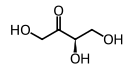
Names and identifiers
- IUPAC name
- (3R)-1,3,4-trihydroxybutan-2-one
- Synonyms
- erythrulose, self-tanner, D-glycero-Tetrulose
+ 27 more
Erythrulose, D-, D-Threulose, Erythrulose, (-)-, D-Glycero-2-tetrulose, 09058VOU0Z, 2-Butanone, 1,3,4-trihydroxy-, (3R)-, CHEBI:16023, DTXSID80420085, RefChem:130519, GlyTouCan:G22000SU, DTXCID00370932, G22000SU, (3R)-1,3,4-trihydroxybutan-2-one;D-erythrulose;D-glycero-tetrulose, (R)-1,3,4-Trihydroxybutan-2-one, (3R)-1,3,4-trihydroxybutan-2-one, D-Erythrulose (1M in Water), 90%, D-Erythrulose (~0.3 M in Water, ~90%), UNII-09058VOU0Z, D-Erythrulose (1M in Water), SCHEMBL15478, D-Erythrulose - 1M Aqueous solution, AKOS006372788, ME07933, MD178896, DB-297147, C02022, Q417337
- Molecular formula
- C4H8O4
- Empirical formula
- CH2O
- Molecular weight
- 120.1 g/mol
- Exact mass
- 120.04226
- CAS number
- 533-50-6
- PubChem CID
- 5460177
- Canonical SMILES
- C(C(C(=O)CO)O)O
- Isomeric SMILES
- C([C@H](C(=O)CO)O)O
- InChI
- InChI=1S/C4H8O4/c5-1-3(7)4(8)2-6/h3,5-7H,1-2H2/t3-/m1/s1
- InChIKey
- UQPHVQVXLPRNCX-GSVOUGTGSA-N
- Molfile
Names, InChI and the identifiers from PubChem, retrieved 2026-10-14.
Calculated
- Heavy atoms
- 8
- Rings
- 0
- Aromatic rings
- 0
- Fraction sp³ carbons (Fsp3)
- 0.75
- H-bond donors
- 3
- H-bond acceptors
- 4
- Rotatable bonds
- 3
- TPSA (Ų)
- 77.8
- Formal charge
- 0
- XLogP3
- -2 PubChem
- Complexity
- 80 PubChem
- Stereocenters
- 1 definedCIP: C3: R
- Double-bond geometry
- None specified
- Point group
- C1 of one 3D conformer with its hydrogens, by Athanor’s engine (as in the app)
Elemental analysis
- C40.00%
- H6.71%
- O53.28%
Isotope pattern
Each peak is a nominal mass with its abundance-weighted exact mass, as a percentage of the tallest, from IUPAC natural isotope abundances.
Computed from the structure with RDKit 2026.09 when this page was built, beside PubChem's own computed values from its record; where the two differ, both are shown.
Predicted
- log P
- -2.1 Crippen (Wildman and Crippen 1999)
- log S (water solubility)
- 0.94 ESOL (Delaney 2004), log mol/L
- Synthetic accessibility
- 3.38 SA score, 1 easy to 10 hard (Ertl and Schuffenhauer 2009)
Drug-likeness: Lipinski’s rule of five
- Molecular weight ≤ 500: 120.1
- log P ≤ 5 (Crippen): -2.1
- H-bond donors ≤ 5: 3
- H-bond acceptors ≤ 10: 4
Passes all four rules.
¹³C NMR shifts, predicted
Predictions, not measurements; each names its method. A measured log P, where a source reports one, is under Physical properties.
Safety
No GHS hazard classification was found in the sources.
Safety data sheets on the supplier’s page: Molport, Clinivex, Chemenu Inc..
Always read the supplier’s safety data sheet before working with it.
Literature
Reading PubChem, OpenAlex and GSRS…
Bioactivity
Reading ChEMBL…
References
- ·Calculated values: computed by Athanor with RDKit 2026.09 from the structure.
- ·Literature on PubChem
Data last updated 2026-10-14.