
Glycerol
Athanor · official
C3H8O3 · 92.09 g/mol
IUPAC name: propane-1,2,3-triol
Also called glycerin, glycerine, E422, propane-1,2,3-triol, glyceritol
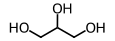
Names and identifiers
- IUPAC name
- propane-1,2,3-triol
- Synonyms
- glycerin, glycerine, E422
+ 39 more
propane-1,2,3-triol, glyceritol, Glycerine, 1,2,3-Propanetriol, Glycyl alcohol, Trihydroxypropane, Glyceritol, Osmoglyn, 1,2,3-trihydroxypropane, Glyrol, Glysanin, Grocolene, Ophthalgan, Glycerinum, Vitrosupos, Dagralax, Glycerin, anhydrous, Synthetic glycerin, Optim, Moon, Synthetic glycerine, Incorporation factor, 90 Technical glycerine, Citifluor AF 2, Glycerolum, Glicerol, FEMA No. 2525, Tryhydroxypropane, Glycerin,anhydrous, Clyzerin, wasserfrei, Glicerina, DTXSID9020663, Monoctanoin Component D, PDC6A3C0OX, NSC-9230, Glycerol 85%, INS NO.422, CHEBI:17754, INS-422
- Molecular formula
- C3H8O3
- Empirical formula
- C3H8O3
- Molecular weight
- 92.09 g/mol
- Exact mass
- 92.04734
- CAS number
- 56-81-5
- PubChem CID
- 753
- Canonical SMILES
- C(C(CO)O)O
- Isomeric SMILES
- C(C(CO)O)O
- InChI
- InChI=1S/C3H8O3/c4-1-3(6)2-5/h3-6H,1-2H2
- InChIKey
- PEDCQBHIVMGVHV-UHFFFAOYSA-N
- Molfile
Names, InChI and the identifiers from PubChem, retrieved 2026-10-14.
Physical properties
- Appearance
- Clear, colorless syrupy liquid[6]
7 values
From Hazardous Substances Data Bank (HSDB), the most authoritative source here.
Value As written Source – Glycerine appears as a colorless to brown colored liquid. Combustible but may require some effort to ignite. [1] CAMEO Chemicals – Dry Powder; Large Crystals; Gas Vapor; Liquid; Wet Solid; Other Solid; Liquid; Other Solid; Dry Powder; Liquid; Other Solid; Large Crystals; Wet Solid; Large Crystals; Liquid; Liquid; Other Solid; CBI; Large Crystals [2] EPA Chemical Data Reporting (CDR) – HYGROSCOPIC VISCOUS COLOURLESS LIQUID. [3] ILO-WHO International Chemical Safety Cards (ICSCs) – Clear, colorless, odorless, syrupy liquid or solid (below 64 °F). [4] Occupational Safety and Health Administration (OSHA) – Clear, colorless, odorless, syrupy liquid or solid (below 64 °F). [Note: The solid form melts above 64 °F but the liquid form freezes at a much lower temperature.] [5] The National Institute for Occupational Safety and Health (NIOSH) –shown Clear, colorless syrupy liquid [6] Hazardous Substances Data Bank (HSDB)cites Lewis, R.J. Sr.; Hawley's Condensed Chemical Dictionary 15th Edition. John Wiley & Sons, Inc. New York, NY 2007., p. 611 – Clear, colorless, ... syrupy liquid or solid (below 64 degrees F) [Note: The solid form melts above 64 degrees F but the liquid form freezes at a much lower temperature]. [6] Hazardous Substances Data Bank (HSDB)cites NIOSH. NIOSH Pocket Guide to Chemical Hazards. DHHS (NIOSH) Publication No. 97-140. Washington, D.C. U.S. Government Printing Office, 1997., p. 152 - Odor
- Odorless[6]
- Melting point
- 18.1 °C[7]
5 values
5 of 5 sources agree on it (most common value).
Value As written Source 18 °C 64 °F (NTP, 1992) [1] CAMEO Chemicalscites National Toxicology Program, Institute of Environmental Health Sciences, National Institutes of Health (NTP). 1992. National Toxicology Program Chemical Repository Database. Research Triangle Park, North Carolina. 18 °C 18 °C [3] ILO-WHO International Chemical Safety Cards (ICSCs) 18 °C 64 °F [4] Occupational Safety and Health Administration (OSHA) 18.1 °Cshown 18.1 °C [7] PAC Chemical Database, U.S. Department of Energy 18 °C 64 °F [5] The National Institute for Occupational Safety and Health (NIOSH) - Boiling point
- 290 °C[3]
5 values
5 of 5 sources agree on it (most common value).
Value As written Source 290 °C 554 °F at 760 mmHg (decomposes) (NTP, 1992) [1] CAMEO Chemicalscites National Toxicology Program, Institute of Environmental Health Sciences, National Institutes of Health (NTP). 1992. National Toxicology Program Chemical Repository Database. Research Triangle Park, North Carolina. 290 °Cshown 290 °C [3] ILO-WHO International Chemical Safety Cards (ICSCs) 290 °C 554 °F (decomposes) [4] Occupational Safety and Health Administration (OSHA) 290 °C 290 °C @760 [mm Hg] [7] PAC Chemical Database, U.S. Department of Energy 290 °C 554 °F (Decomposes) [5] The National Institute for Occupational Safety and Health (NIOSH) - Density
- 1.2613 @ 20°C[7]
5 values
5 of 5 sources agree on it (most common value).
Value As written Source – 1.261 at 68 °F (USCG, 1999) - Denser than water [1] CAMEO Chemicalscites U.S. Coast Guard. 1999. Chemical Hazard Response Information System (CHRIS) - Hazardous Chemical Data. Commandant Instruction 16465.12C. Washington, D.C.: U.S. Government Printing Office. – Relative density (water = 1): 1.26 [3] ILO-WHO International Chemical Safety Cards (ICSCs) – 1.26 [4] Occupational Safety and Health Administration (OSHA) –shown 1.2613 @ 20°C [7] PAC Chemical Database, U.S. Department of Energy – 1.26 [5] The National Institute for Occupational Safety and Health (NIOSH) 3 more values were reported but failed the checks (unreadable or out of range), so they are not shown.
- Solubility in water
- Solubility in water: miscible[3]
7 values
From ILO-WHO International Chemical Safety Cards (ICSCs), the most authoritative source here.
Value As written Source – greater than or equal to 100 mg/mL at 64 °F (NTP, 1992) [1] CAMEO Chemicalscites National Toxicology Program, Institute of Environmental Health Sciences, National Institutes of Health (NTP). 1992. National Toxicology Program Chemical Repository Database. Research Triangle Park, North Carolina. – Miscible with ethanol; slightly soluble in ethyl ether; insoluble in benzene, carbon tetrachloride, chloroform, carbon disulfide, petroleum ether [6] Hazardous Substances Data Bank (HSDB)cites Lide, D.R., G.W.A. Milne (eds.). Handbook of Data on Organic Compounds. Volume I. 3rd ed. CRC Press, Inc. Boca Raton ,FL. 1994., p. V2: 4386 – SOLUBILITY IN ACETONE: 1 G IN 15 ML [6] Hazardous Substances Data Bank (HSDB)cites Osol, A. and J.E. Hoover, et al. (eds.). Remington's Pharmaceutical Sciences. 15th ed. Easton, Pennsylvania: Mack Publishing Co., 1975., p. 1255 – Insoluble in fixed and volatile oils [6] Hazardous Substances Data Bank (HSDB)cites Lewis, R.J. Sr.; Hawley's Condensed Chemical Dictionary 15th Edition. John Wiley & Sons, Inc. New York, NY 2007., p. 611 – In water, 5.296X10+6 mg/L at 25 °C [6] Hazardous Substances Data Bank (HSDB)cites Yalkowsky, S.H., He, Yan., Handbook of Aqueous Solubility Data: An Extensive Compilation of Aqueous Solubility Data for Organic Compounds Extracted from the AQUASOL dATAbASE. CRC Press LLC, Boca Raton, FL. 2003., p. 79 –shown Solubility in water: miscible [3] ILO-WHO International Chemical Safety Cards (ICSCs) – Miscible [5] The National Institute for Occupational Safety and Health (NIOSH) - log P
- -1.76[3]
2 values
2 of 2 sources agree on it (most common value).
Value As written Source – log Kow = -1.76 [6] Hazardous Substances Data Bank (HSDB)cites Hansch, C., Leo, A., D. Hoekman. Exploring QSAR - Hydrophobic, Electronic, and Steric Constants. Washington, DC: American Chemical Society., 1995., p. 7 –shown -1.76 [3] ILO-WHO International Chemical Safety Cards (ICSCs) - pKa
- pKa = 14.4[6]
- Vapor pressure
- VP: 0.0025 MM HG AT 50 °C[6]
6 values
2 of 4 sources agree on it (most common value).
Value As written Source 0.0025 mmHg 0.0025 mmHg at 122 °F [1] CAMEO Chemicalscites National Toxicology Program, Institute of Environmental Health Sciences, National Institutes of Health (NTP). 1992. National Toxicology Program Chemical Repository Database. Research Triangle Park, North Carolina. 40 mmHg 40 mmHg at 388 °F (NTP, 1992) [1] CAMEO Chemicalscites National Toxicology Program, Institute of Environmental Health Sciences, National Institutes of Health (NTP). 1992. National Toxicology Program Chemical Repository Database. Research Triangle Park, North Carolina. 0.0025 mmHgshown VP: 0.0025 MM HG AT 50 °C [6] Hazardous Substances Data Bank (HSDB)cites Sax, N.I. Dangerous Properties of Industrial Materials. 6th ed. New York, NY: Van Nostrand Reinhold, 1984., p. 1479 0.000168 mmHg 1.68X10⁻⁴ mm Hg at 25 °C [6] Hazardous Substances Data Bank (HSDB)cites Daubert, T.E., R.P. Danner. Physical and Thermodynamic Properties of Pure Chemicals Data Compilation. Washington, D.C.: Taylor and Francis, 1989. 0.000075 mmHg Vapor pressure, Pa at 25 °C: 0.01 [3] ILO-WHO International Chemical Safety Cards (ICSCs) 0.003 mmHg 0.003 mmHg at 122 °F [4] Occupational Safety and Health Administration (OSHA) 1 more value was reported but failed the checks (unreadable or out of range), so it is not shown.
- Flash point
- 160 °C (320 °F, NTP 1992)[1]
5 values
3 of 5 sources agree on it (most common value).
Value As written Source 160 °Cshown 320 °F (NTP, 1992) [1] CAMEO Chemicalscites National Toxicology Program, Institute of Environmental Health Sciences, National Institutes of Health (NTP). 1992. National Toxicology Program Chemical Repository Database. Research Triangle Park, North Carolina. 177 °C 177 °C (Open cup) [6] Hazardous Substances Data Bank (HSDB)cites International Labour Office. Encyclopedia of Occupational Health and Safety. Vols. I&II. Geneva, Switzerland: International Labour Office, 1983., p. 971 176 °C 176 °C c.c. [3] ILO-WHO International Chemical Safety Cards (ICSCs) 160 °C 320 °F [4] Occupational Safety and Health Administration (OSHA) 160 °C 320 °F [5] The National Institute for Occupational Safety and Health (NIOSH) - Autoignition temperature
- 393 °C[3]
3 values
2 of 3 sources agree on it (most common value).
Value As written Source 370 °C 698 °F (USCG, 1999) [1] CAMEO Chemicalscites U.S. Coast Guard. 1999. Chemical Hazard Response Information System (CHRIS) - Hazardous Chemical Data. Commandant Instruction 16465.12C. Washington, D.C.: U.S. Government Printing Office. 393 °C 739 °F [6] Hazardous Substances Data Bank (HSDB)cites Lewis, R.J., Sr (Ed.). Hawley's Condensed Chemical Dictionary. 12th ed. New York, NY: Van Nostrand Rheinhold Co., 1993, p. 566 393 °Cshown 393 °C [3] ILO-WHO International Chemical Safety Cards (ICSCs)
Each value as its source reports it, with the source's number after it (listed under References). Where several sources report a property, the row shows the value most of them agree on, the rule the app uses; open the values to see every one.
Calculated
- Heavy atoms
- 6
- Rings
- 0
- Aromatic rings
- 0
- Fraction sp³ carbons (Fsp3)
- 1
- H-bond donors
- 3
- H-bond acceptors
- 3
- Rotatable bonds
- 2
- TPSA (Ų)
- 60.7
- Formal charge
- 0
- XLogP3
- -1.8 PubChem
- Complexity
- 25 PubChem
- Stereocenters
- None
- Double-bond geometry
- None specified
- Point group
- C1 of one 3D conformer with its hydrogens, by Athanor’s engine (as in the app)
Elemental analysis
- C39.13%
- H8.76%
- O52.12%
Isotope pattern
Each peak is a nominal mass with its abundance-weighted exact mass, as a percentage of the tallest, from IUPAC natural isotope abundances.
Computed from the structure with RDKit 2026.09 when this page was built, beside PubChem's own computed values from its record; where the two differ, both are shown.
Predicted
- log P
- -1.67 Crippen (Wildman and Crippen 1999)
- log S (water solubility)
- 0.77 ESOL (Delaney 2004), log mol/L
- Synthetic accessibility
- 2.43 SA score, 1 easy to 10 hard (Ertl and Schuffenhauer 2009)
Drug-likeness: Lipinski’s rule of five
- Molecular weight ≤ 500: 92.09
- log P ≤ 5 (Crippen): -1.67
- H-bond donors ≤ 5: 3
- H-bond acceptors ≤ 10: 3
Passes all four rules.
¹³C NMR shifts, predicted
Predictions, not measurements; each names its method. A measured log P, where a source reports one, is under Physical properties.
Safety
This chemical does not meet GHS hazard criteria for 98.3% (5522 of 5617) of all reports.[8]
Exposure limits
- PEL-TWA (8-Hour Time Weighted Average): 15 mg/m³ (total dust), 5 mg/m³ (respirable)[4]
- PEL: TWA 15 mg/m3 (total) TWA 5 mg/m3 (resp) See Appendix G[5]
- REL: See Appendix D[5]
- TLV-TWA (Time Weighted Average): See Appendix B: Particles (insoluble or poorly soluble) Not Otherwise Specified (PNOS)[4]
- IDLH: N.D. See: IDLH index[5]
- MAK (Maximale Arbeitsplatz Konzentration): (inhalable fraction): 200 mg/m[3]
First aid
- Eyes: First check the victim for contact lenses and remove if present. Flush victim's eyes with water or normal saline solution for 20 to 30 minutes while simultaneously calling a hospital or poison control center. Do not put any ointments, oils, or medication in the victim's eyes without specific instructions from a physician. Immediately transport the victim after flushing eyes to a hospital even if no symptoms (such as redness or irritation) develop. Skin: Immediately flood affected skin with water while removing and isolating all contaminated clothing.[1]
- (General first aid procedures) Eye: Irrigate immediately - If this chemical contacts the eyes, immediately wash (irrigate) the eyes with large amounts of water, occasionally lifting the lower and upper lids. Get medical attention immediately. Skin: Water wash - If this chemical contacts the skin, wash the contaminated skin with water. Breathing: Fresh air[5]
- Fresh air, rest.[3]
- Rinse skin with plenty of water or shower. Rinse skin with plenty of water or shower.[3]
Storage
- Separated from strong oxidants.[3]
- Glycerol should preferably be stored at 40 - 60 °C under nitrogen blanketing. It is not corrosive and presents little risk of ignition because of its high flash point. Highly concentrated glycerol does not corrode steel, but storage tanks of carbon steel must be protected by surface coating to prevent rusting by residual moisture. Glycerol is therefore usually stored in tanks of stainless steel or aluminum.[6]
- Glycerin oral solution should be stored in tight containers at a temp less than 40 °C, perferably between 15-30 °C; freezing should be avoided. Glycerin ophthalmic soln should be protected from light and stored in tight glass or plastic containers. The ophthalmic soln should be ... Discarded 6 mo after the dropper is first placed in the soln.[6]
- Glycerin rectal suppositories should preferably be stored at less than 25 °C.[6]
Incompatibilities
- Exothermic interaction of granular (sodium) hydride with undiluted (viscous) glycerol with inadequate stirring caused charring to occur.[6]
- Can react violently with acetic anhydride, aniline + nitrobenzene, Ca(OCl)2, CrO3, Cr2O3, F2 + PbO, phosphorus triiodide, ethylene oxide + heat, KMnO4, K2O2, AgClO4, Na2O2, NaH. Energetic reaction with sodium hydroxide.[6]
- Strong oxidizers (e.g., chromium trioxide, potassium chlorate, potassium permanganate) [Note: Hygroscopic (i.e., absorbs moisture from the air)].[6]
- Strong oxidizers (e.g., chromium trioxide, potassium chlorate, potassium permanganate) [Note: Hygroscopic (i.e., absorbs moisture from the air).][5]
Safety data sheets on the supplier’s page: Alfa Chemistry, Thermo Fisher Scientific, Sigma-Aldrich.
Always read the supplier’s safety data sheet before working with it.
Spectra
- NMRHazardous Substances Data Bank (HSDB) · NMRShiftDB
- 1H NMRHuman Metabolome Database (HMDB) (Varian · 500 MHz · Water) · Human Metabolome Database (HMDB) (JEOL · 400 MHz · DMSO-d6) · Human Metabolome Database (HMDB) (Bruker · D2O) · SpectraBase (BRUKER AC-300)
- 13C NMRHuman Metabolome Database (HMDB) (Bruker · 125 MHz · Water) · Human Metabolome Database (HMDB) (400 MHz · H2O) · Human Metabolome Database (HMDB) (JEOL · 22.53 MHz · DMSO-d6) · SpectraBase
- 1H-1H NMRHuman Metabolome Database (HMDB)
- 1H-13C NMRHuman Metabolome Database (HMDB) (Bruker · 600 MHz · Water)
- GC-MSHuman Metabolome Database (HMDB) (GC-MS) · Human Metabolome Database (HMDB) (EI-B · positive) · Human Metabolome Database (HMDB) (EI-B · positive) · Human Metabolome Database (HMDB) (GC-EI-TOF · positive) · Human Metabolome Database (HMDB) (GC-EI-TOF · positive) · Human Metabolome Database (HMDB) (GC-EI-TOF · positive)
- MS-MSHuman Metabolome Database (HMDB) (EI-B (HITACHI M-80) · Positive) · Human Metabolome Database (HMDB) (Quattro_QQQ · Positive)
- LC-MSMassBank Europe (Thermo Scientific Q-Exactive Focus · LC-ESI-ITFT · NEGATIVE) · MassBank Europe (Thermo Scientific Q-Exactive Focus · LC-ESI-ITFT · NEGATIVE) · MassBank Europe (Thermo Scientific Q-Exactive Focus · LC-ESI-ITFT · NEGATIVE) · MassBank Europe (Thermo Scientific Q-Exactive Focus · LC-ESI-ITFT · NEGATIVE) · MassBank Europe (Thermo Scientific Q-Exactive Focus · LC-ESI-ITFT · NEGATIVE) · MassBank Europe (Thermo Scientific Q-Exactive Focus · LC-ESI-ITFT · NEGATIVE)
- Other MSHazardous Substances Data Bank (HSDB) · MassBank Europe (HITACHI M-80 · EI-B · POSITIVE) · MassBank Europe (GCMS-2010 Plus, Shimadzu · EI-B · POSITIVE) · MassBank Europe (JMS-700, JEOL · FAB-BE · NEGATIVE) · MassBank Europe (JMS-700, JEOL · FAB-BE · POSITIVE) · MassBank of North America (MoNA) (TQD, Waters · Flow-injection QqQ/MS · ESI)
- UVHazardous Substances Data Bank (HSDB)
- IRHazardous Substances Data Bank (HSDB)
- FTIRSpectraBase (NEAT)
- ATR-IRSpectraBase (Bio-Rad FTS · ATR-Neat (DuraSamplIR II))
- Near IRSpectraBase (BRUKER IFS 88 · NIR Spectrometer= INSTRUMENT PARAMETERS=INST=BRUKER,RSN=6635,REO=2,CNM=HEI,ZFF=2)
- Vapor Phase IRSpectraBase (DIGILAB FTS-14 · Vapor Phase)
- RamanSpectraBase (Bio-Rad FTS 175C with Raman accessory · FT-Raman)
Experimental spectra held by these sources; each link opens the source's own record.
Literature
Reading PubChem, OpenAlex and GSRS…
Bioactivity
Reading ChEMBL…
References
- [1]CAMEO Chemicals · Public domain (NOAA) · via PubChem · retrieved 2026-10-14
- [2]EPA Chemical Data Reporting (CDR) · Public domain (US EPA) · via PubChem · retrieved 2026-10-14
- [3]ILO-WHO International Chemical Safety Cards (ICSCs) · CC BY 4.0 · via PubChem · retrieved 2026-10-14
- [4]Occupational Safety and Health Administration (OSHA) · Public domain (US DOL) · via PubChem · retrieved 2026-10-14
- [5]The National Institute for Occupational Safety and Health (NIOSH) · Public domain (US CDC) · via PubChem · retrieved 2026-10-14
- [6]Hazardous Substances Data Bank (HSDB) · Public domain (US NLM) · via PubChem · retrieved 2026-10-14
- [7]PAC Chemical Database, U.S. Department of Energy · Public domain (US DOE) · via PubChem · retrieved 2026-10-14
- [8]European Chemicals Agency (ECHA) · ECHA legal notice: reuse with acknowledgement · via PubChem · retrieved 2026-10-14
- [9]NMRShiftDB · Linked only · via PubChem · retrieved 2026-10-14
- [10]Human Metabolome Database (HMDB) · Linked only · via PubChem · retrieved 2026-10-14
- [11]SpectraBase · Linked only · via PubChem · retrieved 2026-10-14
- [12]MassBank Europe · Linked only · via PubChem · retrieved 2026-10-14
- [13]MassBank of North America (MoNA) · CC BY 4.0 · via PubChem · retrieved 2026-10-14
- [14]NIST Mass Spectrometry Data Center · Linked only · via PubChem · retrieved 2026-10-14
- ·Calculated values: computed by Athanor with RDKit 2026.09 from the structure.
- ·Literature on PubChem
Data last updated 2026-10-14.