
Anthracene
Athanor · official
C14H10 · 178.23 g/mol
Also called paranaphthalene
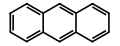


 DangerCauses skin irritation · Causes serious eye irritation · May cause cancer · Very toxic to aquatic life · Very toxic to aquatic life with long lasting effects
Names and identifiers
- IUPAC name
- anthracene
- Synonyms
- paranaphthalene, Paranaphthalene, Anthracin
+ 36 more
Tetra Olive N2G, Anthracen, DTXSID0023878, NSC 7958, p-Naphthalene, CHEBI:35298, AI3-00155, EH46A1TLD7, Sterilite hop defoliant, NSC7958, NSC-7958, DTXCID203878, RefChem:6382, 204-371-1, Anthracen [German], CCRIS 767, Anthraxcene, Anthrazen, HSDB 702, Acen, EINECS 204-371-1, MFCD00001240, WLN: L C666J, NCGC00163972-01, Anthracene, pure, C14315, Anthracene, analytical standard, AN3, CAS-120-12-7, Deuterated anthracene, UNII-EH46A1TLD7, acene, acenes, antracene, Azen, 9-Anthracene
- Molecular formula
- C14H10
- Empirical formula
- C7H5
- Molecular weight
- 178.23 g/mol
- Exact mass
- 178.07825
- CAS number
- 120-12-7
- PubChem CID
- 8418
- Canonical SMILES
- C1=CC=C2C=C3C=CC=CC3=CC2=C1
- Isomeric SMILES
- C1=CC=C2C=C3C=CC=CC3=CC2=C1
- InChI
- InChI=1S/C14H10/c1-2-6-12-10-14-8-4-3-7-13(14)9-11(12)5-1/h1-10H
- InChIKey
- MWPLVEDNUUSJAV-UHFFFAOYSA-N
- Molfile
Names, InChI and the identifiers from PubChem, retrieved 2026-10-14.
Physical properties
- Appearance
- Pale yellow leaves[5]
6 values
From Hazardous Substances Data Bank (HSDB), the most authoritative source here.
Value As written Source – Anthracene is a white to yellow solid with a weak aromatic odor. Sinks in water. (USCG, 1999) [1] CAMEO Chemicalscites U.S. Coast Guard. 1999. Chemical Hazard Response Information System (CHRIS) - Hazardous Chemical Data. Commandant Instruction 16465.12C. Washington, D.C.: U.S. Government Printing Office. – Other Solid [2] EPA Chemical Data Reporting (CDR) – WHITE CRYSTALS OR FLAKES. [3] ILO-WHO International Chemical Safety Cards (ICSCs) – White to yellow solid with a weak aromatic odor. [4] Occupational Safety and Health Administration (OSHA) – Yellow crystals with blue fluorescence [5] Hazardous Substances Data Bank (HSDB)cites Larranaga, M.D., Lewis, R.J. Sr., Lewis, R.A.; Hawley's Condensed Chemical Dictionary 16th Edition. John Wiley & Sons, Inc. Hoboken, NJ 2016., p. 98 –shown Pale yellow leaves [5] Hazardous Substances Data Bank (HSDB)cites Ashford, R.D. Ashford's Dictionary of Industrial Chemicals. London, England: Wavelength Publications Ltd., 1994., p. 91 - Odor
- Weak aromatic odor[5]
- Melting point
- 215.76 °C[6]
4 values
3 of 4 sources agree on it (most common value).
Value As written Source 216 to 218 °C 421 to 424 °F (NTP, 1992) [1] CAMEO Chemicalscites National Toxicology Program, Institute of Environmental Health Sciences, National Institutes of Health (NTP). 1992. National Toxicology Program Chemical Repository Database. Research Triangle Park, North Carolina. 218 °C 218 °C [3] ILO-WHO International Chemical Safety Cards (ICSCs) 216 to 218 °C 421-424 °F [4] Occupational Safety and Health Administration (OSHA) 215.8 °Cshown 215.76 °C [6] PAC Chemical Database, U.S. Department of Energy - Boiling point
- 339.9 °C @760 [mmHg][6]
5 values
3 of 4 sources agree on it (most common value).
Value As written Source 340 °C 644 °F at 760 mmHg (corrected) [1] CAMEO Chemicalscites National Toxicology Program, Institute of Environmental Health Sciences, National Institutes of Health (NTP). 1992. National Toxicology Program Chemical Repository Database. Research Triangle Park, North Carolina. 226.5 °C 439.7 °F at 53 mmHg, sublimes (NTP, 1992) [1] CAMEO Chemicalscites National Toxicology Program, Institute of Environmental Health Sciences, National Institutes of Health (NTP). 1992. National Toxicology Program Chemical Repository Database. Research Triangle Park, North Carolina. 342 °C 342 °C [3] ILO-WHO International Chemical Safety Cards (ICSCs) 340 °C 644 °F [4] Occupational Safety and Health Administration (OSHA) 339.9 °Cshown 339.9 °C @760 [mm Hg] [6] PAC Chemical Database, U.S. Department of Energy - Density
- 1.25-1.28 g/cm³[3]
4 values
4 of 4 sources agree on it (most common value).
Value As written Source – 1.24 at 68 °F (USCG, 1999) - Denser than water [1] CAMEO Chemicalscites U.S. Coast Guard. 1999. Chemical Hazard Response Information System (CHRIS) - Hazardous Chemical Data. Commandant Instruction 16465.12C. Washington, D.C.: U.S. Government Printing Office. –shown 1.25-1.28 g/cm³ [3] ILO-WHO International Chemical Safety Cards (ICSCs) – 1.24 [4] Occupational Safety and Health Administration (OSHA) – 1.28 @25 °C [6] PAC Chemical Database, U.S. Department of Energy - Solubility in water
- Solubility in water, g/100ml at 20 °C: 0.00013[3]
6 values
From ILO-WHO International Chemical Safety Cards (ICSCs), the most authoritative source here.
Value As written Source – less than 1 mg/mL at 68 °F (NTP, 1992) [1] CAMEO Chemicalscites National Toxicology Program, Institute of Environmental Health Sciences, National Institutes of Health (NTP). 1992. National Toxicology Program Chemical Repository Database. Research Triangle Park, North Carolina. – In water, 4.34X10⁻² mg/L at 24 °C [5] Hazardous Substances Data Bank (HSDB)cites May WE et al; J Chem Ref Data 28: 197-200 (1983) – 1.29 mg/L at 25 °C in distilled water [5] Hazardous Substances Data Bank (HSDB)cites Verschueren, K. Handbook of Environmental Data on Organic Chemicals. Volumes 1-2. 4th ed. John Wiley & Sons. New York, NY. 2001, p. 214 – 0.6 mg/L at 25 °C in salt water [5] Hazardous Substances Data Bank (HSDB)cites Verschueren, K. Handbook of Environmental Data on Organic Chemicals. Volumes 1-2. 4th ed. John Wiley & Sons. New York, NY. 2001, p. 214 – For more Solubility (Complete) data for Anthracene (7 total), please visit the HSDB record page. [5] Hazardous Substances Data Bank (HSDB) –shown Solubility in water, g/100ml at 20 °C: 0.00013 [3] ILO-WHO International Chemical Safety Cards (ICSCs) - log P
- log Kow = 4.45[5]
2 values
2 of 2 sources agree on it (most common value).
Value As written Source –shown log Kow = 4.45 [5] Hazardous Substances Data Bank (HSDB)cites Hansch, C., Leo, A., D. Hoekman. Exploring QSAR - Hydrophobic, Electronic, and Steric Constants. Washington, DC: American Chemical Society., 1995., p. 118 – 4.5 (calculated) [3] ILO-WHO International Chemical Safety Cards (ICSCs) - Vapor pressure
- VP: 1 mmHg at 145 °C (sublimes)[5]
5 values
3 of 4 sources agree on it (most common value).
Value As written Source 1 mmHg 1 mmHg at 293 °F (sublimes) (NTP, 1992) [1] CAMEO Chemicalscites National Toxicology Program, Institute of Environmental Health Sciences, National Institutes of Health (NTP). 1992. National Toxicology Program Chemical Repository Database. Research Triangle Park, North Carolina. 1 mmHgshown VP: 1 mm Hg at 145 °C (sublimes) [5] Hazardous Substances Data Bank (HSDB)cites Lewis, R.J. Sr. (ed) Sax's Dangerous Properties of Industrial Materials. 12th Edition. Wiley-Interscience, Wiley & Sons, Inc. Hoboken, NJ. 2012., p. V2: 329 0.00000656 mmHg 6.56X10⁻⁶ mm Hg at 25 °C (exptrapolated) [5] Hazardous Substances Data Bank (HSDB)cites Oja V, Suuberg EM; J Chem Eng Data 43: 486-492 (1998) 0.0006 mmHg Vapor pressure, Pa at 25 °C: 0.08 [3] ILO-WHO International Chemical Safety Cards (ICSCs) 1 mmHg 1 mmHg at 293 °F (sublimes) [4] Occupational Safety and Health Administration (OSHA) - Flash point
- 121.0 °C (249.8 °F) - closed cup[5]
5 values
4 of 4 sources agree on it (most common value).
Value As written Source 121 °C 250 °F (NTP, 1992) [1] CAMEO Chemicalscites National Toxicology Program, Institute of Environmental Health Sciences, National Institutes of Health (NTP). 1992. National Toxicology Program Chemical Repository Database. Research Triangle Park, North Carolina. 121.0 °Cshown 121.0 °C (249.8 °F) - closed cup [5] Hazardous Substances Data Bank (HSDB)cites Sigma-Aldrich; Safety Data Sheet for Anthracene. Product Number: 48567, Version 4.11 (Revision Date 05/27/2016). Available from, as of February 1, 2017: https://www.sigmaaldrich.com/safety-center.html 121 °C 250 °F (121 °C) (Closed cup) [5] Hazardous Substances Data Bank (HSDB)cites National Fire Protection Association; Fire Protection Guide to Hazardous Materials. 14TH Edition, Quincy, MA 2010, p. 325-17 121 °C 121 °C [3] ILO-WHO International Chemical Safety Cards (ICSCs) 121 °C 250 °F [4] Occupational Safety and Health Administration (OSHA) - Autoignition temperature
- 540 °C (1004 °F, USCG 1999)[1]
3 values
2 of 3 sources agree on it (most common value).
Value As written Source 540 °Cshown 1004 °F (USCG, 1999) [1] CAMEO Chemicalscites U.S. Coast Guard. 1999. Chemical Hazard Response Information System (CHRIS) - Hazardous Chemical Data. Commandant Instruction 16465.12C. Washington, D.C.: U.S. Government Printing Office. 540 °C 540 °C (1004 °F) [5] Hazardous Substances Data Bank (HSDB)cites National Fire Protection Association; Fire Protection Guide to Hazardous Materials. 14TH Edition, Quincy, MA 2010, p. 325-17 538 °C 538 °C [3] ILO-WHO International Chemical Safety Cards (ICSCs)
Each value as its source reports it, with the source's number after it (listed under References). Where several sources report a property, the row shows the value most of them agree on, the rule the app uses; open the values to see every one.
Calculated
- Heavy atoms
- 14
- Rings
- 3
- Aromatic rings
- 3
- Fraction sp³ carbons (Fsp3)
- 0
- H-bond donors
- 0
- H-bond acceptors
- 0
- Rotatable bonds
- 0
- TPSA (Ų)
- 0
- Formal charge
- 0
- XLogP3
- 4.4 PubChem
- Complexity
- 154 PubChem
- Stereocenters
- None
- Double-bond geometry
- None specified
- Point group
- D2h of one 3D conformer with its hydrogens, by Athanor’s engine (as in the app)
Elemental analysis
- C94.34%
- H5.66%
Isotope pattern
Each peak is a nominal mass with its abundance-weighted exact mass, as a percentage of the tallest, from IUPAC natural isotope abundances.
Computed from the structure with RDKit 2026.09 when this page was built, beside PubChem's own computed values from its record; where the two differ, both are shown.
Predicted
- log P
- 3.99 Crippen (Wildman and Crippen 1999)
- log S (water solubility)
- -4.2 ESOL (Delaney 2004), log mol/L
- Synthetic accessibility
- 1.14 SA score, 1 easy to 10 hard (Ertl and Schuffenhauer 2009)
Drug-likeness: Lipinski’s rule of five
- Molecular weight ≤ 500: 178.23
- log P ≤ 5 (Crippen): 3.99
- H-bond donors ≤ 5: 0
- H-bond acceptors ≤ 10: 0
Passes all four rules.
¹³C NMR shifts, predicted
Predictions, not measurements; each names its method. A measured log P, where a source reports one, is under Physical properties.
Safety
Danger
Most widely reported: 573 company reports to ECHA. Source [7].
- Harmful or irritant
- Health hazard
- Environmental hazard
- H315Causes skin irritation (21.1% of reports)
- H319Causes serious eye irritation (97.7% of reports)
- H350May cause cancer (18.5% of reports)
- H400Very toxic to aquatic life (21.1% of reports)
- H410Very toxic to aquatic life with long lasting effects (22.2% of reports)
Precautionary statements: P203, P264, P264+P265, P273, P280, P302+P352, P305+P351+P338, P318, P321, P332+P317, P337+P317, P362+P364, P391, P405, P501
View all classifications (3)
- [7] European Chemicals Agency (ECHA)This chemical does not meet GHS hazard criteria for 0.5% (3 of 573) of reports.
- [7] European Chemicals Agency (ECHA) · 573 reports · DangerH315, H319, H350, H400, H410
- [5] Hazardous Substances Data Bank (HSDB) · WarningH315, H319, H335, H400, H410
Exposure limits
- PEL-TWA (8-Hour Time Weighted Average): 0.2 mg/m³ as Coal tar pitch volatiles (benzene soluble fraction)[4]
- REL-TWA (Time Weighted Average): 0.1 mg/m³[4]
- TLV: For more Threshold Limit Values (TLV) (Complete) data for Anthracene (6 total), please visit the HSDB record page.[5]
- TLV-TWA (Time Weighted Average): 0.2 mg/m³, as benzene soluble aerosol [1984][4]
- IDLH: NIOSH considers coal tar pitch volatiles to be potential occupational carcinogens. (coal tar pitch volatiles)[5]
First aid
- Eyes: First check the victim for contact lenses and remove if present. Flush victim's eyes with water or normal saline solution for 20 to 30 minutes while simultaneously calling a hospital or poison control center. Do not put any ointments, oils, or medication in the victim's eyes without specific instructions from a physician. Immediately transport the victim after flushing eyes to a hospital even if no symptoms (such as redness or irritation) develop. Skin: Immediately flood affected skin with water while removing and isolating all contaminated clothing.[1]
- Fresh air, rest. Refer for medical attention.[3]
- Remove contaminated clothes. Rinse and then wash skin with water and soap.[3]
- First rinse with plenty of water for several minutes (remove contact lenses if easily possible), then refer for medical attention.[3]
Storage
- Separated from strong oxidants. Well closed.[3]
- Keep container tightly closed in a dry and well-ventilated place. Storage class (TRGS 510): Non Combustible Solids.[5]
- Store in a secure poison location. ... Before entering a confined space where this chemical may be present, check to make sure that an explosive concentration does not exist. Anthracene must be stored to avoid contact with strong oxidizers (such as chlorine, bromine, and fluorine), chromic acid, and calcium hypochlorite, since violent reactions occur. Store in tightly closed containers in a cool, well-ventilated area.[5]
Incompatibilities
Safety data sheets on the supplier’s page: Hairui Chemical, Enamine, Thermo Fisher Scientific.
Always read the supplier’s safety data sheet before working with it.
Spectra
- NMRNMRShiftDB
- 1H NMRHuman Metabolome Database (HMDB) (JEOL · 90 MHz · CDCl3) · SpectraBase (BRUKER AC-300)
- 13C NMRHuman Metabolome Database (HMDB) (Varian · 25.16 MHz · CDCl3) · SpectraBase
- GC-MSMassBank Europe (Bruker 450 GC coupled to maXis Impact · GC-APCI-QTOF · POSITIVE) · MassBank Europe (Bruker 450 GC coupled to maXis Impact · GC-APCI-QTOF · POSITIVE) · MassBank Europe (Bruker 450 GC coupled to maXis Impact · GC-APCI-QTOF · POSITIVE) · MassBank Europe (Bruker 450 GC coupled to maXis Impact · GC-APCI-QTOF · POSITIVE) · MassBank Europe (Bruker 450 GC coupled to maXis Impact · GC-APCI-QTOF · POSITIVE) · MassBank Europe (Pegasus III TOF-MS system, Leco; GC 6890, Agilent Technologies · GC-EI-TOF · POSITIVE)
- Other MSHazardous Substances Data Bank (HSDB) · MassBank Europe (VARIAN MAT-44 · EI-B · POSITIVE) · MassBank Europe (JEOL JMS-DX-300 · EI-B · POSITIVE) · MassBank Europe (HITACHI M-80A · EI-B · POSITIVE) · MassBank Europe (FINNIGAN-MAT 4500 · CI-B · POSITIVE)
- UVHazardous Substances Data Bank (HSDB)
- IRHazardous Substances Data Bank (HSDB)
- FTIRSpectraBase (FILM (CAST FROM CHLOROFORM))
- ATR-IRSpectraBase
- Vapor Phase IRSpectraBase (Bruker IFS 85 · Gas-GC)
- RamanHazardous Substances Data Bank (HSDB) · SpectraBase (FT-Raman)
Experimental spectra held by these sources; each link opens the source's own record.
Literature
Reading PubChem, OpenAlex and GSRS…
Bioactivity
Reading ChEMBL…
References
- [1]CAMEO Chemicals · Public domain (NOAA) · via PubChem · retrieved 2026-10-14
- [2]EPA Chemical Data Reporting (CDR) · Public domain (US EPA) · via PubChem · retrieved 2026-10-14
- [3]ILO-WHO International Chemical Safety Cards (ICSCs) · CC BY 4.0 · via PubChem · retrieved 2026-10-14
- [4]Occupational Safety and Health Administration (OSHA) · Public domain (US DOL) · via PubChem · retrieved 2026-10-14
- [5]Hazardous Substances Data Bank (HSDB) · Public domain (US NLM) · via PubChem · retrieved 2026-10-14
- [6]PAC Chemical Database, U.S. Department of Energy · Public domain (US DOE) · via PubChem · retrieved 2026-10-14
- [7]European Chemicals Agency (ECHA) · ECHA legal notice: reuse with acknowledgement · via PubChem · retrieved 2026-10-14
- [8]NMRShiftDB · Linked only · via PubChem · retrieved 2026-10-14
- [9]Human Metabolome Database (HMDB) · Linked only · via PubChem · retrieved 2026-10-14
- [10]SpectraBase · Linked only · via PubChem · retrieved 2026-10-14
- [11]MassBank Europe · Linked only · via PubChem · retrieved 2026-10-14
- [12]MassBank of North America (MoNA) · CC BY 4.0 · via PubChem · retrieved 2026-10-14
- [13]NIST Mass Spectrometry Data Center · Linked only · via PubChem · retrieved 2026-10-14
- ·Calculated values: computed by Athanor with RDKit 2026.09 from the structure.
- ·Literature on PubChem
Data last updated 2026-10-14.