
AMP
Athanor · official
C10H14N5O7P · 347.22 g/mol
IUPAC name: [(2R,3S,4R,5R)-5-(6-aminopurin-9-yl)-3,4-dihydroxyoxolan-2-yl]methyl dihydrogen phosphate
Also called adenosine monophosphate, adenosine 5'-monophosphate, adenylic acid, 5-AMP
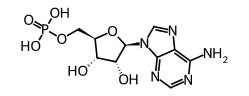
Names and identifiers
- IUPAC name
- [(2R,3S,4R,5R)-5-(6-aminopurin-9-yl)-3,4-dihydroxyoxolan-2-yl]methyl dihydrogen phosphate
- Synonyms
- adenosine monophosphate, adenosine 5'-monophosphate, adenylic acid
+ 39 more
5-AMP, 5'-adenylic acid, Adenosine monophosphate, adenosine phosphate, Phosphentaside, adenosine 5'-phosphate, Adenovite, Cardiomone, Lycedan, Phosaden, 5'-AMP, adenylate, My-B-Den, Myoston, Vitamin B8, Adenyl, a-5mp, 5'-adenosine monophosphate, Fosfato de adenosina, Adenosine 5'-(dihydrogen phosphate), Phosphate d'adenosine, Adenosini phosphas, PAdo, adenosine-5'P, NSC-20264, Ado5'P, 5'-O-phosphonoadenosine, Adenosine, mono(dihydrogen phosphate) (ester), [(2R,3S,4R,5R)-5-(6-aminopurin-9-yl)-3,4-dihydroxyoxolan-2-yl]methyl dihydrogen phosphate, A 5MP, DTXSID5022560, CHEBI:16027, 415SHH325A, DTXCID002560, {[(2R,3S,4R,5R)-5-(6-amino-9H-purin-9-yl)-3,4-dihydroxyoxolan-2-yl]methoxy}phosphonic acid, NSC20264, adenosina fosfato, (((2R,3S,4R,5R)-5-(6-amino-9H-purin-9-yl)-3,4-dihydroxyoxolan-2-yl)methoxy)phosphonic acid, ((2R,3S,4R,5R)-5-(6-aminopurin-9-yl)-3,4-dihydroxyoxolan-2-yl)methyl dihydrogen phosphate
- Molecular formula
- C10H14N5O7P
- Empirical formula
- C10H14N5O7P
- Molecular weight
- 347.22 g/mol
- Exact mass
- 347.06308
- CAS number
- 61-19-8
- PubChem CID
- 6083
- Canonical SMILES
- C1=NC(=C2C(=N1)N(C=N2)C3C(C(C(O3)COP(=O)(O)O)O)O)N
- Isomeric SMILES
- C1=NC(=C2C(=N1)N(C=N2)[C@H]3[C@@H]([C@@H]([C@H](O3)COP(=O)(O)O)O)O)N
- InChI
- InChI=1S/C10H14N5O7P/c11-8-5-9(13-2-12-8)15(3-14-5)10-7(17)6(16)4(22-10)1-21-23(18,19)20/h2-4,6-7,10,16-17H,1H2,(H2,11,12,13)(H2,18,19,20)/t4-,6-,7-,10-/m1/s1
- InChIKey
- UDMBCSSLTHHNCD-KQYNXXCUSA-N
- Molfile
Names, InChI and the identifiers from PubChem, retrieved 2026-10-14.
Physical properties
- Solubility in water
- INSOL IN ALCOHOL[1]
2 values
From Hazardous Substances Data Bank (HSDB), the most authoritative source here.
Value As written Source – ALMOST INSOL IN COLD H2O /YEAST ADENYLIC ACID MONO-HCL/ [1] Hazardous Substances Data Bank (HSDB)cites Hawley, G.G. The Condensed Chemical Dictionary. 9th ed. New York: Van Nostrand Reinhold Co., 1977., p. 17 –shown INSOL IN ALCOHOL [1] Hazardous Substances Data Bank (HSDB)cites American Society of Hospital Pharmacists. Data supplied on contract from American Hospital Formulary Service and other current ASHP sources., p. 1967
Each value as its source reports it, with the source's number after it (listed under References). Where several sources report a property, the row shows the value most of them agree on, the rule the app uses; open the values to see every one.
Calculated
- Heavy atoms
- 23
- Rings
- 3
- Aromatic rings
- 2
- Fraction sp³ carbons (Fsp3)
- 0.5
- H-bond donors
- 5
- H-bond acceptors
- 9 computed here · PubChem 11
- Rotatable bonds
- 4
- TPSA (Ų)
- 186.1 computed here · PubChem 186
- Formal charge
- 0
- XLogP3
- -3.5 PubChem
- Complexity
- 481 PubChem
- Stereocenters
- 4 definedCIP: C11: R · C13: R · C20: S · C22: R
- Double-bond geometry
- None specified
- Point group
- C1 of one 3D conformer with its hydrogens, by Athanor’s engine (as in the app)
Elemental analysis
- C34.59%
- H4.06%
- N20.17%
- O32.25%
- P8.92%
Isotope pattern
Each peak is a nominal mass with its abundance-weighted exact mass, as a percentage of the tallest, from IUPAC natural isotope abundances.
Computed from the structure with RDKit 2026.09 when this page was built, beside PubChem's own computed values from its record; where the two differ, both are shown.
Predicted
- log P
- -1.86 Crippen (Wildman and Crippen 1999)
- log S (water solubility)
- -0.84 ESOL (Delaney 2004), log mol/L
- Synthetic accessibility
- 3.8 SA score, 1 easy to 10 hard (Ertl and Schuffenhauer 2009)
Drug-likeness: Lipinski’s rule of five
- Molecular weight ≤ 500: 347.22
- log P ≤ 5 (Crippen): -1.86
- H-bond donors ≤ 5: 5
- H-bond acceptors ≤ 10: 9
Passes all four rules.
¹³C NMR shifts, predicted
Predictions, not measurements; each names its method. A measured log P, where a source reports one, is under Physical properties.
Safety
This chemical does not meet GHS hazard criteria for 97.7% (127 of 130) of all reports.[2]
Safety data sheets on the supplier’s page: Key Organics/BIONET, eMolecules, AKos Consulting & Solutions.
Always read the supplier’s safety data sheet before working with it.
Spectra
- 1H NMRHuman Metabolome Database (HMDB) (Varian · 600 MHz · Water) · Human Metabolome Database (HMDB) (600 MHz · H2O) · Human Metabolome Database (HMDB) (600 MHz · H2O) · Human Metabolome Database (HMDB) (600 MHz · H2O) · SpectraBase
- 13C NMRSpectraBase
- 31P NMRSpectraBase
- 1H-1H NMRHuman Metabolome Database (HMDB)
- 1H-13C NMRHuman Metabolome Database (HMDB) (Bruker · 600 MHz · Water)
- GC-MSHuman Metabolome Database (HMDB) (GC-MS) · Human Metabolome Database (HMDB) (GC-MS) · MassBank of North America (MoNA) (GC-MS) · MassBank of North America (MoNA) (GC-MS)
- MS-MSHuman Metabolome Database (HMDB) (Positive) · Human Metabolome Database (HMDB) (Negative) · Human Metabolome Database (HMDB) (Negative) · Human Metabolome Database (HMDB) (Positive) · Human Metabolome Database (HMDB) (Positive) · Human Metabolome Database (HMDB) (Negative)
- LC-MSMassBank Europe (Agilent 6530 QTOF · LC-ESI-QTOF · POSITIVE) · MassBank Europe (Agilent 6530 QTOF · LC-ESI-QTOF · POSITIVE) · MassBank Europe (Agilent 6530 QTOF · LC-ESI-QTOF · POSITIVE) · MassBank Europe (Thermo Scientific Q-Exactive Focus · LC-ESI-ITFT · NEGATIVE) · MassBank Europe (Thermo Scientific Q-Exactive Focus · LC-ESI-ITFT · NEGATIVE) · MassBank Europe (Thermo Scientific Q-Exactive Focus · LC-ESI-ITFT · NEGATIVE)
- Other MSMassBank of North America (MoNA) (TQD, Waters · Flow-injection QqQ/MS · ESI) · MassBank of North America (MoNA) (TQD, Waters · Flow-injection QqQ/MS · ESI) · MassBank of North America (MoNA) (TQD, Waters · Flow-injection QqQ/MS · ESI)
- UVHazardous Substances Data Bank (HSDB)
- IRHazardous Substances Data Bank (HSDB)
- FTIRSpectraBase (KBr WAFER)
- ATR-IRSpectraBase (Bruker Tensor 27 FT-IR · ATR-Neat (DuraSamplIR II))
- RamanSpectraBase (Bruker MultiRAM Stand Alone FT-Raman Spectrometer · FT-Raman)
Experimental spectra held by these sources; each link opens the source's own record.
Literature
Reading PubChem, OpenAlex and GSRS…
Bioactivity
Reading ChEMBL…
References
- [1]Hazardous Substances Data Bank (HSDB) · Public domain (US NLM) · via PubChem · retrieved 2026-10-14
- [2]European Chemicals Agency (ECHA) · ECHA legal notice: reuse with acknowledgement · via PubChem · retrieved 2026-10-14
- [3]Human Metabolome Database (HMDB) · Linked only · via PubChem · retrieved 2026-10-14
- [4]SpectraBase · Linked only · via PubChem · retrieved 2026-10-14
- [5]MassBank of North America (MoNA) · CC BY 4.0 · via PubChem · retrieved 2026-10-14
- [6]NIST Mass Spectrometry Data Center · Linked only · via PubChem · retrieved 2026-10-14
- [7]MassBank Europe · Linked only · via PubChem · retrieved 2026-10-14
- ·Calculated values: computed by Athanor with RDKit 2026.09 from the structure.
- ·Literature on PubChem
Data last updated 2026-10-14.