
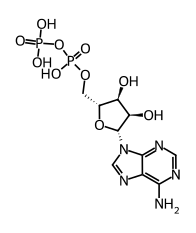
ADP
Athanor · official
C10H15N5O10P2 · 427.2 g/mol
IUPAC name: [(2R,3S,4R,5R)-5-(6-aminopurin-9-yl)-3,4-dihydroxyoxolan-2-yl]methyl phosphono hydrogen phosphate
Also called adenosine diphosphate
 WarningCauses skin irritation · Causes serious eye irritation · May cause respiratory irritation
Names and identifiers
- IUPAC name
- [(2R,3S,4R,5R)-5-(6-aminopurin-9-yl)-3,4-dihydroxyoxolan-2-yl]methyl phosphono hydrogen phosphate
- Synonyms
- adenosine diphosphate, Adenosine 5'-diphosphate, Adenosine diphosphate
+ 34 more
Adenosine 5'-(trihydrogen diphosphate), adenosine pyrophosphate, 5'-Adp, adenosine 5'-pyrophosphate, 61D2G4IYVH, ADENOSINE, 5'-(TRIHYDROGEN PYROPHOSPHATE), [(2R,3S,4R,5R)-5-(6-aminopurin-9-yl)-3,4-dihydroxyoxolan-2-yl]methyl phosphono hydrogen phosphate, DTXSID60883210, 5'-Pyrophosphate, Adenosine, ADP, Magnesium, ((2R,3S,4R,5R)-5-(6-aminopurin-9-yl)-3,4-dihydroxyoxolan-2-yl)methyl phosphono hydrogen phosphate, Diphosphate, Adenosine, Pyrophosphate, Adenosine, RefChem:912857, Adenosine 5' Pyrophosphate, DTXCID301022759, (((((2S,3R,4S,5S)-5-(6-amino-9H-purin-9-yl)-3,4-dihydroxyoxolan-2-yl)methoxy)(hydroxy)phosphoryl)oxy)phosphonic acid, 200-392-5, adenosine-5'-diphosphate, ADP (nucleotide), Adenosindiphosphorsaeure, 5'-Adenylphosphoric acid, Adenosine 5'-pyrophosphoric acid, Adenosine-5'-diphosphat, Adenosine 5'-diphosphoric acid, Adenosine diphosphoric acid, Ado-5'-P-P, MFCD00066473, BRN 0067722, adenosine 5' diphosphate, adenosine-5-diphosphate, CHEMBL14830, CHEBI:16761, C10H15N5O10P2
- Molecular formula
- C10H15N5O10P2
- Empirical formula
- C10H15N5O10P2
- Molecular weight
- 427.2 g/mol
- Exact mass
- 427.02942
- CAS number
- 58-64-0
- PubChem CID
- 6022
- Canonical SMILES
- C1=NC(=C2C(=N1)N(C=N2)C3C(C(C(O3)COP(=O)(O)OP(=O)(O)O)O)O)N
- Isomeric SMILES
- C1=NC(=C2C(=N1)N(C=N2)[C@H]3[C@@H]([C@@H]([C@H](O3)COP(=O)(O)OP(=O)(O)O)O)O)N
- InChI
- InChI=1S/C10H15N5O10P2/c11-8-5-9(13-2-12-8)15(3-14-5)10-7(17)6(16)4(24-10)1-23-27(21,22)25-26(18,19)20/h2-4,6-7,10,16-17H,1H2,(H,21,22)(H2,11,12,13)(H2,18,19,20)/t4-,6-,7-,10-/m1/s1
- InChIKey
- XTWYTFMLZFPYCI-KQYNXXCUSA-N
- Molfile
Names, InChI and the identifiers from PubChem, retrieved 2026-10-14.
Calculated
- Heavy atoms
- 27
- Rings
- 3
- Aromatic rings
- 2
- Fraction sp³ carbons (Fsp3)
- 0.5
- H-bond donors
- 6
- H-bond acceptors
- 11 computed here · PubChem 14
- Rotatable bonds
- 6
- TPSA (Ų)
- 232.6 computed here · PubChem 233
- Formal charge
- 0
- XLogP3
- -4.6 PubChem
- Complexity
- 637 PubChem
- Stereocenters
- 4 defined, 1 undefinedCIP: C11: R · C13: R · P16: undefined · C24: S · C26: R
- Double-bond geometry
- None specified
- Point group
- C1 of one 3D conformer with its hydrogens, by Athanor’s engine (as in the app)
Elemental analysis
- C28.12%
- H3.54%
- N16.39%
- O37.45%
- P14.50%
Isotope pattern
Each peak is a nominal mass with its abundance-weighted exact mass, as a percentage of the tallest, from IUPAC natural isotope abundances.
Computed from the structure with RDKit 2026.09 when this page was built, beside PubChem's own computed values from its record; where the two differ, both are shown.
Predicted
- log P
- -1.75 Crippen (Wildman and Crippen 1999)
- log S (water solubility)
- -1.24 ESOL (Delaney 2004), log mol/L
- Synthetic accessibility
- 4.13 SA score, 1 easy to 10 hard (Ertl and Schuffenhauer 2009)
Drug-likeness: Lipinski’s rule of five
- Molecular weight ≤ 500: 427.2
- log P ≤ 5 (Crippen): -1.75
- H-bond donors ≤ 5: 6
- H-bond acceptors ≤ 10: 11
Breaks 2 of the four rules.
¹³C NMR shifts, predicted
Predictions, not measurements; each names its method. A measured log P, where a source reports one, is under Physical properties.
Safety
Warning
From European Chemicals Agency (ECHA). Source [1].
- Harmful or irritant
- H315Causes skin irritation
- H319Causes serious eye irritation
- H335May cause respiratory irritation
Precautionary statements: P261, P264, P264+P265, P271, P280, P302+P352, P304+P340, P305+P351+P338, P319, P321, P332+P317, P337+P317, P362+P364, P403+P233, P405, P501
Safety data sheets on the supplier’s page: MuseChem, BOC Sciences, NewCan Biotech.
Always read the supplier’s safety data sheet before working with it.
Spectra
- 1H NMRHuman Metabolome Database (HMDB) (600 MHz · DMSO) · Human Metabolome Database (HMDB) (600 MHz · DMSO) · Human Metabolome Database (HMDB) (Bruker · 600 MHz · 100%_DMSO) · SpectraBase
- 13C NMRSpectraBase
- 31P NMRSpectraBase
- 1H-1H NMRHuman Metabolome Database (HMDB)
- 1H-13C NMRHuman Metabolome Database (HMDB) (Bruker · 600 MHz · 100%_DMSO)
- MS-MSHuman Metabolome Database (HMDB) (Quattro_QQQ · Positive) · Human Metabolome Database (HMDB) (Quattro_QQQ · Positive) · Human Metabolome Database (HMDB) (Quattro_QQQ · Positive) · Human Metabolome Database (HMDB) (Negative) · Human Metabolome Database (HMDB) (Positive) · Human Metabolome Database (HMDB) (Positive)
- LC-MSMassBank Europe (Thermo Scientific Q-Exactive Focus · LC-ESI-ITFT · NEGATIVE) · MassBank Europe (Thermo Scientific Q-Exactive Focus · LC-ESI-ITFT · NEGATIVE) · MassBank Europe (Thermo Scientific Q-Exactive Focus · LC-ESI-ITFT · NEGATIVE) · MassBank Europe (Thermo Scientific Q-Exactive Focus · LC-ESI-ITFT · NEGATIVE) · MassBank Europe (Thermo Scientific Q-Exactive Focus · LC-ESI-ITFT · NEGATIVE) · MassBank Europe (Thermo Scientific Q-Exactive Focus · LC-ESI-ITFT · NEGATIVE)
- Other MSMassBank of North America (MoNA) (TQD, Waters · Flow-injection QqQ/MS · ESI) · MassBank of North America (MoNA) (TQD, Waters · Flow-injection QqQ/MS · ESI) · MassBank of North America (MoNA) (TQD, Waters · Flow-injection QqQ/MS · ESI)
Experimental spectra held by these sources; each link opens the source's own record.
Literature
Reading PubChem, OpenAlex and GSRS…
Bioactivity
Reading ChEMBL…
References
- [1]European Chemicals Agency (ECHA) · ECHA legal notice: reuse with acknowledgement · via PubChem · retrieved 2026-10-14
- [2]Human Metabolome Database (HMDB) · Linked only · via PubChem · retrieved 2026-10-14
- [3]SpectraBase · Linked only · via PubChem · retrieved 2026-10-14
- [4]NIST Mass Spectrometry Data Center · Linked only · via PubChem · retrieved 2026-10-14
- [5]MassBank Europe · Linked only · via PubChem · retrieved 2026-10-14
- [6]MassBank of North America (MoNA) · CC BY 4.0 · via PubChem · retrieved 2026-10-14
- ·Calculated values: computed by Athanor with RDKit 2026.09 from the structure.
- ·Literature on PubChem
Data last updated 2026-10-14.