
Tristearin
Athanor · official
C57H110O6 · 891.5 g/mol
IUPAC name: 2,3-di(octadecanoyloxy)propyl octadecanoate
Also called glyceryl tristearate, triglyceride
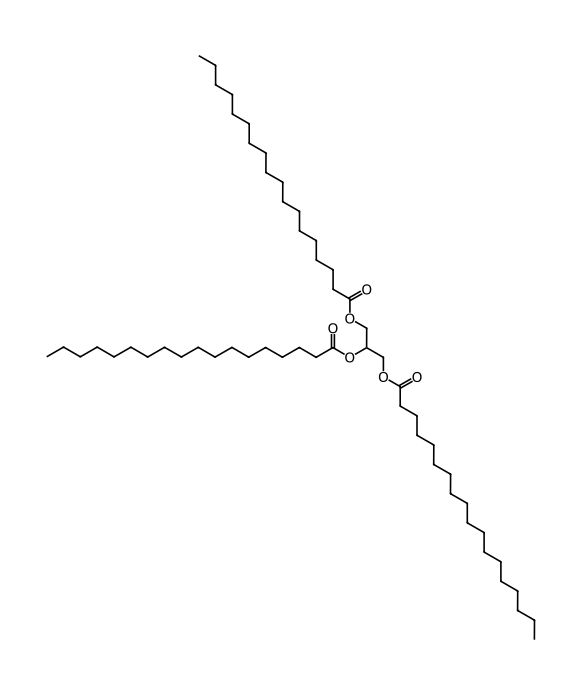
Names and identifiers
- IUPAC name
- 2,3-di(octadecanoyloxy)propyl octadecanoate
- Synonyms
- glyceryl tristearate, triglyceride, Glycerol tristearate
+ 37 more
Glyceryl tristearate, Trioctadecanoin, TRISTEAROYLGLYCEROL, Stearic triglyceride, Stearin, tri-, Spezialfett 118, Stearoyl triglyceride, Dynasan 118, 2,3-di(octadecanoyloxy)propyl octadecanoate, Stearic acid triglycerin ester, Stearic acid triglyceride, Glycerol, trioctadecanoate, Octadecanoic acid, 1,2,3-propanetriyl ester, P6OCJ2551R, DTXSID8047503, CHEBI:45956, 209-097-6, RefChem:933543, DTXCID6027503, Propane-1,2,3-triyl tristearate, triacylglycerol, C57H110O6, propane-1,2,3-triyl trioctadecanoate, TG(18:0/18:0/18:0), 1,2,3-Trioctadecanoylglycerol, 1,2,3-trioctadecanoyl-glycerol, 1,2,3-trioctadecanoyl-sn-glycerol, 1,2,3-Trioctadecanoyl-rac-glycerol, MFCD00036230, Glyceryl tristearate (NF), GLYCERYL TRISTEARATE [NF], Octadecanoic acid, 1,1',1''-(1,2,3-propanetriyl) ester, TGL, HSDB 5690, Glycerol trioctadecanoate, EINECS 209-097-6, UNII-P6OCJ2551R
- Molecular formula
- C57H110O6
- Empirical formula
- C57H110O6
- Molecular weight
- 891.5 g/mol
- Exact mass
- 890.83024
- CAS number
- 555-43-1
- PubChem CID
- 11146
- Canonical SMILES
- CCCCCCCCCCCCCCCCCC(=O)OCC(COC(=O)CCCCCCCCCCCCCCCCC)OC(=O)CCCCCCCCCCCCCCCCC
- Isomeric SMILES
- CCCCCCCCCCCCCCCCCC(=O)OCC(COC(=O)CCCCCCCCCCCCCCCCC)OC(=O)CCCCCCCCCCCCCCCCC
- InChI
- InChI=1S/C57H110O6/c1-4-7-10-13-16-19-22-25-28-31-34-37-40-43-46-49-55(58)61-52-54(63-57(60)51-48-45-42-39-36-33-30-27-24-21-18-15-12-9-6-3)53-62-56(59)50-47-44-41-38-35-32-29-26-23-20-17-14-11-8-5-2/h54H,4-53H2,1-3H3
- InChIKey
- DCXXMTOCNZCJGO-UHFFFAOYSA-N
- Molfile
Names, InChI and the identifiers from PubChem, retrieved 2026-10-14.
Physical properties
- Appearance
- Colorless crystals or powder[2]
2 values
From Hazardous Substances Data Bank (HSDB), the most authoritative source here.
Value As written Source – CBI; Large Crystals [1] EPA Chemical Data Reporting (CDR) –shown Colorless crystals or powder [2] Hazardous Substances Data Bank (HSDB)cites Lewis, R.J., Sr (Ed.). Hawley's Condensed Chemical Dictionary. 13th ed. New York, NY: John Wiley & Sons, Inc. 1997., p. 1047 - Odor
- Odorless[2]
- Solubility in water
- Insoluble in water. Soluble in chloroform, carbon disulfide[2]
- log P
- Reported, but no value passed the checks.
The value and why
- log Kow = 24 /Estimated/ (outside the plausible range; source [2])
- Vapor pressure
- 5.4 × 10⁻¹⁷ mmHg at 25 °C (estimated)[2]
Each value as its source reports it, with the source's number after it (listed under References). Where several sources report a property, the row shows the value most of them agree on, the rule the app uses; open the values to see every one.
Calculated
- Heavy atoms
- 63
- Rings
- 0
- Aromatic rings
- 0
- Fraction sp³ carbons (Fsp3)
- 0.95
- H-bond donors
- 0
- H-bond acceptors
- 6
- Rotatable bonds
- 53 computed here · PubChem 56
- TPSA (Ų)
- 78.9
- Formal charge
- 0
- XLogP3
- 25.2 PubChem
- Complexity
- 886 PubChem
- Stereocenters
- None
- Double-bond geometry
- None specified
Elemental analysis
- C76.79%
- H12.44%
- O10.77%
Isotope pattern
Each peak is a nominal mass with its abundance-weighted exact mass, as a percentage of the tallest, from IUPAC natural isotope abundances.
Computed from the structure with RDKit 2026.09 when this page was built, beside PubChem's own computed values from its record; where the two differ, both are shown.
Predicted
- log P
- 18.77 Crippen (Wildman and Crippen 1999)
- log S (water solubility)
- -13.69 ESOL (Delaney 2004), log mol/L
- Synthetic accessibility
- 2.69 SA score, 1 easy to 10 hard (Ertl and Schuffenhauer 2009)
Drug-likeness: Lipinski’s rule of five
- Molecular weight ≤ 500: 891.5
- log P ≤ 5 (Crippen): 18.77
- H-bond donors ≤ 5: 0
- H-bond acceptors ≤ 10: 6
Breaks 2 of the four rules.
¹³C NMR shifts, predicted
Predictions, not measurements; each names its method. A measured log P, where a source reports one, is under Physical properties.
Safety
This chemical does not meet GHS hazard criteria for 100% (198 of 198) of all reports.[3]
Safety data sheets on the supplier’s page: Sigma-Aldrich, Alfa Chemistry, Clinivex.
Always read the supplier’s safety data sheet before working with it.
Spectra
- NMRHazardous Substances Data Bank (HSDB)
- 1H NMRHuman Metabolome Database (HMDB) (JEOL · 400 MHz · CDCl3) · SpectraBase (BRUKER AC-300)
- 13C NMRHuman Metabolome Database (HMDB) (JEOL · 22.53 MHz · CDCl3) · SpectraBase
- GC-MSHuman Metabolome Database (HMDB) (EI-B · positive) · Human Metabolome Database (HMDB) (EI-B · positive) · Human Metabolome Database (HMDB) (EI-B · positive) · MassBank of North America (MoNA) (HITACHI M-80 · EI-B · positive) · MassBank of North America (MoNA) (HITACHI M-80 · EI-B · positive) · MassBank of North America (MoNA) (HITACHI M-80 · EI-B · positive)
- LC-MSSpectraBase
- Other MSHazardous Substances Data Bank (HSDB) · MassBank Europe (HITACHI M-80 · EI-B · POSITIVE) · MassBank Europe (HITACHI M-80 · EI-B · POSITIVE) · MassBank of North America (MoNA) (JMS-S3000 · MALDI-TOFTOF · positive) · MassBank of North America (MoNA) (positive) · MassBank of North America (MoNA) (positive)
- IRHazardous Substances Data Bank (HSDB)
- FTIRSpectraBase (CAPILLARY CELL: MELT)
- ATR-IRSpectraBase (Bio-Rad FTS · ATR-Neat (DuraSamplIR II))
- RamanSpectraBase (FT-Raman)
Experimental spectra held by these sources; each link opens the source's own record.
Literature
Reading PubChem, OpenAlex and GSRS…
Bioactivity
Reading ChEMBL…
References
- [1]EPA Chemical Data Reporting (CDR) · Public domain (US EPA) · via PubChem · retrieved 2026-10-14
- [2]Hazardous Substances Data Bank (HSDB) · Public domain (US NLM) · via PubChem · retrieved 2026-10-14
- [3]European Chemicals Agency (ECHA) · ECHA legal notice: reuse with acknowledgement · via PubChem · retrieved 2026-10-14
- [4]Human Metabolome Database (HMDB) · Linked only · via PubChem · retrieved 2026-10-14
- [5]SpectraBase · Linked only · via PubChem · retrieved 2026-10-14
- [6]MassBank of North America (MoNA) · CC BY 4.0 · via PubChem · retrieved 2026-10-14
- [7]NIST Mass Spectrometry Data Center · Linked only · via PubChem · retrieved 2026-10-14
- [8]MassBank Europe · Linked only · via PubChem · retrieved 2026-10-14
- ·Calculated values: computed by Athanor with RDKit 2026.09 from the structure.
- ·Literature on PubChem
Data last updated 2026-10-14.