
Sucrose
Athanor · official
C12H22O11 · 342.3 g/mol
IUPAC name: (2R,3R,4S,5S,6R)-2-[(2S,3S,4S,5R)-3,4-dihydroxy-2,5-bis(hydroxymethyl)oxolan-2-yl]oxy-6-(hydroxymethyl)oxane-3,4,5-triol
Also called table sugar, saccharose, cane sugar, beet sugar, sucrose, C12H22O11
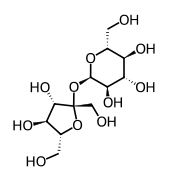
Names and identifiers
- IUPAC name
- (2R,3R,4S,5S,6R)-2-[(2S,3S,4S,5R)-3,4-dihydroxy-2,5-bis(hydroxymethyl)oxolan-2-yl]oxy-6-(hydroxymethyl)oxane-3,4,5-triol
- Synonyms
- table sugar, saccharose, cane sugar
+ 40 more
beet sugar, sucrose, C12H22O11, sugar, Table sugar, Cane sugar, White sugar, Saccharum, Microse, Rock candy, Amerfand, Confectioner's sugar, Sucraloxum, Amerfond, beta-D-Fructofuranosyl-alpha-D-glucopyranoside, beta-D-Fructofuranosyl alpha-D-glucopyranoside, DTXSID2021288, alpha-D-Glucopyranosyl beta-D-fructofuranoside, NCI-C56597, (+)-Sucrose, (alpha-D-Glucosido)-beta-D-fructofuranoside, alpha-D-Glucopyranoside, beta-D-fructofuranosyl, CHEBI:17992, Fructofuranoside, alpha-D-glucopyranosyl, beta-D, Glucopyranoside, beta-D-fructofuranosyl, alpha-D, alpha-D-Glucopyranoside, beta-D-fructofuranosyl-, GNE-410, S-67F, SACCHARUM OFFICINALE, C151H8M554, NSC-406942, DTXCID101288, 1-alpha-D-glucopyranosyl-2-beta-D-fructofuranoside, (2R,3R,4S,5S,6R)-2-[(2S,3S,4S,5R)-3,4-dihydroxy-2,5-bis(hydroxymethyl)oxolan-2-yl]oxy-6-(hydroxymethyl)oxane-3,4,5-triol, (2R,3R,4S,5S,6R)-2-{[(2S,3S,4S,5R)-3,4-dihydroxy-2,5-bis(hydroxymethyl)oxolan-2-yl]oxy}-6-(hydroxymethyl)oxane-3,4,5-triol, alpha-D-glucopyranosyl-(1->2)-beta-D-fructofuranoside, Saccarose, (2R,3R,4S,5S,6R)-2-(((2S,3S,4S,5R)-3,4-dihydroxy-2,5-bis(hydroxymethyl)oxolan-2-yl)oxy)-6-(hydroxymethyl)oxane-3,4,5-triol, (2R,3R,4S,5S,6R)-2-((2S,3S,4S,5R)-3,4-dihydroxy-2,5-bis(hydroxymethyl)oxolan-2-yl)oxy-6-(hydroxymethyl)oxane-3,4,5-triol, Sucrose 15%
- Molecular formula
- C12H22O11
- Empirical formula
- C12H22O11
- Molecular weight
- 342.3 g/mol
- Exact mass
- 342.11621
- CAS number
- 57-50-1
- PubChem CID
- 5988
- Canonical SMILES
- C(C1C(C(C(C(O1)OC2(C(C(C(O2)CO)O)O)CO)O)O)O)O
- Isomeric SMILES
- C([C@@H]1[C@H]([C@@H]([C@H]([C@H](O1)O[C@]2([C@H]([C@@H]([C@H](O2)CO)O)O)CO)O)O)O)O
- InChI
- InChI=1S/C12H22O11/c13-1-4-6(16)8(18)9(19)11(21-4)23-12(3-15)10(20)7(17)5(2-14)22-12/h4-11,13-20H,1-3H2/t4-,5-,6-,7-,8+,9-,10+,11-,12+/m1/s1
- InChIKey
- CZMRCDWAGMRECN-UGDNZRGBSA-N
- Molfile
Names, InChI and the identifiers from PubChem, retrieved 2026-10-14.
Physical properties
- Appearance
- Hard, white ... crystals, lumps, or powder ...[6]
6 values
From Hazardous Substances Data Bank (HSDB), the most authoritative source here.
Value As written Source – Sucrose appears as white odorless crystalline or powdery solid. Denser than water. [1] CAMEO Chemicals – Liquid; Liquid; Other Solid; Large Crystals; Other Solid [2] EPA Chemical Data Reporting (CDR) – WHITE SOLID IN VARIOUS FORMS. [3] ILO-WHO International Chemical Safety Cards (ICSCs) – Hard, white, odorless crystals, lumps, or powder. [4] Occupational Safety and Health Administration (OSHA) – Hard, white, odorless crystals, lumps, or powder. [Note: May have a characteristic, caramel odor when heated.] [5] The National Institute for Occupational Safety and Health (NIOSH) –shown Hard, white ... crystals, lumps, or powder ... [6] Hazardous Substances Data Bank (HSDB)cites NIOSH. NIOSH Pocket Guide to Chemical Hazards. DHHS (NIOSH) Publication No. 97-140. Washington, D.C. U.S. Government Printing Office, 1997., p. 288 - Odor
- ... Odorless ... [Note: May have a characteristic caramel odor when heated].[6]
- Melting point
- 160 to 186 °C (320 to 367 °F) (decomposes) (NTP, 1992)[1]
3 values
3 of 3 sources agree on it (most common value).
Value As written Source 160 to 186 °Cshown 320 to 367 °F (decomposes) (NTP, 1992) [1] CAMEO Chemicalscites National Toxicology Program, Institute of Environmental Health Sciences, National Institutes of Health (NTP). 1992. National Toxicology Program Chemical Repository Database. Research Triangle Park, North Carolina. 160 to 186 °C 320-367 °F (decomposes) [4] Occupational Safety and Health Administration (OSHA) 160 to 186 °C 320-367 °F (Decomposes) [5] The National Institute for Occupational Safety and Health (NIOSH) - Boiling point
- Reported, but no value passed the checks.
The value and why
- Decomposes (NTP, 1992) (could not be read; source [1])
- Density
- 1.59 at 20 °C (68 °F) (USCG, 1999) - Denser than water[1]
4 values
4 of 4 sources agree on it (most common value).
Value As written Source –shown 1.59 at 68 °F (USCG, 1999) - Denser than water [1] CAMEO Chemicalscites U.S. Coast Guard. 1999. Chemical Hazard Response Information System (CHRIS) - Hazardous Chemical Data. Commandant Instruction 16465.12C. Washington, D.C.: U.S. Government Printing Office. – 1.6 g/cm³ [3] ILO-WHO International Chemical Safety Cards (ICSCs) – 1.59 [4] Occupational Safety and Health Administration (OSHA) – 1.59 [5] The National Institute for Occupational Safety and Health (NIOSH) - Solubility in water
- Solubility in water, g/100ml at 25 °C: 200[3]
4 values
From ILO-WHO International Chemical Safety Cards (ICSCs), the most authoritative source here.
Value As written Source – greater than or equal to 100 mg/mL at 66 °F (NTP, 1992) [1] CAMEO Chemicalscites National Toxicology Program, Institute of Environmental Health Sciences, National Institutes of Health (NTP). 1992. National Toxicology Program Chemical Repository Database. Research Triangle Park, North Carolina. – water solubility = 2.12X10+6 mg/l @ 25 °C [6] Hazardous Substances Data Bank (HSDB)cites Yalkowsky SH, Dannenfelser RM; The AQUASOL dATAbASE of Aqueous Solubility. Fifth Ed, Tucson, AZ: Univ Az, College of Pharmacy (1992) –shown Solubility in water, g/100ml at 25 °C: 200 [3] ILO-WHO International Chemical Safety Cards (ICSCs) – 200% [5] The National Institute for Occupational Safety and Health (NIOSH) - log P
- -3.67[3]
2 values
2 of 2 sources agree on it (most common value).
Value As written Source – log Kow = -3.70 [6] Hazardous Substances Data Bank (HSDB)cites Hansch, C., Leo, A., D. Hoekman. Exploring QSAR - Hydrophobic, Electronic, and Steric Constants. Washington, DC: American Chemical Society., 1995., p. 107 –shown -3.67 [3] ILO-WHO International Chemical Safety Cards (ICSCs) - Vapor pressure
- Reported, but no value passed the checks.
The 3 values and why
- 0 mmHg (approx) (NIOSH, 2024) (no temperature given; source [1])
- 0 mmHg (approx) (no temperature given; source [4])
- 0 mmHg (approx) (no temperature given; source [5])
Each value as its source reports it, with the source's number after it (listed under References). Where several sources report a property, the row shows the value most of them agree on, the rule the app uses; open the values to see every one.
Calculated
- Heavy atoms
- 23
- Rings
- 2
- Aromatic rings
- 0
- Fraction sp³ carbons (Fsp3)
- 1
- H-bond donors
- 8
- H-bond acceptors
- 11
- Rotatable bonds
- 5
- TPSA (Ų)
- 189.5 computed here · PubChem 190
- Formal charge
- 0
- XLogP3
- -3.7 PubChem
- Complexity
- 395 PubChem
- Stereocenters
- 9 definedCIP: C3: R · C5: S · C9: R · C11: R · C14: S · C16: S · C18: R · C20: S · C22: S
- Double-bond geometry
- None specified
- Point group
- C1 of one 3D conformer with its hydrogens, by Athanor’s engine (as in the app)
Elemental analysis
- C42.11%
- H6.48%
- O51.41%
Isotope pattern
Each peak is a nominal mass with its abundance-weighted exact mass, as a percentage of the tallest, from IUPAC natural isotope abundances.
Computed from the structure with RDKit 2026.09 when this page was built, beside PubChem's own computed values from its record; where the two differ, both are shown.
Predicted
- log P
- -5.4 Crippen (Wildman and Crippen 1999)
- log S (water solubility)
- 1.77 ESOL (Delaney 2004), log mol/L
- Synthetic accessibility
- 4.48 SA score, 1 easy to 10 hard (Ertl and Schuffenhauer 2009)
Drug-likeness: Lipinski’s rule of five
- Molecular weight ≤ 500: 342.3
- log P ≤ 5 (Crippen): -5.4
- H-bond donors ≤ 5: 8
- H-bond acceptors ≤ 10: 11
Breaks 2 of the four rules.
¹³C NMR shifts, predicted
Predictions, not measurements; each names its method. A measured log P, where a source reports one, is under Physical properties.
Safety
This chemical does not meet GHS hazard criteria for 95.7% (423 of 442) of all reports.[7]
Exposure limits
- PEL-TWA (8-Hour Time Weighted Average): 15 mg/m³ (total dust), 5 mg/m³ (respirable fraction)[4]
- PEL: TWA 15 mg/m3 (total) TWA 5 mg/m3 (resp)[5]
- REL-TWA (Time Weighted Average): 10 mg/m³ (total), 5 mg/m³ (resp)[4]
- REL: TWA 10 mg/m3 (total) TWA 5 mg/m3 (resp)[5]
- TLV: 10 mg/m[3]
- TLV-TWA (Time Weighted Average): 10 mg/m³ [1992][4]
First aid
- Eyes: First check the victim for contact lenses and remove if present. Flush victim's eyes with water or normal saline solution for 20 to 30 minutes while simultaneously calling a hospital or poison control center. Do not put any ointments, oils, or medication in the victim's eyes without specific instructions from a physician. If symptoms (such as redness or irritation) develop, immediately transport the victim to a hospital. Skin: Immediately flood affected skin with water while removing and isolating all contaminated clothing.[1]
- (General first aid procedures) Eye: Irrigate immediately - If this chemical contacts the eyes, immediately wash (irrigate) the eyes with large amounts of water, occasionally lifting the lower and upper lids. Get medical attention immediately. Breathing: Fresh air[5]
- Fresh air, rest.[3]
- Rinse skin with plenty of water or shower.[3]
Storage
- Separated from strong oxidants.[3]
Safety data sheets on the supplier’s page: Biosynth, Oakwood Products, CATO Research Chemicals Inc..
Always read the supplier’s safety data sheet before working with it.
Spectra
- NMRHazardous Substances Data Bank (HSDB)
- 1H NMRHuman Metabolome Database (HMDB) (Varian · 500 MHz · Water) · Human Metabolome Database (HMDB) (JEOL · 400 MHz · D2O) · Human Metabolome Database (HMDB) (Bruker · D2O) · SpectraBase
- 13C NMRHuman Metabolome Database (HMDB) (Bruker · 125 MHz · Water) · Human Metabolome Database (HMDB) (400 MHz · H2O) · Human Metabolome Database (HMDB) (Varian · 25.16 MHz · D2O) · SpectraBase
- 1H-1H NMRHuman Metabolome Database (HMDB)
- 1H-13C NMRHuman Metabolome Database (HMDB) (Bruker · 600 MHz · Water)
- GC-MSHuman Metabolome Database (HMDB) (GC-EI-TOF · positive) · Human Metabolome Database (HMDB) (GC-EI-TOF · positive) · Human Metabolome Database (HMDB) (GC-EI-TOF · positive) · Human Metabolome Database (HMDB) (GC-EI-TOF · positive) · Human Metabolome Database (HMDB) (GC-EI-TOF (Pegasus III TOF-MS system, Leco; GC 6890, Agilent Technologies) · Positive) · Human Metabolome Database (HMDB) (GC-EI-TOF (Pegasus III TOF-MS system, Leco; GC 6890, Agilent Technologies) · Positive)
- MS-MSHuman Metabolome Database (HMDB) (Negative) · Human Metabolome Database (HMDB) (Negative) · Human Metabolome Database (HMDB) (Negative) · Human Metabolome Database (HMDB) (Positive) · Human Metabolome Database (HMDB) (Negative) · Human Metabolome Database (HMDB) (Positive)
- LC-MSMassBank Europe (Q-Exactive Orbitrap, Thermo Scientfic; Ultimate 3000 HPLC, Thermo Scientfic · LC-ESI-QFT · NEGATIVE) · MassBank Europe (Agilent 6530 Q-TOF LC/MS · LC-ESI-QTOF · NEGATIVE) · MassBank Europe (Agilent 6530 Q-TOF LC/MS · LC-ESI-QTOF · NEGATIVE) · MassBank Europe (Agilent 6530 Q-TOF LC/MS · LC-ESI-QTOF · NEGATIVE) · MassBank Europe (UPLC Q-Tof Premier, Waters · LC-ESI-QTOF · NEGATIVE) · MassBank of North America (MoNA) (UPLC Q-Tof Premier, Waters · LC-ESI-QTOF · ESI)
- Other MSHazardous Substances Data Bank (HSDB) · MassBank of North America (MoNA) (TQD, Waters · Flow-injection QqQ/MS · ESI) · MassBank of North America (MoNA) (TQD, Waters · Flow-injection QqQ/MS · ESI) · MassBank of North America (MoNA) (ESI-QTOF · ESI · positive)
- IRHazardous Substances Data Bank (HSDB)
- FTIRSpectraBase (KBr WAFER)
- ATR-IRSpectraBase (Bio-Rad FTS · ATR-Neat (DuraSamplIR II))
- RamanSpectraBase (Thermo Nicolet FT-Raman 960 · FT-Raman)
Experimental spectra held by these sources; each link opens the source's own record.
Literature
Reading PubChem, OpenAlex and GSRS…
Bioactivity
Reading ChEMBL…
References
- [1]CAMEO Chemicals · Public domain (NOAA) · via PubChem · retrieved 2026-10-14
- [2]EPA Chemical Data Reporting (CDR) · Public domain (US EPA) · via PubChem · retrieved 2026-10-14
- [3]ILO-WHO International Chemical Safety Cards (ICSCs) · CC BY 4.0 · via PubChem · retrieved 2026-10-14
- [4]Occupational Safety and Health Administration (OSHA) · Public domain (US DOL) · via PubChem · retrieved 2026-10-14
- [5]The National Institute for Occupational Safety and Health (NIOSH) · Public domain (US CDC) · via PubChem · retrieved 2026-10-14
- [6]Hazardous Substances Data Bank (HSDB) · Public domain (US NLM) · via PubChem · retrieved 2026-10-14
- [7]European Chemicals Agency (ECHA) · ECHA legal notice: reuse with acknowledgement · via PubChem · retrieved 2026-10-14
- [8]Human Metabolome Database (HMDB) · Linked only · via PubChem · retrieved 2026-10-14
- [9]SpectraBase · Linked only · via PubChem · retrieved 2026-10-14
- [10]MassBank Europe · Linked only · via PubChem · retrieved 2026-10-14
- [11]MassBank of North America (MoNA) · CC BY 4.0 · via PubChem · retrieved 2026-10-14
- ·Calculated values: computed by Athanor with RDKit 2026.09 from the structure.
- ·Literature on PubChem
Data last updated 2026-10-14.