
Picric acid
Athanor · official
C6H3N3O7 · 229.1 g/mol
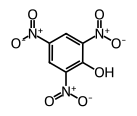
IUPAC name: 2,4,6-trinitrophenol
Also called 2,4,6-trinitrophenol, melinite, Bouin fixative

 Danger(Deleted) Explosive; mass explosion hazard · Toxic if swallowed · Toxic in contact with skin · Toxic if inhaled
Names and identifiers
- IUPAC name
- 2,4,6-trinitrophenol
- Synonyms
- 2,4,6-trinitrophenol, melinite, Bouin fixative
+ 38 more
2,4,6-Trinitrophenol, Trinitrophenol, Carbazotic acid, Picronitric acid, Melinite, Acide picrique, Nitroxanthic acid, Phenol trinitrate, Picral, Pikrinezuur, Pikrinsaeure, Acido picrico, Pikrynowy kwas, Phenol, 2,4,6-trinitro-, Phenoltrinitrate, 2-Hydroxy-1,3,5-trinitrobenzene, Picricum acidum, Kyselina pikrova, Acidum picrinicum, 1,3,5-Trinitrophenol, 2,4,6-Trinitrofenol, 2,4,6-Trinitrofenolo, 2,4,6-Trinitrophenyl, C.I. 10305, NSC 36947, CI 10305, NSC-36947, A49OS0F91S, DTXSID4025909, CHEBI:46149, Acidum Picricum, 1-hydroxy-2,4,6-trinitrobenzene, San Su, RefChem:6142, DTXCID905909, 201-865-9, Picric acid, dry, Picric acid, wet
- Molecular formula
- C6H3N3O7
- Empirical formula
- C6H3N3O7
- Molecular weight
- 229.1 g/mol
- Exact mass
- 228.99710
- CAS number
- 88-89-1
- PubChem CID
- 6954
- Canonical SMILES
- C1=C(C=C(C(=C1[N+](=O)[O-])O)[N+](=O)[O-])[N+](=O)[O-]
- Isomeric SMILES
- C1=C(C=C(C(=C1[N+](=O)[O-])O)[N+](=O)[O-])[N+](=O)[O-]
- InChI
- InChI=1S/C6H3N3O7/c10-6-4(8(13)14)1-3(7(11)12)2-5(6)9(15)16/h1-2,10H
- InChIKey
- OXNIZHLAWKMVMX-UHFFFAOYSA-N
- Molfile
Names, InChI and the identifiers from PubChem, retrieved 2026-10-14.
Physical properties
- Appearance
- Yellow solid [Note: Usually used as an aqueous solution][4]
7 values
From Hazardous Substances Data Bank (HSDB), the most authoritative source here.
Value As written Source – Picric acid, [dry] appears as yellow crystals. An explosive. Specific gravity 1.767. Melting point 251.2 °F (121.8 °C). Explodes at 572 °F. Toxic by ingestion. [1] CAMEO Chemicals – "Trinitrophenol (picric acid), Wetted, with not less than 10% water by mass" is a yellow mass of of moist crystals or a slurry. An explosive, but wetting lowers the risk of detonation. Dangerously explosive if allowed to dry out. The pure substance is denser than water (1.77 g cm-3) and moderately soluble in water. Used in synthesis of dyes, as a drug, to manufacture explosives and matches, to etch copper and to make colored glass. Store tightly sealed (to protect from drying out) in a cool, ventilated place, away from acute fire hazards and easily oxidized materials. May be irritating to skin [1] CAMEO Chemicals – Picric acid, wetted with not less than 30% water by mass appears as a paste or slurry consisting of the yellow crystalline solid mixed with water. The dry compound is a sensitive high explosive. The mixture with water is considered safe for storage, handling and shipping. Can be detonated with a number 8 electric blasting cap. The primary hazard is blast where the entire load explodes instantaneously and not from flying projectiles fragments. Can explode under prolonged exposure to heat. [1] CAMEO Chemicals – YELLOW CRYSTALS. [2] ILO-WHO International Chemical Safety Cards (ICSCs) – Yellow, odorless solid. [Note: Usually used as an aqueous solution.] [3] The National Institute for Occupational Safety and Health (NIOSH) –shown Yellow solid [Note: Usually used as an aqueous solution] [4] Hazardous Substances Data Bank (HSDB)cites NIOSH. NIOSH Pocket Guide to Chemical Hazards. Department of Health & Human Services, Centers for Disease Control & Prevention. National Institute for Occupational Safety & Health. DHHS (NIOSH) Publication No. 2010-168 (2010). Available from: https://www.cdc.gov/niosh/npg – Colorless crystals from ligroin or concentrated hydrochloric acid; yellow leaflets from water [4] Hazardous Substances Data Bank (HSDB)cites Lewis, R.J. Sr. (ed) Sax's Dangerous Properties of Industrial Materials. 12th Edition. Wiley-Interscience, Wiley & Sons, Inc. Hoboken, NJ. 2012., p. V5: 3647 - Melting point
- 122.5 °C[5]
5 values
4 of 4 sources agree on it (most common value).
Value As written Source 122 °C 252 °F (NIOSH, 2024) [1] CAMEO Chemicals 122 to 123 °C 251 to 253 °F (NTP, 1992) [1] CAMEO Chemicalscites National Toxicology Program, Institute of Environmental Health Sciences, National Institutes of Health (NTP). 1992. National Toxicology Program Chemical Repository Database. Research Triangle Park, North Carolina. 122 °C 122 °C [2] ILO-WHO International Chemical Safety Cards (ICSCs) 122.5 °Cshown 122.5 °C [5] PAC Chemical Database, U.S. Department of Energy 122 °C 252 °F [3] The National Institute for Occupational Safety and Health (NIOSH) - Boiling point
- greater than 300 °C (572 °F) at 760 mmHg (Sublimes/explodes) (NTP, 1992)[1]
- Density
- 1.763 no temp[5]
5 values
4 of 4 sources agree on it (most common value).
Value As written Source – 1.76 (NIOSH, 2024) - Denser than water [1] CAMEO Chemicals – 1.763 (NTP, 1992) - Denser than water [1] CAMEO Chemicalscites National Toxicology Program, Institute of Environmental Health Sciences, National Institutes of Health (NTP). 1992. National Toxicology Program Chemical Repository Database. Research Triangle Park, North Carolina. – 1.8 g/cm³ [2] ILO-WHO International Chemical Safety Cards (ICSCs) –shown 1.763 no temp [5] PAC Chemical Database, U.S. Department of Energy – 1.76 [3] The National Institute for Occupational Safety and Health (NIOSH) - Solubility in water
- Solubility in water, g/100ml: 1.4[2]
5 values
From ILO-WHO International Chemical Safety Cards (ICSCs), the most authoritative source here.
Value As written Source – 1 % (NIOSH, 2024) [1] CAMEO Chemicals – 1 to 10 mg/mL at 75 °F (NTP, 1992) [1] CAMEO Chemicalscites National Toxicology Program, Institute of Environmental Health Sciences, National Institutes of Health (NTP). 1992. National Toxicology Program Chemical Repository Database. Research Triangle Park, North Carolina. – In water, 1.27X10+4 mg/L at 25 °C [4] Hazardous Substances Data Bank (HSDB)cites Yalkowsky, S.H., He, Yan, Jain, P. Handbook of Aqueous Solubility Data Second Edition. CRC Press, Boca Raton, FL 2010, p. 200 –shown Solubility in water, g/100ml: 1.4 [2] ILO-WHO International Chemical Safety Cards (ICSCs) – 1% [3] The National Institute for Occupational Safety and Health (NIOSH) - log P
- 2.03[2]
2 values
Sources disagree; from ILO-WHO International Chemical Safety Cards (ICSCs), the most authoritative.
Value As written Source – log Kow = 1.44 [4] Hazardous Substances Data Bank (HSDB)cites Sangster J; LOGKOW Database. A databank of evaluated octanol-water partition coefficients (Log P). Available from, as of April 15, 2010: https://logkow.cisti.nrc.ca/logkow/search.html –shown 2.03 [2] ILO-WHO International Chemical Safety Cards (ICSCs) - Vapor pressure
- 7.5 × 10⁻⁷ mmHg at 25 °C[4]
2 values
Sources disagree; from Hazardous Substances Data Bank (HSDB), the most authoritative.
Value As written Source 1 mmHg 1 mmHg at 383 °F (NIOSH, 2024) [1] CAMEO Chemicals 7.5e-7 mmHgshown 7.5X10⁻⁷ mm Hg at 25 °C [4] Hazardous Substances Data Bank (HSDB)cites Gorontzy T et al; Crit Rev Microbiol 10: 265-84 (1994) 3 more values were reported but failed the checks (unreadable or out of range), so they are not shown.
- Flash point
- 150 °C c.c.[2]
5 values
4 of 4 sources agree on it (most common value).
Value As written Source 150 °C 302 °F (NIOSH, 2024) [1] CAMEO Chemicals 150 °C 302 °F (NTP, 1992) [1] CAMEO Chemicalscites National Toxicology Program, Institute of Environmental Health Sciences, National Institutes of Health (NTP). 1992. National Toxicology Program Chemical Repository Database. Research Triangle Park, North Carolina. 150 °C 150 °C (302 °F) - closed cup [4] Hazardous Substances Data Bank (HSDB)cites Sigma-Aldrich; Safety Data Sheet for Picric acid. Product Number: 197378, Version 5.14 (Revision Date 09/27/2017). Available from, as of February 6, 2018: https://www.sigmaaldrich.com/safety-center.html 150 °Cshown 150 °C c.c. [2] ILO-WHO International Chemical Safety Cards (ICSCs) 150 °C 302 °F [3] The National Institute for Occupational Safety and Health (NIOSH) - Autoignition temperature
- 300 °C[2]
3 values
3 of 3 sources agree on it (most common value).
Value As written Source 300 °C 572 °F (NTP, 1992) [1] CAMEO Chemicalscites National Toxicology Program, Institute of Environmental Health Sciences, National Institutes of Health (NTP). 1992. National Toxicology Program Chemical Repository Database. Research Triangle Park, North Carolina. 300 °C 572 °F (300 °C). [4] Hazardous Substances Data Bank (HSDB)cites National Fire Protection Association; Fire Protection Guide to Hazardous Materials. 14TH Edition, Quincy, MA 2010, p. 49-122 300 °Cshown 300 °C [2] ILO-WHO International Chemical Safety Cards (ICSCs)
Each value as its source reports it, with the source's number after it (listed under References). Where several sources report a property, the row shows the value most of them agree on, the rule the app uses; open the values to see every one.
Calculated
- Heavy atoms
- 16
- Rings
- 1
- Aromatic rings
- 1
- Fraction sp³ carbons (Fsp3)
- 0
- H-bond donors
- 1
- H-bond acceptors
- 7
- Rotatable bonds
- 3 computed here · PubChem 0
- TPSA (Ų)
- 149.7 computed here · PubChem 158
- Formal charge
- 0
- XLogP3
- 0.9 PubChem
- Complexity
- 292 PubChem
- Stereocenters
- None
- Double-bond geometry
- None specified
- Point group
- C1 of one 3D conformer with its hydrogens, by Athanor’s engine (as in the app)
Elemental analysis
- C31.46%
- H1.32%
- N18.34%
- O48.88%
Isotope pattern
Each peak is a nominal mass with its abundance-weighted exact mass, as a percentage of the tallest, from IUPAC natural isotope abundances.
Computed from the structure with RDKit 2026.09 when this page was built, beside PubChem's own computed values from its record; where the two differ, both are shown.
Predicted
- log P
- 1.12 Crippen (Wildman and Crippen 1999)
- log S (water solubility)
- -2.04 ESOL (Delaney 2004), log mol/L
- Synthetic accessibility
- 2.3 SA score, 1 easy to 10 hard (Ertl and Schuffenhauer 2009)
Drug-likeness: Lipinski’s rule of five
- Molecular weight ≤ 500: 229.1
- log P ≤ 5 (Crippen): 1.12
- H-bond donors ≤ 5: 1
- H-bond acceptors ≤ 10: 7
Passes all four rules.
¹³C NMR shifts, predicted
Predictions, not measurements; each names its method. A measured log P, where a source reports one, is under Physical properties.
Safety
Danger
Harmonized EU classification (CLP Annex VI). Source [6].
- Explosive
- Acute toxicity
- H201(Deleted) Explosive; mass explosion hazard
- H301Toxic if swallowed
- H311Toxic in contact with skin
- H331Toxic if inhaled
Precautionary statements: P210, P230, P240, P250, P261, P262, P264, P270, P271, P280, P301+P316, P302+P352, P304+P340, P316, P321, P330, P361+P364, P370+P380, P372, P373, P401, P403+P233, P405, P501
View all classifications (3)
- [6] Regulation (EC) No 1272/2008 of the European Parliament and of the Council · DangerH201, H301, H311, H331
- [7] European Chemicals Agency (ECHA) · 205 reports · DangerH201, H301+H311+H331, H301, H311, H317, H319, H331, H361f, H373, H411
- [4] Hazardous Substances Data Bank (HSDB) · DangerH228, H302, H311, H331
Exposure limits
First aid
- Excerpt from NIOSH Pocket Guide for Picric acid: Eye: Irrigate immediately - If this chemical contacts the eyes, immediately wash (irrigate) the eyes with large amounts of water, occasionally lifting the lower and upper lids. Get medical attention immediately. Skin: SOAP WASH promptly - If this chemical contacts the skin, promptly wash the contaminated skin with soap and water. If this chemical penetrates the clothing, promptly remove the clothing and wash the skin with soap and water.[1]
- Excerpt from ERG Guide 113 [Flammable Materials (Wet / Desensitized Explosive)]: Refer to the "General First Aid" section. (ERG, 2024)[1]
- Eyes: First check the victim for contact lenses and remove if present. Flush victim's eyes with water or normal saline solution for 20 to 30 minutes while simultaneously calling a hospital or poison control center. Do not put any ointments, oils, or medication in the victim's eyes without specific instructions from a physician. Immediately transport the victim after flushing eyes to a hospital even if no symptoms (such as redness or irritation) develop. Skin: Immediately flood affected skin with water while removing and isolating all contaminated clothing.[1]
- General First Aid: · Call 911 or emergency medical service. · Ensure that medical personnel are aware of the material(s) involved, take precautions to protect themselves and avoid contamination. · Move victim to fresh air if it can be done safely. · Administer oxygen if breathing is difficult. · If victim is not breathing: -- DO NOT perform mouth-to-mouth resuscitation; the victim may have ingested or inhaled the substance. -- If equipped and pulse detected, wash face and mouth, then give artificial respiration using a proper respiratory medical device (bag-valve mask, pocket mask equipped…[8]
Storage
- Fireproof. Cool. Substance should be kept wet. Separated from strong oxidants, metals and reducing agents. Store in an area without drain or sewer access.[2]
- Keep container tightly closed in a dry and well-ventilated place. Keep wetted with water. Do not allow material to become dry.[4]
- Store in a flammable materials storage area. Prior to working with this chemical you should be trained on its proper handling and storage. Store in an explosion-proof refrigerator away from oxidizers, reducing agents, and metals. Where possible, automatically pump liquid from drums or other storage containers to process containers. Sources of ignition, such as smoking and open flames, are prohibited where this chemical is handled, used, or stored. Metal containers involving the transfer of 5 gallons or more of this chemical should be grounded and bonded.[4]
- Store in a cool, dry, well-ventilated detached location. Do not allow material to become dry. Isolate from organic materials; transition and heavy metals.[4]
Incompatibilities
- Incompatible materials: Strong bases, reducing agents, heavy metals, heavy metal salts, ammonia.[4]
- ... Can react vigorously with oxidizing materials ... It forms unstable salts with concrete, (ammonia), bases, and metals (e.g., copper, lead, mercury, and zinc). Many of these are heat-, friction-, or impact-sensitive. Mixtures with uranium perchlorate are extremely powerful explosives. Mixtures with aluminum and water ignite after a delay period. Can react vigorously with reducing materials.[4]
- Dry mixtures of picric acid and aluminum powder are inert, but addition of water causes ignition after a delay dependent upon the quantity added.[4]
- Ammonia and metals with picric acid give results similar to bases.[4]
Safety data sheets on the supplier’s page: Smolecule, MuseChem, Chem-Impex.
Always read the supplier’s safety data sheet before working with it.
Spectra
- NMRHazardous Substances Data Bank (HSDB) · NMRShiftDB
- 1H NMRSpectraBase (400 MHz)
- 13C NMRSpectraBase
- 15N NMRSpectraBase
- GC-MSNIST Mass Spectrometry Data Center · NIST Mass Spectrometry Data Center · NIST Mass Spectrometry Data Center · NIST Mass Spectrometry Data Center · NIST Mass Spectrometry Data Center · NIST Mass Spectrometry Data Center
- LC-MSSpectraBase (QStar XL, AB Sciex · Q-TOF)
- Other MSHazardous Substances Data Bank (HSDB)
- UVHazardous Substances Data Bank (HSDB)
- UV-VISSpectraBase
- IRHazardous Substances Data Bank (HSDB)
- FTIRSpectraBase (Bruker IFS 85 · KBr-Pellet)
- RamanSpectraBase (FT-Raman)
Experimental spectra held by these sources; each link opens the source's own record.
Literature
Reading PubChem, OpenAlex and GSRS…
Bioactivity
Reading ChEMBL…
References
- [1]CAMEO Chemicals · Public domain (NOAA) · via PubChem · retrieved 2026-10-14
- [2]ILO-WHO International Chemical Safety Cards (ICSCs) · CC BY 4.0 · via PubChem · retrieved 2026-10-14
- [3]The National Institute for Occupational Safety and Health (NIOSH) · Public domain (US CDC) · via PubChem · retrieved 2026-10-14
- [4]Hazardous Substances Data Bank (HSDB) · Public domain (US NLM) · via PubChem · retrieved 2026-10-14
- [5]PAC Chemical Database, U.S. Department of Energy · Public domain (US DOE) · via PubChem · retrieved 2026-10-14
- [6]Regulation (EC) No 1272/2008 of the European Parliament and of the Council · EU reuse policy, CC BY 4.0 · via PubChem · retrieved 2026-10-14
- [7]European Chemicals Agency (ECHA) · ECHA legal notice: reuse with acknowledgement · via PubChem · retrieved 2026-10-14
- [8]Emergency Response Guidebook (ERG) · Public domain (US DOT) · via PubChem · retrieved 2026-10-14
- [9]NMRShiftDB · Linked only · via PubChem · retrieved 2026-10-14
- [10]SpectraBase · Linked only · via PubChem · retrieved 2026-10-14
- [11]NIST Mass Spectrometry Data Center · Linked only · via PubChem · retrieved 2026-10-14
- ·Calculated values: computed by Athanor with RDKit 2026.09 from the structure.
- ·Literature on PubChem
Data last updated 2026-10-14.