
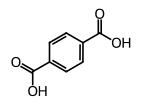
Terephthalic acid
Athanor · official
C8H6O4 · 166.13 g/mol
Also called PTA, benzene-1,4-dicarboxylic acid, PET monomer
 WarningCauses skin irritation · Causes serious eye irritation · May cause respiratory irritation
Names and identifiers
- IUPAC name
- terephthalic acid
- Synonyms
- PTA, benzene-1,4-dicarboxylic acid, PET monomer
+ 37 more
p-Phthalic acid, 1,4-Benzenedicarboxylic acid, p-Dicarboxybenzene, 1,4-dicarboxybenzene, Acide terephtalique, p-Benzenedicarboxylic acid, p-Carboxybenzoic acid, Tephthol, para-Phthalic acid, Kyselina tereftalova, 4-Carboxybenzoic Acid, TA-33MP, WR 16262, NSC 36973, TA 12, DTXSID6026080, 6S7NKZ40BQ, NSC-36973, DTXCID006080, CHEBI:15702, hydron;terephthalate, 4-oxoniocarbonylbenzoate, P-PTHALIC ACID, RefChem:6289, 202-830-0, 685-562-0, p-Phthalate, Kyselina terftalova, MFCD00002558, Benzene-p-dicarboxylic acid, HSDB 834, terephthalicacid, Acide terephtalique [French], Kyselina tereftalova [Czech], CAS-100-21-0, CCRIS 2786, EINECS 202-830-0
- Molecular formula
- C8H6O4
- Empirical formula
- C4H3O2
- Molecular weight
- 166.13 g/mol
- Exact mass
- 166.02661
- CAS number
- 100-21-0
- PubChem CID
- 7489
- Canonical SMILES
- C1=CC(=CC=C1C(=O)O)C(=O)O
- Isomeric SMILES
- C1=CC(=CC=C1C(=O)O)C(=O)O
- InChI
- InChI=1S/C8H6O4/c9-7(10)5-1-2-6(4-3-5)8(11)12/h1-4H,(H,9,10)(H,11,12)
- InChIKey
- KKEYFWRCBNTPAC-UHFFFAOYSA-N
- Molfile
Names, InChI and the identifiers from PubChem, retrieved 2026-10-14.
Physical properties
- Appearance
- White crystals or powder[5]
5 values
From Hazardous Substances Data Bank (HSDB), the most authoritative source here.
Value As written Source – Terephthalic acid is a white powder. (NTP, 1992) [1] CAMEO Chemicalscites National Toxicology Program, Institute of Environmental Health Sciences, National Institutes of Health (NTP). 1992. National Toxicology Program Chemical Repository Database. Research Triangle Park, North Carolina. – Liquid; Dry Powder; Other Solid; Dry Powder; Large Crystals; CBI [2] EPA Chemical Data Reporting (CDR) – WHITE CRYSTALLINE POWDER. [3] ILO-WHO International Chemical Safety Cards (ICSCs) – White powder [4] Occupational Safety and Health Administration (OSHA) –shown White crystals or powder [5] Hazardous Substances Data Bank (HSDB)cites Lewis, R.J. Sr.; Hawley's Condensed Chemical Dictionary 15th Edition. John Wiley & Sons, Inc. New York, NY 2007., p. 1212 - Melting point
- 427 °C (sealed tube)[5]
- Boiling point
- Reported, but no value passed the checks.
The 2 values and why
- greater than 572 °F at 760 mmHg (sublimes without melting) (NTP, 1992) (boiling point at or below the melting point; source [1])
- >572 °F (sublimes) (boiling point at or below the melting point; source [4])
- Density
- 1.51 @25 °C[6]
4 values
4 of 4 sources agree on it (most common value).
Value As written Source – 1.51 (NTP, 1992) - Denser than water [1] CAMEO Chemicalscites National Toxicology Program, Institute of Environmental Health Sciences, National Institutes of Health (NTP). 1992. National Toxicology Program Chemical Repository Database. Research Triangle Park, North Carolina. – Relative density (water = 1): 1.51 [3] ILO-WHO International Chemical Safety Cards (ICSCs) – 1.51 [4] Occupational Safety and Health Administration (OSHA) –shown 1.51 @25 °C [6] PAC Chemical Database, U.S. Department of Energy 1 more value was reported but failed the checks (unreadable or out of range), so it is not shown.
- Solubility in water
- Solubility in water, g/100ml at 20 °C: 0.28[3]
5 values
From ILO-WHO International Chemical Safety Cards (ICSCs), the most authoritative source here.
Value As written Source – Insoluble (NTP, 1992) [1] CAMEO Chemicalscites National Toxicology Program, Institute of Environmental Health Sciences, National Institutes of Health (NTP). 1992. National Toxicology Program Chemical Repository Database. Research Triangle Park, North Carolina. – Insoluble in chloroform, ether, acetic acid; slightly soluble in alcohol; soluble in alkalies [5] Hazardous Substances Data Bank (HSDB)cites Lewis, R.J. Sr.; Hawley's Condensed Chemical Dictionary 15th Edition. John Wiley & Sons, Inc. New York, NY 2007., p. 1212 – Solubilities at 25 °C (g/100 g solvent): water = 0.0017, glacial acetic acid = 0.013, methanol = 0.1, dimethylformamide = 6.7, dimethyl sulfoxide = 19.0 [5] Hazardous Substances Data Bank (HSDB)cites Park CM, Sheehan RJ; Kirk-Othmer Encyclopedia of Chemical Technology. (1999-2011). New York, NY: John Wiley & Sons; Phthalic Acids and Other Benzenepolycarboxylic Acids. Online Posting Date: Dec 4, 2000 – In water, 15 mg/L at 20 °C [5] Hazardous Substances Data Bank (HSDB)cites Yalkowsky, S.H., He, Yan, Jain, P. Handbook of Aqueous Solubility Data Second Edition. CRC Press, Boca Raton, FL 2010, p. 459 –shown Solubility in water, g/100ml at 20 °C: 0.28 [3] ILO-WHO International Chemical Safety Cards (ICSCs) - log P
- 1.96[3]
2 values
2 of 2 sources agree on it (most common value).
Value As written Source – log Kow = 2.00 [5] Hazardous Substances Data Bank (HSDB)cites Hansch, C., Leo, A., D. Hoekman. Exploring QSAR - Hydrophobic, Electronic, and Steric Constants. Washington, DC: American Chemical Society., 1995., p. 38 –shown 1.96 [3] ILO-WHO International Chemical Safety Cards (ICSCs) - pKa
- Reported, but no value passed the checks.
The value and why
- The dissociation constants pK1 and pK2 for terephthalic acid at 25 °C are 3.54 and 4.46, respectively. (could not be read; source [5])
- Vapor pressure
- 101.3 kPa at 404 °C[5]
7 values
Only one source reports it.
Value As written Source 9.8 mmHg Vapor pressure: 1.3 kPa at 303 °C [5] Hazardous Substances Data Bank (HSDB)cites Park CM, Sheehan RJ; Kirk-Othmer Encyclopedia of Chemical Technology. (1999-2011). New York, NY: John Wiley & Sons; Phthalic Acids and Other Benzenepolycarboxylic Acids. Online Posting Date: Dec 4, 2000 99.8 mmHg 13.3 kPa at 353 °C [5] Hazardous Substances Data Bank (HSDB)cites Park CM, Sheehan RJ; Kirk-Othmer Encyclopedia of Chemical Technology. (1999-2011). New York, NY: John Wiley & Sons; Phthalic Acids and Other Benzenepolycarboxylic Acids. Online Posting Date: Dec 4, 2000 200 mmHg 26.7 kPa at 370 °C [5] Hazardous Substances Data Bank (HSDB)cites Park CM, Sheehan RJ; Kirk-Othmer Encyclopedia of Chemical Technology. (1999-2011). New York, NY: John Wiley & Sons; Phthalic Acids and Other Benzenepolycarboxylic Acids. Online Posting Date: Dec 4, 2000 400 mmHg 53.3 kPa at 387 °C [5] Hazardous Substances Data Bank (HSDB)cites Park CM, Sheehan RJ; Kirk-Othmer Encyclopedia of Chemical Technology. (1999-2011). New York, NY: John Wiley & Sons; Phthalic Acids and Other Benzenepolycarboxylic Acids. Online Posting Date: Dec 4, 2000 759.8 mmHgshown 101.3 kPa at 404 °C [5] Hazardous Substances Data Bank (HSDB)cites Park CM, Sheehan RJ; Kirk-Othmer Encyclopedia of Chemical Technology. (1999-2011). New York, NY: John Wiley & Sons; Phthalic Acids and Other Benzenepolycarboxylic Acids. Online Posting Date: Dec 4, 2000 0.73 mmHg Vapor pressure = 0.097 kPa at 250 °C [5] Hazardous Substances Data Bank (HSDB)cites Sheehan RJ; Ullmann's Encyclopedia of Industrial Chemistry 7th ed. (1999-2011). New York, NY: John Wiley & Sons; Terephthalic Acid, Dimethyl Terephthalate, and Isophthalic Acid. Online Posting Date: June 15, 2000 6e-11 mmHg 6X10-11 mm Hg at 25 °C /Antoine extrapolation from higher temperatures/ [5] Hazardous Substances Data Bank (HSDB)cites Park CM, Sheehan RJ; Kirk-Othmer Encyclopedia of Chemical Technology. (1999-2011). New York, NY: John Wiley & Sons; Phthalic Acids and Other Benzenepolycarboxylic Acids. Online Posting Date: Dec 4, 2000 1 more value was reported but failed the checks (unreadable or out of range), so it is not shown.
- Flash point
- 260 °C[3]
2 values
2 of 2 sources agree on it (most common value).
Value As written Source 260 °C 500 °F (260 °C) (Open cup) [5] Hazardous Substances Data Bank (HSDB)cites National Fire Protection Association; Fire Protection Guide to Hazardous Materials. 14TH Edition, Quincy, MA 2010, p. 325-105 260 °Cshown 260 °C [3] ILO-WHO International Chemical Safety Cards (ICSCs) - Autoignition temperature
- 496 °C[3]
2 values
2 of 2 sources agree on it (most common value).
Value As written Source 496 °C 925 °F (496 °C) [5] Hazardous Substances Data Bank (HSDB)cites National Fire Protection Association; Fire Protection Guide to Hazardous Materials. 14TH Edition, Quincy, MA 2010, p. 325-105 496 °Cshown 496 °C [3] ILO-WHO International Chemical Safety Cards (ICSCs)
Each value as its source reports it, with the source's number after it (listed under References). Where several sources report a property, the row shows the value most of them agree on, the rule the app uses; open the values to see every one.
Calculated
- Heavy atoms
- 12
- Rings
- 1
- Aromatic rings
- 1
- Fraction sp³ carbons (Fsp3)
- 0
- H-bond donors
- 2
- H-bond acceptors
- 2 computed here · PubChem 4
- Rotatable bonds
- 2
- TPSA (Ų)
- 74.6
- Formal charge
- 0
- XLogP3
- 2 PubChem
- Complexity
- 169 PubChem
- Stereocenters
- None
- Double-bond geometry
- None specified
- Point group
- C2h of one 3D conformer with its hydrogens, by Athanor’s engine (as in the app)
Elemental analysis
- C57.84%
- H3.64%
- O38.52%
Isotope pattern
Each peak is a nominal mass with its abundance-weighted exact mass, as a percentage of the tallest, from IUPAC natural isotope abundances.
Computed from the structure with RDKit 2026.09 when this page was built, beside PubChem's own computed values from its record; where the two differ, both are shown.
Predicted
- log P
- 1.08 Crippen (Wildman and Crippen 1999)
- log S (water solubility)
- -1.79 ESOL (Delaney 2004), log mol/L
- Synthetic accessibility
- 1.3 SA score, 1 easy to 10 hard (Ertl and Schuffenhauer 2009)
Drug-likeness: Lipinski’s rule of five
- Molecular weight ≤ 500: 166.13
- log P ≤ 5 (Crippen): 1.08
- H-bond donors ≤ 5: 2
- H-bond acceptors ≤ 10: 2
Passes all four rules.
¹³C NMR shifts, predicted
Predictions, not measurements; each names its method. A measured log P, where a source reports one, is under Physical properties.
Safety
Warning
Most widely reported: 1,260 company reports to ECHA. Source [7].
- Harmful or irritant
- H315Causes skin irritation (17.4% of reports)
- H319Causes serious eye irritation (17.1% of reports)
- H335May cause respiratory irritation (15.1% of reports)
Precautionary statements: P261, P264, P264+P265, P271, P280, P302+P352, P304+P340, P305+P351+P338, P319, P321, P332+P317, P337+P317, P362+P364, P403+P233, P405, P501
View all classifications (2)
- [7] European Chemicals Agency (ECHA)This chemical does not meet GHS hazard criteria for 82.5% (1040 of 1260) of all reports.
- [7] European Chemicals Agency (ECHA) · 1,260 reports · WarningH315, H319, H335
Exposure limits
First aid
- Eyes: First check the victim for contact lenses and remove if present. Flush victim's eyes with water or normal saline solution for 20 to 30 minutes while simultaneously calling a hospital or poison control center. Do not put any ointments, oils, or medication in the victim's eyes without specific instructions from a physician. Immediately transport the victim after flushing eyes to a hospital even if no symptoms (such as redness or irritation) develop. Skin: Immediately flood affected skin with water while removing and isolating all contaminated clothing.[1]
- Fresh air, rest.[3]
- Remove contaminated clothes. Rinse skin with plenty of water or shower.[3]
- First rinse with plenty of water for several minutes (remove contact lenses if easily possible), then refer for medical attention.[3]
Incompatibilities
- Dust may for an explosive mixture with air. May react with strong oxidizers such as chlorine or permanganates, and may form explosive compounds when exposed to nitric acid.[5]
- Very high sensitivity: [srp: To mechanical shock] is shown by mixtures with benzene close to the stoicheiometric proportions of around 84% acid.[5]
Safety data sheets on the supplier’s page: AKos Consulting & Solutions, Molport, abcr GmbH.
Always read the supplier’s safety data sheet before working with it.
Spectra
- 1H NMRHuman Metabolome Database (HMDB) (Bruker · 600 MHz · Water) · SpectraBase (Varian A-60)
- 13C NMRSpectraBase
- 1H-13C NMRHuman Metabolome Database (HMDB) (Bruker · 600 MHz · Water)
- GC-MSHuman Metabolome Database (HMDB) (EI-B · positive) · Human Metabolome Database (HMDB) (EI-B · positive) · Human Metabolome Database (HMDB) (EI-B · positive) · Human Metabolome Database (HMDB) (GC-EI-TOF · positive) · Human Metabolome Database (HMDB) (GC-EI-TOF · positive) · Human Metabolome Database (HMDB) (GC-EI-TOF (Pegasus III TOF-MS system, Leco; GC 6890, Agilent Technologies) · Positive)
- MS-MSHuman Metabolome Database (HMDB) (Negative) · Human Metabolome Database (HMDB) (Negative) · Human Metabolome Database (HMDB) (Negative) · Human Metabolome Database (HMDB) (Quattro_QQQ · Negative) · Human Metabolome Database (HMDB) (Quattro_QQQ · Negative) · Human Metabolome Database (HMDB) (Quattro_QQQ · Negative)
- LC-MSMassBank Europe (API3000, Applied Biosystems · LC-ESI-QQ · NEGATIVE) · MassBank Europe (API3000, Applied Biosystems · LC-ESI-QQ · NEGATIVE) · MassBank Europe (API3000, Applied Biosystems · LC-ESI-QQ · NEGATIVE) · MassBank Europe (API3000, Applied Biosystems · LC-ESI-QQ · NEGATIVE) · MassBank Europe (API3000, Applied Biosystems · LC-ESI-QQ · NEGATIVE) · MassBank of North America (MoNA) (Q Exactive Orbitrap (Thermo Scientific) · LC-ESI-QFT · ESI)
- Other MSHazardous Substances Data Bank (HSDB) · MassBank Europe (JEOL JMS-AX-505-H · EI-B · POSITIVE) · MassBank Europe (HITACHI M-80A · EI-B · POSITIVE) · MassBank Europe (HITACHI M-2500 · EI-B · POSITIVE)
- UVHazardous Substances Data Bank (HSDB)
- IRHazardous Substances Data Bank (HSDB)
- FTIRSpectraBase (Bruker IFS 85 · KBr-Pellet)
- ATR-IRSpectraBase
- RamanSpectraBase (Bio-Rad FTS 175C with Raman accessory · FT-Raman)
Experimental spectra held by these sources; each link opens the source's own record.
Literature
Reading PubChem, OpenAlex and GSRS…
Bioactivity
Reading ChEMBL…
References
- [1]CAMEO Chemicals · Public domain (NOAA) · via PubChem · retrieved 2026-10-14
- [2]EPA Chemical Data Reporting (CDR) · Public domain (US EPA) · via PubChem · retrieved 2026-10-14
- [3]ILO-WHO International Chemical Safety Cards (ICSCs) · CC BY 4.0 · via PubChem · retrieved 2026-10-14
- [4]Occupational Safety and Health Administration (OSHA) · Public domain (US DOL) · via PubChem · retrieved 2026-10-14
- [5]Hazardous Substances Data Bank (HSDB) · Public domain (US NLM) · via PubChem · retrieved 2026-10-14
- [6]PAC Chemical Database, U.S. Department of Energy · Public domain (US DOE) · via PubChem · retrieved 2026-10-14
- [7]European Chemicals Agency (ECHA) · ECHA legal notice: reuse with acknowledgement · via PubChem · retrieved 2026-10-14
- [8]Human Metabolome Database (HMDB) · Linked only · via PubChem · retrieved 2026-10-14
- [9]SpectraBase · Linked only · via PubChem · retrieved 2026-10-14
- [10]MassBank Europe · Linked only · via PubChem · retrieved 2026-10-14
- [11]MassBank of North America (MoNA) · CC BY 4.0 · via PubChem · retrieved 2026-10-14
- [12]NIST Mass Spectrometry Data Center · Linked only · via PubChem · retrieved 2026-10-14
- ·Calculated values: computed by Athanor with RDKit 2026.09 from the structure.
- ·Literature on PubChem
Data last updated 2026-10-14.